
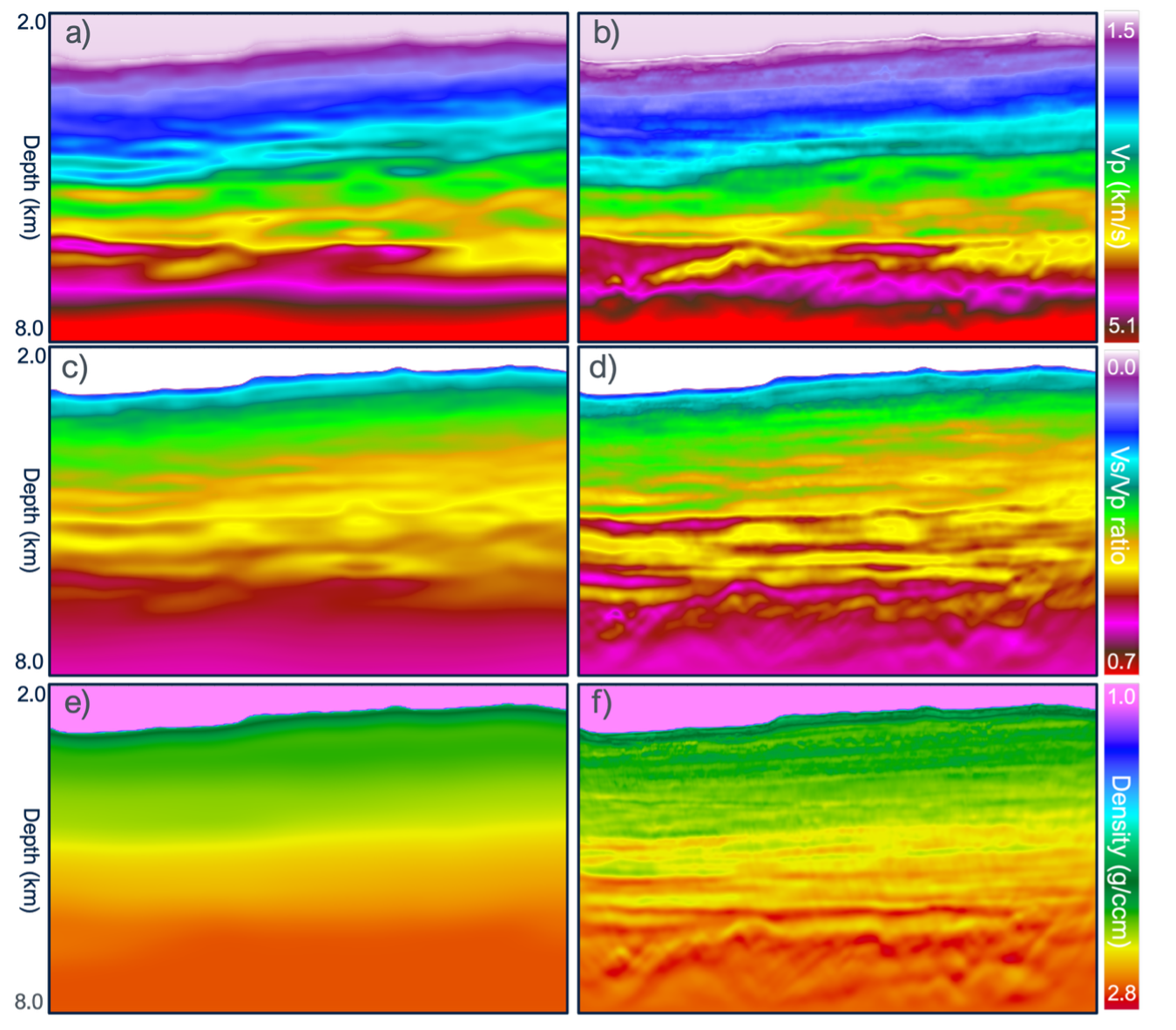
The expanding application of full-waveform inversion (FWI) beyond structural imaging requires a clearer understanding of which subsurface properties can be robustly recovered from seismic data. Extending FWI from acoustic to elastic formulations enables estimation of parameters critical for quantitative reservoir characterisation. We present a multiparameter elastic FWI (MP-EFWI) workflow for the joint inversion of P-wave velocity, S-wave velocity, and density (ρ). As the first-or-der system of elastodynamic equation is not self-adjoint, an extra adjoint equation is required for computing the correct sensitivity kernels. Our implementation uses the same elastic wave equation for both forward and backward propagation, connected by a compliance tensor for evaluating accurate gradients, avoiding the need for an explicit adjoint solver, thereby improving computational efficiency. The study focuses on pressure-only data typical of marine acquisition. The approach is demonstrated using a synthetic deep-water scenario, where results show that updates in S-wave velocity and density are mainly driven by local contrasts, supporting quantitative interpretation. The workflow is then applied to field data offshore Brazil. Inverted models are validated against well-log data and by comparing angle-dependent amplitude responses derived from the inversion with those observed in Kirchhoff prestack depth migration gathers. The results demonstrate that MP-EFWI applied to pressure-only data can provide valuable information to support reservoir characterisation.
Introduction
In velocity model-building and depth imaging, incorporating elastic wave propagation into full-waveform inversion has led to significant improvements. Single-parameter elastic FWI is known to enhance P-wave velocity estimation, particularly in settings with strong impedance contrasts (e.g., Plessix and Krupovnickas, 2021; Liu et al., 2025). As a result, elastic FWI-derived reflectivity (FDR) shows improved resolution in challenging environments such as salt bodies and carbonate formations, supporting more reliable imaging in areas critical for exploration and development.
Multiparameter elastic FWI (MP-EFWI) further extends these capabilities beyond structural imaging towards quantitative interpretation. Recent studies across different acquisition types and geological settings have demonstrated its potential for estimating subsurface properties relevant to reservoir characterisation and potentially for decision-making in areas with limited well control (e.g., Gomes et al., 2025; Shen et al., 2025). Huang et al. (2026) showed that density contrasts, often negatively correlated with P- and S-wave velocity contrasts, can be recovered consistently with amplitude-versus-angle (AVA) anomalies. Their formulation expresses the elastodynamic wave equation in terms of P-wave velocity and reflectivity, reducing parameter trade-offs through gradient scale separation (e.g., Whitmore and Crawley, 2012; Ramos-Martínez et al., 2016). In that framework, density is inferred from inverted reflectivity, while shear velocity contrasts are derived from empirical relationships with P-wave velocity, enabling practical integration with existing interpretation workflows. Shen et al. (2025), by contrast, proposed a multiparameter formulation for the joint inversion of P-wave velocity, S-wave velocity, and density, demonstrating that amplitude and phase variations in hydrophone data can be exploited to resolve local variations in all three parameters. This highlights the potential of elastic FWI to extract additional value from conventional marine acquisitions.
Here, we introduce a multiparameter elastic FWI formulation directly parameterised in terms of P-wave velocity (), S-wave velocity (), and density (ρ). We assess the extent to which these parameters can be resolved from pressure-only data using a controlled numerical experiment of a marine streamer acquisition, with the aim of clarifying their practical interpretability. The methodology is then applied to a narrow-azimuth field dataset acquired with dual-sensor technology offshore Brazil. The inverted models are validated against well-log data and further assessed by comparing AVA responses derived from the inverted parameters with those observed in Kirchhoff prestack depth migration gathers, demonstrating the applicability of the approach for reservoir characterisation workflows.

