
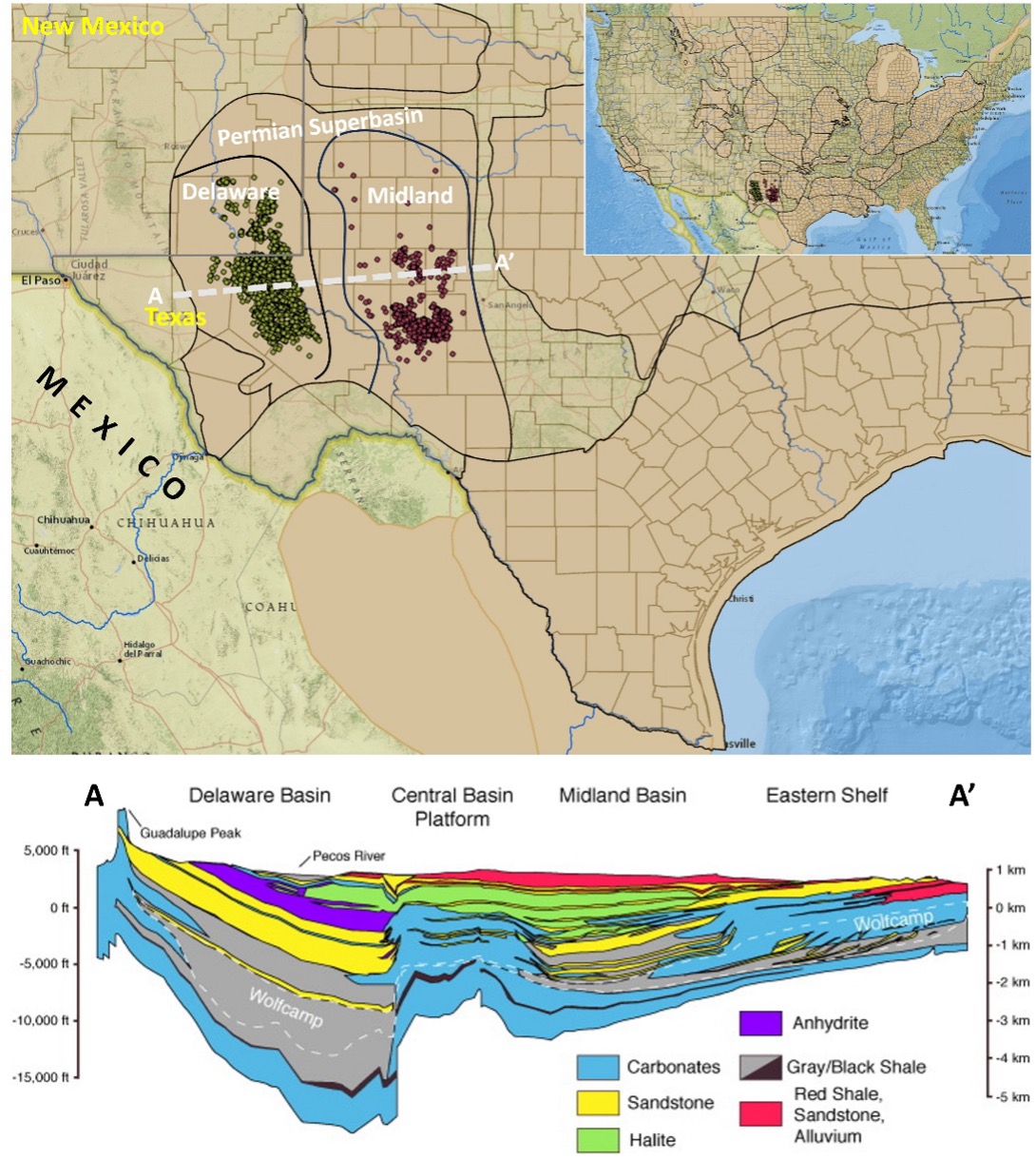
With a crude production of 3.3 million barrels of oil per day, Wolfcamp shale formation in the US Permian Superbasin in Texas and New Mexico is the world’s second-largest producing oil reservoir – second only to Saudi Arabia’s Ghawar, the world’s largest oil field. This formation distributed across the Delaware and Midland basins of the Permian Superbasin was deposited in a deep marine environment during Late Pennsylvanian to Early Permian times (307-283 Ma). We applied data science analytics and explainable artificial intelligence to a large set of data from horizontal Wolfcamp wells in both the Delaware and Midland basins. This study shows drastically variable production performance between Delaware Wolfcamp (one of the best among the US tight oil plays) and Midland Wolfcamp (one of the poorer performing plays). We attribute these differences to the basinal conditions – namely, much thicker, deeper, thermally matured and pressurised Wolfcamp zones in the Delaware basin – which exert first-order impacts on oil production. Superimposed on the geological substratum, optimised completion practices contribute significantly to production performance.
Introduction
The US shale revolution, which stemmed from technological advances in horizontal drilling, hydraulic fracture stimulation, micro-seismicity monitoring and 3D seismic surveys, has more than doubled US crude production since 2010 (Figure 1). How-
ever, this steep production growth hinges on a handful of tight-oil formations and basins. The Permian Superbasin in west Texas and southeast New Mexico tops this handful list. In December 2025, US total crude production stood at 13.66 million barrels of oil per day (MMBOPD), making the US the largest oil producer in the world. Of this crude volume, about 6 MMBOPD or 44% came from the Permian Superbasin with the Wolfcamp Formation accounting for 55% of the Permian Superbasin production (Figure 2) (EIA, 2026a). The Wolfcamp formation’s share of methane production in the Permian Superbasin was 61% in December 2025 (EIA, 2026b). These data underscore the critical position of the Wolfcamp production not only in the USA but also worldwide as Wolfcamp is only second to the world’s largest oil field – the Ghawar field of Saudi Arabia with production close to 4 MMBOPD (Sorkhabi, 2010; Bloomberg, 2019).
In this paper, we apply data science analytics and machine learning (ML) techniques to better understand the production performance of Wolfcamp in the Permian Superbasin, which consists of the Delaware basin in the west and the Midland basin on the east (Figure 3). The principal finding of this study is that Wolfcamp Shale distributed across both Delaware and Midland basins, even though of the same stratigraphic age, depositional environment and tectonic setting, exhibit drastically different production behaviours with Delaware Wolfcamp being the best shale oil producer in the USA while Midland Wolfcamp has very poor production performance. We attribute these differences to the basinal conditions in the Delaware and Midland basins and suggest that optimal geological conditions are of paramount importance in shale oil and gas production and have first-order impacts on production economy.

