
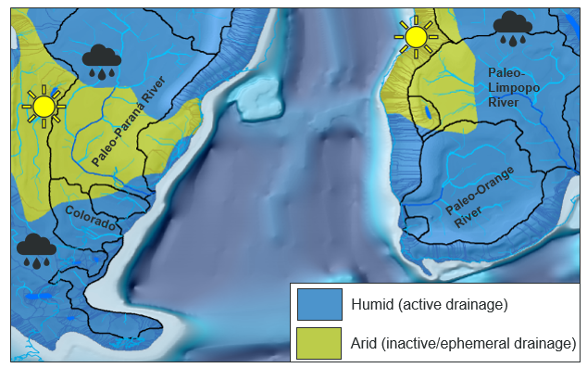
Dr Chris Willcox and Dr Benjamin Gréselle use detailed paleo-climate tools to demonstrate how this Earth Systems approach can be applied in exploration to better understand the risks and opportunities for potential clastic reservoirs along a margin.
Introduction
The Cretaceous period of the South Atlantic is very important to understand for hydrocarbon exploration. The majority of the proven plays along the South Atlantic margins have been in Cretaceous petroleum systems, and linked to the story of the opening of this ocean. It is no surprise therefore that the Cretaceous of the South Atlantic African and South American conjugate margins have been a prime target for recent hydrocarbon exploration, especially moving further south (e.g. in the Orange Basin offshore Namibia and South Africa). Recent exploration, however, has had mixed results: in spite of several recent successes (e.g. Venus, Capricornus), both poorer-than expected reservoir quality, lack of charge, or unfavourable hydrocarbon volumes, have all contributed to a number of either outright failures or uneconomic discoveries on the conjugate margins (Sorkhabi, 2025).
A holistic Earth Systems Science approach, modelling the evolution through time and space of the mechanisms shaping the surface of the Earth, can shed light on the geological risks, and be used to screen for areas that are more likely to be met with exploration success in terms of the primary presence and quality of key petroleum systems elements. We use detailed paleo-climate tools, within the Neftex® solution from Halliburton, in this study to demonstrate how this Earth Systems approach can be applied in exploration to better understand the risks and opportunities for potential clastic reservoirs along a margin. To do this, the following questions must be addressed:
- How did the distribution and evolution of major river systems draining the continents affect the extent, volume and quality of deep-marine clastic fans?
- Did the major drainage reorganisation events in the Cretaceous alter the clastic composition (based on the potential hinterland geology of rocks likely to have been exposed at the time of erosion) and volume of the sediment shed by rivers into the ocean?
- How did the climate in the hinterland change over time and how will this have impacted the sediment flux and potential quartz content of clastic material delivered?
By addressing these questions, we can also see if tectonic and climatic processes are likely to have affected the two southern Atlantic conjugate margins in different or similar ways throughout the Cretaceous.

