
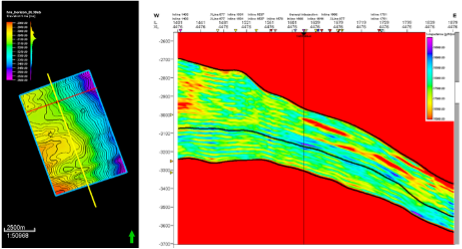
This study uses seismic anisotropy Eta (η) and its association with lithological and fluid effects through Residual Eta (ηRES). Residual Eta’s capability to detect lithology and fluids is supported by a comparison to Poisson’s Impedance, an elastic parameter. To increase the sensitivity of Residual Eta, the Residual Eta Gradient (ηGRAD) is calculated as a function of time. Derivatives or gradients can identify subtle changes that are not immediately visible. The Residual Eta Gradient correlates well with Poisson’s Impedance Step Function, an elastic characteristic that affects Residual Eta. An abrupt change in the Residual Eta Gradient corresponds to large changes in the water table during sediment deposition, such as the boundary between electrofacies in INPEFA Gamma-ray data. The Residual Eta Gradient, which is influenced by lithology and fluids, can be used as an alternative physical measure for initial reservoir identification scanning during the hydrocarbon exploration phase. Residual Eta Gradient, a seismic data processing product, does not require well-processed seismic or well data to be used. Residual Eta Gradient’s amplitude independence is one of its advantages, as it avoids misunderstandings caused by non-pre-served amplitude or decay.
Introduction
This study makes use of anisotropy, the phenomenon of changes in seismic velocity with regard to the direction of seismic wave propagation. Based on the effects of rock compaction, overburden trends are followed by seismic anisotropy, particularly the seismic anisotropy Eta (η). The objective of this study is to assess deviations from the normal trend in the seismic anisotropy Eta (η) values and correlate them with fluid and lithological impacts. Currently, seismic anisotropy Eta (η) is only used for processing seismic data to improve images using high-order normal move-out correction. It is believed that this study may spark a new way of determining reservoir characteristics. Evaluating Residual Eta (ηRES) anisotropy factors and their link to lithology and fluids might improve the reliability of seismic velocity fluctuations as an additional feature for identifying hydrocarbon reserves.
The seismic anisotropy Eta (η) is primarily used in residual move-out correction as a component of VNMO. In line with trends in overburden and normal compaction, seismic anisotropy Eta (η) also tends to increase with depth. Analogous to the concept of abnormal pore pressure (Bruce & Bowers, 2002), this study aims to investigate anomalies in the seismic anisotropy Eta (η) as the result of intrinsic anisotropy from lithological and fluid effects, namely the Residual Eta (ηRES) and its derivative, Residual Eta Gradient (ηGRAD).
Analysis of Residual Eta (ηRES) against relative shale content using the INPEFA method (Yuan, 2018; Nainggolan & Winardhi, 2019) was applied to examine the influence of lithology on apparent seismic anisotropy. Subsequently, rock physics modelling and fluid substitution were performed to observe the influence of saturated hydrocarbons on Residual Eta (ηRES). The formulation of Residual Eta (ηRES) relative to the seismic anisotropy Eta (η) was conducted to provide a quantitative assessment of the reliability of anisotropy parameters in their application for identifying lithology and fluids in deep-water hydrocarbon reservoirs.
Through integration with the seismic elastic parameter Poisson’s Impedance, Residual Eta (ηRES) can serve as an alternative pre-exploration analysis tool for reservoir identification. The hypothesis raised in this study is that the Residual Eta (ηRES) can eliminate background anisotropy trends, primarily caused by overburden, so that the seismic anisotropy Eta (η) can be utilised to evaluate the intrinsic conditions of the reservoir in the form of lithology and fluid identification.
The following are some advantages of this study for scientific progress: In order to identify the lithology and fluids in oil reservoirs, the Residual Eta (ηRES) seismic anisotropy parameter is developed. In the meantime, the time needed for field development and exploration can be reduced by using the seismic anisotropy Eta (η) parameter in early reservoir scanning.

