
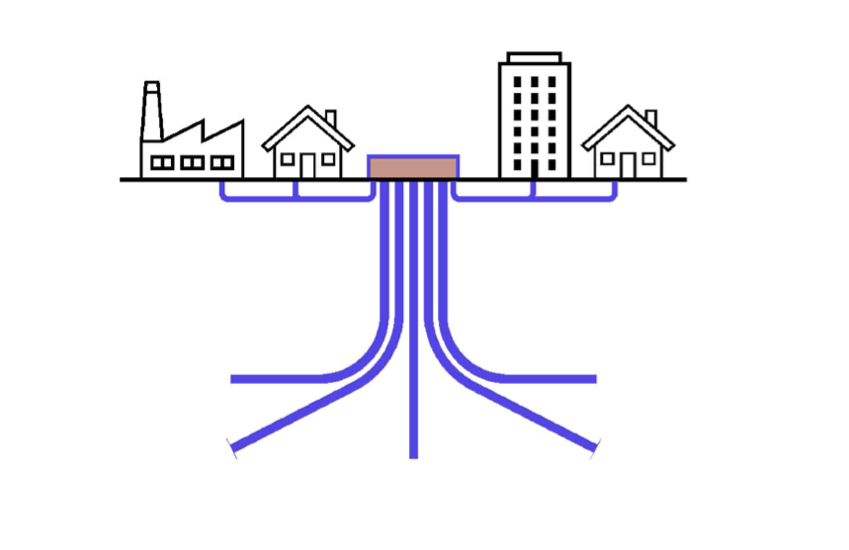
Kim Gunn Maver, Andromachi Kalogirou, Søren Bom Nielsen and Niels Balling describe the basic concept behind a deep closed-loop geothermal well solution, the properties involved in the petrothermal zone assessment, how this information can be obtained, and the impact of the properties on petrothermal energy production.
Introduction
Focus is increasingly shifting to closed-loop solutions for geothermal energy harvesting (IEA, 2024a) to mitigate the issues and limitations associated with conventional hydrothermal doublet solutions.
Reservoir characterisation is key to resource assessment, drilling risk mitigation, and production optimisation in oil and gas exploration, with important parameters including porosity, permeability, and presence of hydrocarbons. For hydrothermal doublet solutions, which rely on fluid flow in geological formations, reservoir characterisation is also important, with key
parameters being porosity, permeability, possible presence of water, and temperature.
For single closed-loop geothermal well solutions, which rely solely on thermal diffusivity for heat extraction, ‘reservoir characterisation’ consists of predicting the thermal conductivity as a proxy for the geological formation’s thermal properties, along with the associated geothermal temperature, in what will be referred to as ‘Petrothermal Zone Assessment’.
The terms ‘petrothermal energy’ and ‘petrothermal zone’ are used to describe conductive heat stored in hot/warm, low‐permeability rock formations, consistent with the terminology used by the GFZ German Research Centre for Geosciences (2026).
This paper describes the basic concept behind a deep closed-loop geothermal well solution, the properties involved in the petrothermal zone assessment, how this information can be obtained, and the impact of the properties on petrothermal energy production.

