
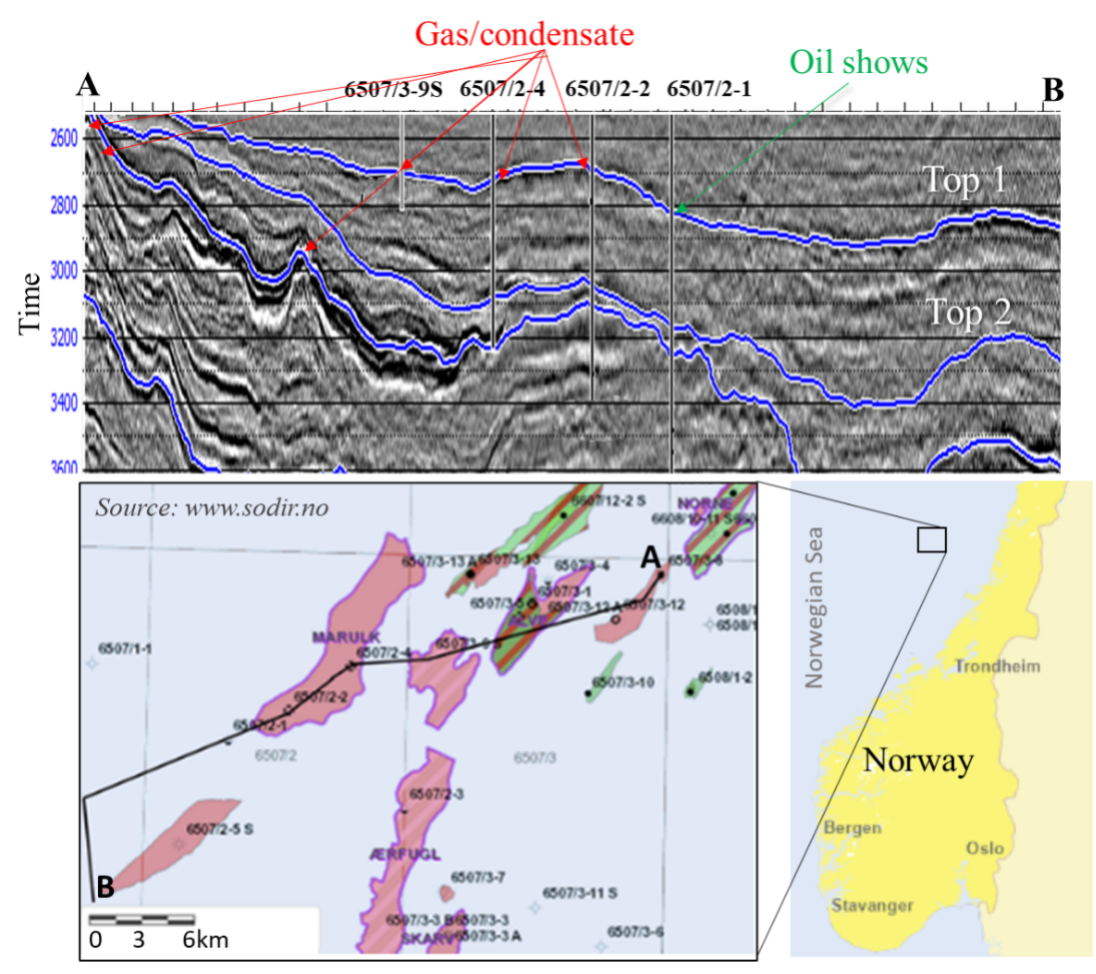
This study investigates the practical application of supervised machine learning (ML) techniques for predicting subsurface fluid type from seismic data and presents a structured methodological workflow supported by geophysical reasoning at each stage. Two modelling scenarios are analysed. The first relies solely on post-stack seismic data, while the second incorporates inverted seismic rock properties. The comparison highlights the clear advantage of using geologically meaningful and physically interpretable parameters for ML-based fluid prediction.
Instead of training models directly on field seismic data, which may contain acquisition and processing artefacts, we propose training on well logs and their corresponding synthetic seismic traces. These traces, generated from P-wave velocity and density logs, are transformed into 11 seismic attributes, forming a controlled and physically consistent training dataset. For prediction, the same attribute set is computed from the post-stack seismic volume, ensuring consistency between synthetic and real data.
In the second scenario, velocity, density, clay volume, and porosity logs are used for training, with inverted seismic parameters used for prediction. Fluid type (0 = brine, 1 = hydrocarbons) serves as the target variable. Validation on a 3D dataset from the Haltenbanken area demonstrates improved performance when inverted parameters are included.
Keywords
ML, fluid prediction, property prediction from post-stack seismic data, supervised ML

Introduction
Modern exploration relies on extracting subtle geological and petrophysical information from seismic data. While AVO and seismic inversion remain standard tools, they require detailed rock-physics models and strong prior assumptions (Russell, 2014; Avseth et al., 2005). Machine learning offers a data-driven alternative that is capable of learning nonlinear relationships between well logs and seismic data.
This study is mainly motivated by the development of a tool for fluid prediction from post-stack seismic data. However, application to additional data, e.g., those acquired from pre-stack inversion, can provide better precision in property prediction. In conventional interpretation, seismic inverted data are interpreted using rock-physics templates for property prediction. In contrast, the proposed approach applies a machine-learning workflow that replaces empirical templates with learned, data-driven relationships. Thus, both types of data are addressed. To obtain a sufficient number of training samples and to ensure consistency between training and recognition domains, we augment the dataset by generating synthetic seismic traces from well logs. Training on synthetic traces also prevents the models from inadvertently learning acquisition or processing noise present in field seismic data. This strategy of training ML models on well-log-derived synthetic seismic rather than field seismic was originally developed in the frame of the Innovation Norway project (PSS-GEO at al., 2020). While synthetic data-driven ML workflows for seismic inversion have recently been proposed (e.g., Ali et al., 2024; Corrales et al., 2023), to the best of our knowledge, none follow the post-stack, synthetic-train, fluid-type classification workflow that is introduced in this study. The present work demonstrates a systematic and reproducible workflow for binary fluid-type classification (hydrocarbons or brine) using machine learning trained on synthetic seismic traces.
The workflow was designed to be transparent and fully reproducible, implemented with open-source Python tools, and supported by a clear explanation of the geological logic at each stage. This ensures that the output is driven by, and remains consistent with, fundamental subsurface principles, rather than relying solely on abstract mathematical computation. It enables the prediction of fluid type directly from seismic attributes, verification of model validity at the well scale, and subsequent spatial generalisation across seismic volumes. This article builds upon two previously published extended abstracts (Karaseva and Kalashnikova, 2021; Kalashnikova et al., 2021), and presents for the first time the full geophysical and geological rationale of the property-prediction problem. For completeness, the mathematical formulation, Python implementation, and open-access dataset are summarised here, complementing a previously published YouTube video tutorial (Karaseva and Kalashnikova, 2021).

