
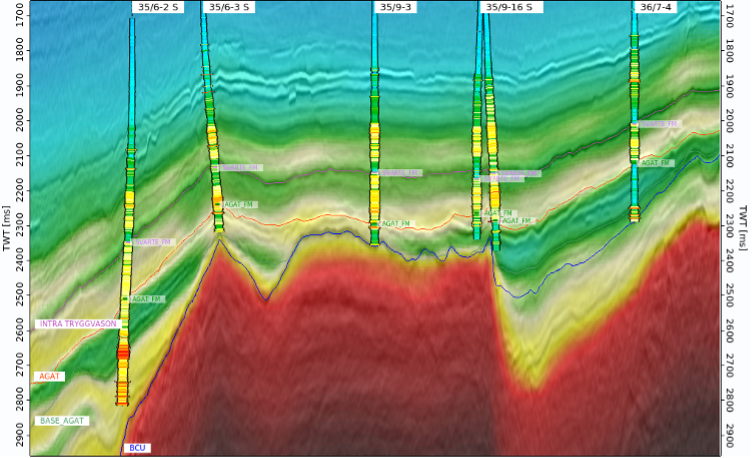
Diego Lopez, Marit Stokke Bauck and Andy Holman compare Extended Elastic Impedance coloured inversion (EEI-CI) and Deterministic Elastic Impedance (DEI) as prospect-scale screening tools for the Agat play on the Måløy Slope in the Norwegian North Sea.
Abstract
Recent success in exploring the Lower Cretaceous Agat play in the Norwegian North Sea can partly be attributed to improved seismic imaging and integrated subsurface evaluation work conducted on the Northern Viking Graben dataset. The play targets deep marine reservoir sands, fed from an exposed source area in the east (Hansen et al., 2021). Seismic attribute maps are useful for identifying the sediment fairways and sand accumulations (Pene et al., 2024); however, identifying hydrocarbon-filled sands remains challenging. Viridien has conducted a test of inversion techniques to evaluate which methods prove useful over large areas of interest. Both Extended Elastic Impedance coloured inversion (EEI-CI) and Deterministic Elastic Inversion (DEI) were evaluated as exploration screening tools for the Lower Cretaceous Agat play on the Måløy Slope, offshore Norway. The study covers 600 km² using 3D seismic angle stacks and a limited set of wells with elastic logs. While EEI-CI provides rapid reconnaissance of the major fairways, it exhibits reduced spatial continuity and local false positives. DEI better resolves sand-body architecture and fluid fill, including correct discrimination of known dry wells, and remains robust when well-control configuration is reduced.

