
Karyna Rodriguez and Neil Hodgson explore how modern seismic interpretation techniques, including a multi-attribute approach, combined with a willingness to challenge conventional workflows, are reshaping our understanding of source rock distribution and effectiveness in the Orange and Pelotas Basins in the South Atlantic.
Introduction: From Myth to Momentum in the South Atlantic
For decades, the southern South Atlantic margin sat in the shadows of global exploration, overshadowed by more mature basins and constrained by persistent geological scepticism. Conventional wisdom questioned whether this region possessed the essential ingredients of a working petroleum system — particularly the presence, quality, and maturity of source rocks. These concerns were not trivial; without an effective source, even the most attractive reservoirs and traps remain barren.
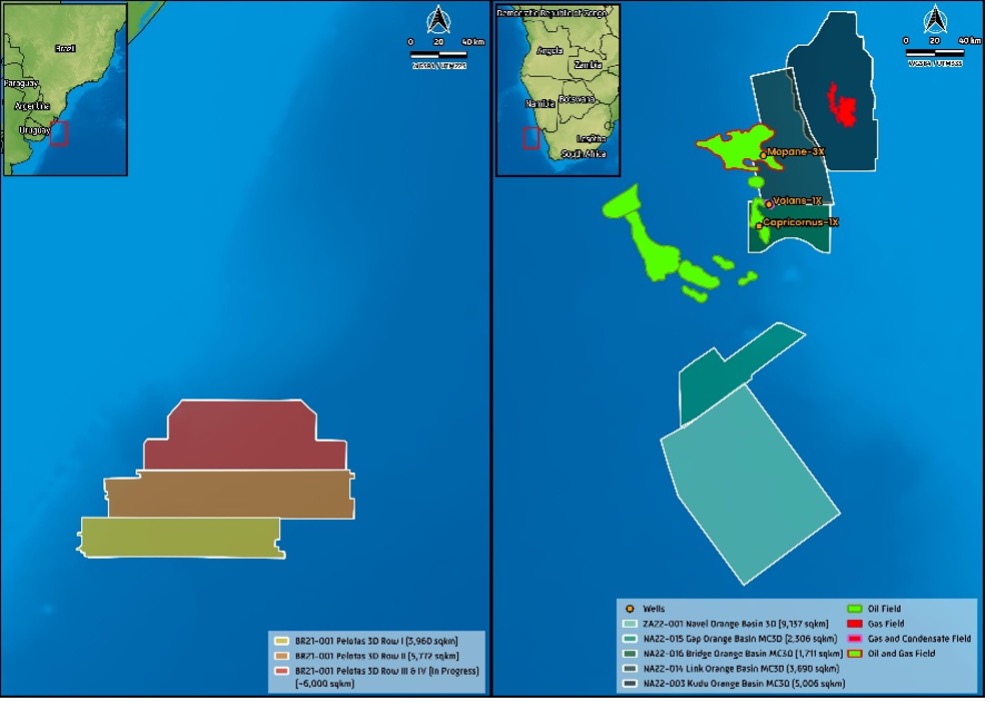
That narrative began to unravel in 2022 with a series of transformative discoveries offshore Namibia, including Graff and Venus, followed by Mopane, Capricornus, and Volans, all of which collectively dismantled long-held assumptions about the Orange Basin. These discoveries demonstrated unequivocally that a world-class petroleum system was not only present but actively generating and trapping hydrocarbons at scale.
Across the Atlantic, the Pelotas Basin offshore southern Brazil represents the conjugate counterpart to the Orange Basin. Despite sharing a common tectonostratigraphic heritage, Pelotas has remained largely unexplored. Yet, recent acquisition of extensive 3D seismic datasets has begun to illuminate its subsurface architecture, revealing compelling evidence that the same fundamental elements — source, reservoir, seal, and trap — are not only present but potentially even more favourably configured.
At the heart of this renewed exploration narrative lies the challenge of identifying and characterising source rocks. While the Aptian interval has emerged as a proven and reliable contributor to hydrocarbon generation, attention has increasingly turned to the Cenomanian–Turonian (CT) interval. Deposited during a global oceanic anoxic event (OAE2), this interval is widely recognised as one of the most prolific source rock systems worldwide. However, its seismic expression — and therefore its detectability — have been found to vary, making it less predictable than the Aptian source rock.
This paper explores how modern seismic interpretation techniques, including a multi-attribute approach, combined with a willingness to challenge conventional workflows, are reshaping our understanding of source rock distribution and effectiveness in the Orange and Pelotas Basins.

