
Elodie Morgan, Habib Al Khatib, Varun Pathak, Valeria Di Filippo and Pramit Basu jointly challenge O&G monitoring paradigm to enable an end-to end monitoring workflow for bankable CO2 storage projects.
Introduction – Why partnerships are critical for CCS: a necessary shift from resource to waste management.
Carbon Capture and Storage (CCS) is now widely recognised as a cornerstone of global decarbonisation pathways. From hard‑to‑abate industries to power generation and hydrogen production, large‑scale deployment of CCS is required to meet climate targets. Yet despite years of pilot projects and flagship developments, CCS deployment remains slower than anticipated. One of the recurring challenges is to match the established and emerging technologies to solve the complexity of designing capture, transport, and storage projects that remain economically viable and socially acceptable over multiple decades.
The monitoring paradigm
This challenge reflects a fundamental difference in economic and operational paradigms between oil and gas and CCS. While oil and gas projects are driven by upside production revenues, CCS is inherently a long‑term waste‑management activity, where value lies in risk control, liability management, and regulatory compliance. To support Final Investment Decisions, CO2 storage sites must submit the technical proof to demonstrate longterm containment and conformance, comply with regulatory frameworks, and maintain stakeholder confidence. Measurement Monitoring and Verification (MMV) plans are mandatory in most jurisdictions. However, CCS monitoring strategies have largely inherited image‑based practices developed for oil and gas, relying on infrequent and costly large‑scale seismic surveys originally designed to optimise production.
While such image‑based approaches are necessary in oil and gas, where the objective is to identify unexpected subsurface behaviour, CCS permitting processes require a particular monitoring strategy. For CCS projects, the primary goal is to avoid surprises as much as possible to ensure long-term containment and safety. The goal is not to make the most accurate match from the model data, but to find regular credible evidence of deviation which increases the risk of violating the permit conditions. Periodic seismic imaging, though proven technology, is complex to deploy at full-scale and needs scheduling. Given the nature of uncertainty of the reservoir and CO2 plume migration risk, it would be much more beneficial if industry had a way to adopt a technology based on the same first principles of geophysics yet deployable at a faster and relatively simple manner. This would essentially shift the paradigm from obligatory monitoring to design and risk-leading monitoring. Recognising this shift, from episodic imaging to frequent, evidence‑based surveillance, is essential and calls for a paradigm change in how CCS monitoring is designed, valued, and integrated into project decision‑making.
Monitoring: obligation or strategic?
On top of the inherent conceptual differences between oil and gas and CCS, monitoring in CCS is still frequently approached as a regulatory obligation rather than as a strategic business value. MMV programs are often designed to satisfy compliance requirements, resulting in conservative, and often costly, surveillance strategies based on infrequent, large‑scale image‑based seismic surveys, largely inherited from oil and gas monitoring practices.
In CCS, monitoring can do more than just demonstrate periodic compliance. At a design level monitoring can guide the uncertainty management principles, and model Capex and Opex scenarios with subsurface risk uncertainties. During operations it maintains confidence and provides mitigation pathways over project lifecycles if done correctly. Reframing monitoring from an obligation into a strategic value proposition should therefore be a prerequisite for scalable, economically viable CCS.
Inherited silos vs partnerships value
To manage subsurface uncertainty efficiently, the oil and gas industry has historically developed highly sophisticated expertise in monitoring technologies, modelling workflows, risk‑assessment frameworks, drilling and completions operations. Decades of innovation have produced specialised tools that are highly effective for hydrocarbon exploration and production. However, this technological maturity often has been observed to unintentionally create design and operational silos, rather than an integrated approach.
In the context of CCS, these silos can become a significant limitation from a value chain perspective. CO2 storage projects require the continuous integration of geology, reservoir engineering, geophysics, and field operations to frequently manage uncertainty over decades. Persisting with siloed, technology‑specific approaches risks extending oil‑and‑gas‑driven surveillance philosophies into CCS, approaches that are neither fully aligned with the objective or the economics of long‑term CCS uncertainty reduction.
Overcoming this limitation requires a different form of collaboration, one that prioritises integration over specialisation and enables monitoring workflows explicitly designed to manage compliance, uncertainty and budget over the project lifecycle.
A solution: David meets Goliath
Rethinking CCS monitoring therefore requires change in mindset: from periodic compliance to frequent insights, and from regulatory obligation to strategic risk mitigation. Achieving this transformation is not a matter of technology alone, but of integration, breaking disciplinary and organisational silos to connect planning, monitoring, and operational decision‑making into a coherent model and data-driven end‑to‑end workflow.
This is where David meets Goliath. Large, integrated technology companies, Goliaths of the energy industry, with the scale, field presence, and operational maturity required to deploy and sustain long‑term monitoring, needs to join forces with more agile and specialised technology providers, Davids, capable of challenging legacy paradigms and introducing innovative, uncertainty‑driven and economically viable approaches.
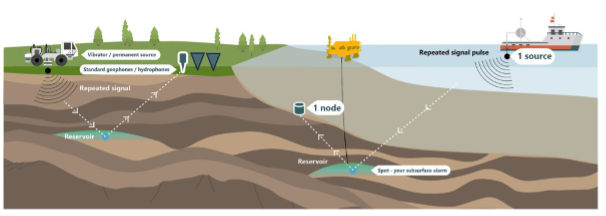
The partnership between Baker Hughes, CMG, and SpotLight illustrates how such collaboration can move beyond the traditional monitoring inherited from oil and gas. By combining large‑scale project design, integration and field execution (Baker Hughes), multi‑scenario dynamic subsurface modelling and uncertainty quantification (CMG), and targeted, decision‑driven monitoring strategies (SpotLight), this partnership establishes an end‑to‑end CCS monitoring approach. The holistic solution is explicitly designed to manage uncertainty, support operational and investment decisions, and deliver sustainable value for all CCS stakeholders over the full project lifecycle.
Why subsurface models are the backbone of CCS projects
To fully understand the mechanisms underpinning this collaboration and its ability to deliver an end-to-end CO2 storage surveillance solution, it is essential to start with what unifies the three companies: the central role of the subsurface model to capture subsurface uncertainties. Long before the first molecule of CO2 is injected, operators rely on geological and reservoir models to evaluate storage capacity, injectivity, pressure evolution, plume migration, and containment risks. From a regulatory point of view, CCS projects generate non-liable revenue only if injected volumes can be certified or verified as permanently stored. In many regulatory frameworks, including the EU CCS Directive and the US Class VI permitting process, operators must demonstrate prior to injecting, based on numerical models, that CO2 will remain contained within an approved storage complex. The predicted extent of pressure and plume migration defines the Area of Review (AoR), which in turn governs monitoring obligations, corrective action plans, and long-term liabilities.
These models therefore form the common reference point for a wide range of stakeholders involved in CCS projects. For regulators, they underpin permitting decisions and long‑term compliance; for operators, they guide field development and monitoring obligations; for insurers and financial institutions, they inform risk exposure, liability management, and project bankability. Ultimately, subsurface models support financing discussions and the Final Investment Decision (FID), as illustrated in Figure 1. Each of these decisions relies on expectations derived from subsurface model predictions.

