
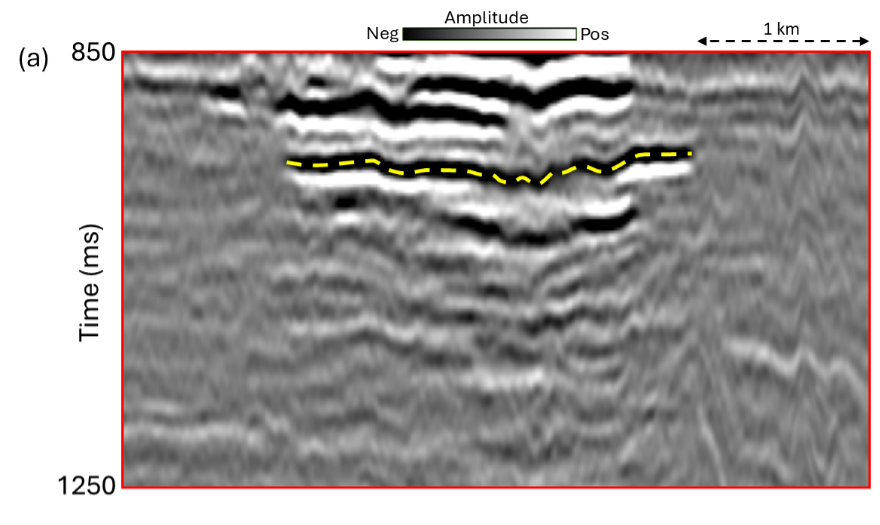
In this study, we describe and analyse the relatively uncommon Teager-Kaiser (TK) energy- and variation attributes, focusing on their application to a time-lapse seismic dataset from the Sleipner Field, offshore Norway. Our results demonstrate that TK attributes effectively delineate CO2-related anomalies and boundaries, highlighting them as distinct and interpretable features.
Seismic amplitudes are known to be highly sensitive to phase variations, which can arise from changes in acquisition, processing, or true subsurface alterations. In contrast, the envelope (or instantaneous amplitude) attribute, derived from the analytic signal, is phase-independent and therefore commonly preferred in time-lapse seismic analysis for its stability and reliability. As attribute computation should begin with appropriate preconditioning of seismic data, we first illustrate the impact of data conditioning on each attribute evaluated in this study. We then compare the TK attribute displays with those of the envelope. To ensure a fair and meaningful comparison, we also include displays of instantaneous energy (i.e., the square of the envelope) alongside the TK attributes.
Based on our analysis, we conclude that the TK attributes are a valuable addition to the interpreter’s toolkit, offering strong potential for identifying gas-related features in this and similar geological settings.

