
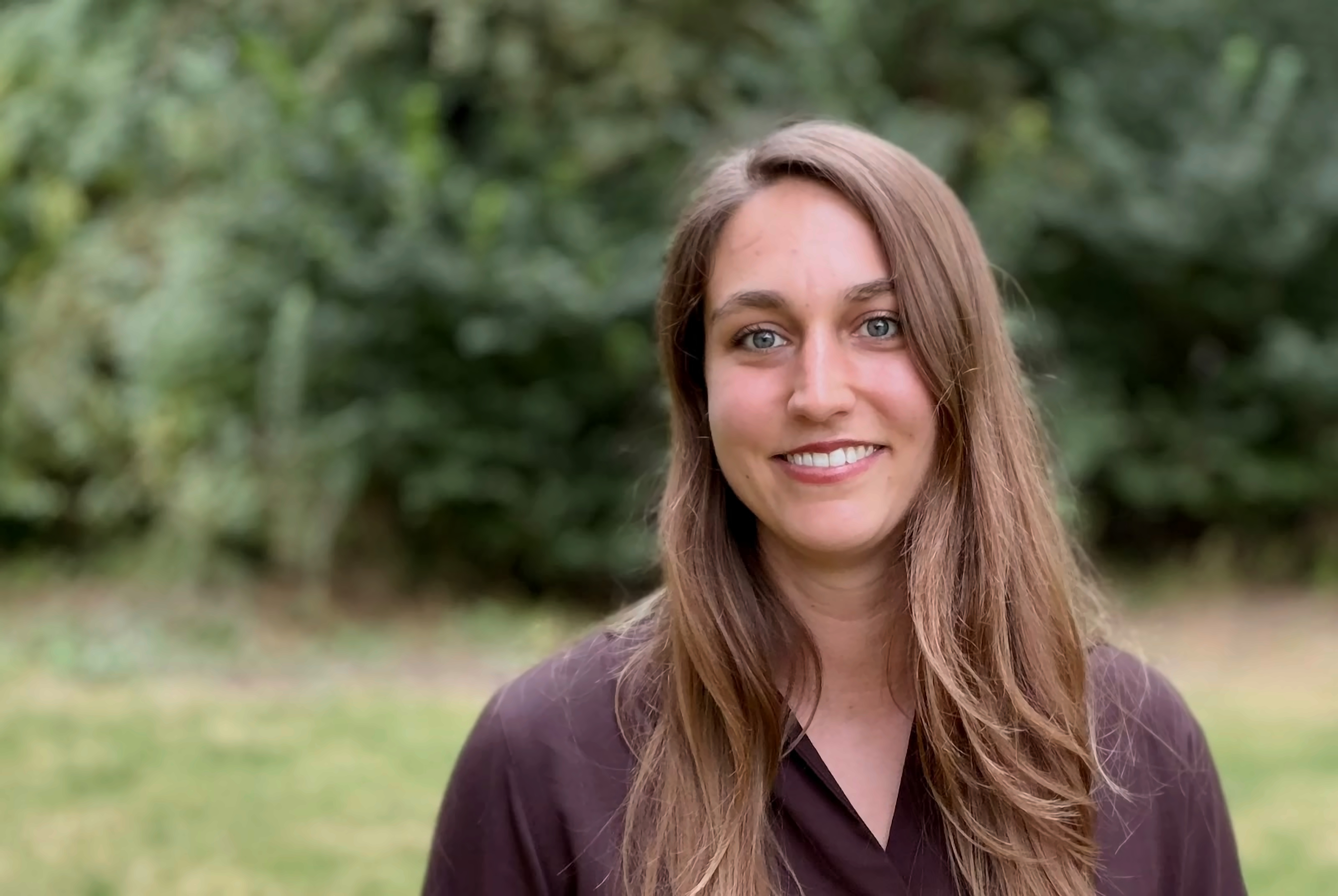
Naomi van den Ameele applied for the EAGE Marie Tharp Award, bringing great enthusiasm and a unique profile as PhD candidate in the Department of Geoscience and Engineering at TU Delft, as well as a part-time subsurface inspector at the Dutch State Supervision of Mines (SSM), the national regulator for subsurface mining activities, a combination that firmly grounds her research to the real-world challenges it aims to address.
The technical ambition of her work, as well as her commitment to contributing to a geoscience that serves society, earned her this year’s Tharp Award, the EAGE’s recognition dedicated to talented students pursuing a curriculum in the energy transition space.
First Break Online spoke with Naomi about her research, her experience working at the interface of science and regulation, and her perspective on the future of the geoscience community.
Your research
Could you tell us about your PhD project, “Caves and Waves”, and the questions you are seeking to address?
With Caves and Waves we aim to investigate how geological characteristics and operational practices influence micro-seismicity around underground hydrogen storage caverns in salt formations. Hydrogen has the potential to play a central role in balancing the variability of renewable energy, but only if it can be stored safely at scale. Salt caverns offer one of the most viable solutions for storing hydrogen on such a large scale.
However, the construction and cyclic operation of cavern systems can pose geomechanical challenges. Induced seismicity is among the less well characterised of these, and improving that understanding matters both for managing public safety and for building societal acceptance of this technology. At the same time, micro-seismicity is a valuable tool for monitoring the stability of the caverns. With my research I want to understand which geological structures and operational conditions influence micro-seismicity, so that this can be taken into account in the design and operation of large-scale cavern storage systems.
Your work brings together geomechanics, seismology and geological characterisation. What does this multidisciplinary approach allow you to understand that individual disciplines might not capture on their own?
Combining these disciplines allows us to follow the whole chain: from how the cavern is operated, to how the surrounding salt responds, to whether that can potentially lead to micro-seismicity. The geomechanical simulation of rock salt describes how the salt creeps and how the stresses around the caverns evolve during operation. The seismological modelling translates those stress changes into micro-seismicity rates, and the geological characterisation describes the subsurface heterogeneity, and with that the setting in which this all occurs.
Each discipline on its own misses part of that picture. Salt, and salt domes in particular, has long been treated as a homogeneous material, while in reality it can contain layers and structures that behave very differently. Similarly, stress changes around salt caverns are often modelled, but have not yet been linked to seismicity rates in this way.
By combining the three we can study how geological features and operational conditions together influence micro-seismicity. Linking these is a novel part of this work and at the core of my research.
From research to practice
You combine your PhD research with your work as a subsurface inspector at the Dutch State Supervision of Mines. How does this practical experience influence your research?
As part of my work as a subsurface inspector, I provide technical analyses on induced seismicity and reservoir geomechanics, both for advising the licensing authority and supervising compliance with the mining law. This means I am not only researching these potential risks in an academic setting, but also actively participating in the regulatory frameworks that govern them.
Working at the Dutch regulator gives me a better sense of what is currently going on in the industry than I would have if I only worked in academia. I also see firsthand where the critical knowledge gaps exist, which questions are the most urgent from a safety perspective, and how scientific understanding can be translated into operational practice. This connection between research and regulation helps keep my work relevant to society.
You are also involved in teaching the MSc course Subsurface Storage at TU Delft. What do you hope students take away from the course, and how important is it to you to share knowledge with the next generation of geoscientists?
In the course I teach about the risks of underground hydrogen storage and lead a practical on salt cavern simulations. What I enjoy most is making that practical as applicable as possible. Students work on a case in which they first run a stable cavern operation, then explore under which conditions it can become unstable, and finally carry out a risk assessment.
That way, I hope they see that these simulations are not just a theoretical exercise, but tools that are actually used in practice for assessing the safety of subsurface storage.
Looking ahead
What are the next steps in your PhD research, and what do you hope your work will contribute to the safe development of underground hydrogen storage?
The next phase of my PhD aims to scale the framework from single-cavern to dome-scale multi-cavern systems, and from 2D to 3D modelling. The initial single-cavern models have allowed us to identify which geological structures and operational conditions increase the sensitivity to induced seismicity, and these findings now inform what needs to be captured at the field scale.
3D multi-cavern models allow us to investigate more realistic representations of cavern fields: storage and brine caverns at varying locations within the dome, heterogeneous geological structures, the proximity of the dome wall, and individual pressure schemes for each cavern. Ultimately, this could help us better understand how stresses evolve across a cavern field and how this relates to the occurrence of micro-seismicity, which can be useful for regulators and operators, as well as for other researchers.
Looking beyond your PhD, where do you see the greatest opportunities for geoscience to contribute to the energy transition?
Many aspects of the energy transition depend on the subsurface, for example the storage of hydrogen and CO2, and geothermal energy. Geoscience therefore has an important role to play in making sure these technologies can be deployed safely and at the scale that is needed.
For me that means two things. First, combining disciplines and expertise because questions like induced seismicity often can’t be answered from the perspective of a single field alone. Second, communicating clearly about risks and uncertainties, since these projects take place close to where people live, and societal acceptance is essential for them to succeed.
The Marie Tharp Award and the EAGE community
What did receiving the EAGE Marie Tharp Award mean to you, and what are you looking forward to most about connecting with the EAGE community at GET26?
It means a lot to me that a multidisciplinary project like mine is recognised, and I’m grateful to my supervisors, Hadi Hajibeygi and Annemarie Muntendam-Bos, for their excellent guidance and expertise. There is often talk about how closer collaboration between academia, industry and regulators could benefit our work and help shape it, so it is great to see a project that brings academia and regulation together being valued.
At GET26 I’m mostly looking forward to meeting the community working on these topics: researchers working on underground storage, regulators working on safety frameworks, and people from industry who are working on this in the field. I’m excited about the discussions and about learning from their perspectives.
Finally, what advice would you give to young EAGE members, particularly students who are considering how they can contribute to the future of our profession?
I would say: don’t be afraid to step outside your own discipline. I was trained as a geologist and had to learn numerical modelling and seismology during my PhD. That was challenging, but also very rewarding, especially because my work at the regulator showed me why those questions matter in practice. Looking for that connection to practice really helps you see where your work can make a difference. Sharing your work early helps too: presenting at conferences and summer schools, even with preliminary results, gave me critical feedback that sharpened both my work and my thinking. And above all, enjoy it, because working on questions that are relevant to the energy transition can be a great motivation.
About the EAGE Marie Tharp Award
Applications are open for the Marie Tharp Award 2027 until 31 October 2026. Eligible candidates must be M.Sc. or Ph.D. students under 35 years of age who are pursuing a college curriculum directed toward a career in geoscience and engineering to support the energy transition. Recognising the multidimensional nature of the challenge, the award encourages applications from a diverse range of disciplines. The awardee will receive a grant to attend the EAGE GET27 Conference.
Read more about the award and application process here.

