
Report by: Anastasiia Jacobsen , Co-Chair of the EAGE Technical Community on Radioactive Waste Disposal
The Need for Disposal Sites for Nuclear Waste
The future of nuclear energy is under debate currently. While some countries regard it as green energy and as a solution in the fight against the climate crisis, others remain sceptical and have decided to trust on renewable energies as the backbone of their energy supply. Regardless of the perspective taken on nuclear energy, one problem yet needs to be solved: the safe final disposal of existing nuclear waste. The burning question that must be answered is: how can radioactive waste be managed safely over several generations?
The current consensus is that deep geological disposal is the most robust solution for high-level radioactive waste and spent nuclear fuel. Since Finland, Switzerland, France and Sweden have decided on their respective disposal sites the underlying scientific concept can be regarded as well accepted beyond the scientific community and we are now - at least in these cases - at the point of implementation. As mentioned above, some countries have reached major milestones in repository development while many others, including Germany, the Czech Republic and the UK , continue to advance their own national programmes through site selection and characterisation. Together, these programmes demonstrate that geological disposal has moved beyond research into a phase of implementation, engineering and societal decision-making.
This changing landscape provided the backdrop for the second EAGE Workshop on Radioactive Waste Management, held during the 2026 EAGE Annual Conference in Aberdeen. More significantly, the workshop marked the launch of the EAGE Technical Community on Radioactive Waste Storage and Disposal. It is a dedicated EAGE platform that brings together geoscientists, engineers, regulators, repository implementers, consultants, and researchers working in this rapidly developing field.
Rather than presenting individual national programmes in isolation, the workshop highlighted the common scientific and technical challenges they face. Despite differences in geology, regulatory frameworks and repository concepts, participants repeatedly returned to reducing geological uncertainty, integrating multidisciplinary evidence into robust safety cases, and building confidence among regulators, policymakers and the public.
Repository Programmes Enter a New Phase
Deep geological disposal is no longer solely the subject of underground research laboratories or conceptual safety assessments. Several national programmes have now entered implementation.
Switzerland reached a major milestone in 2022 when Nagra proposed Nördlich Lägern as the preferred site for a deep geological repository after evaluating six candidate regions. The General Licence Application, submitted in 2024, is currently undergoing federal review.
In the workshop we presented and discussed the site selection processes only of those countries represented in the workshop, namely Switzerland, UK, Czech Republic and Germany.
In Germany, under the Site Selection Act (StandAG), the country is conducting a nationwide, science-based site selection process without identifying preferred candidate regions in advance. The programme combines progressively more detailed geological investigations with public participation at each stage.
Czech Republic is also progressing through earlier phases of site selection and investigation, reflecting the effort to develop long-term disposal solutions.
Despite differences in geology, regulation and programme maturity, each national strategy pursues the same objective: demonstrating long-term safety through robust science and transparent decision-making.
Perspectives from Across Europe
Opening the programme, Rodney Garrard (Arch Insurance International) delivered a compelling message that without a credible, demonstrable solution for radioactive waste, the broader nuclear renaissance risks losing public trust and investor confidence. While the scientific basis for geological disposal is well established and engineering solutions continue to mature, governance and public confidence remain decisive factors. As he observed, "We've solved the physics. We haven't solved ourselves."
Matthias Riede (Federal Office for the Safety of Nuclear Waste Management (BASE), Germany) expanded on this theme by highlighting the importance of international collaboration. While repository programmes differ in geology and regulation, many scientific and technical challenges are shared, making knowledge exchange increasingly valuable.
The role of national geological surveys was explored by Dave McCarthy (British Geological Survey, United Kingdom). Geological surveys, he argued, provide the regional datasets, geological models and hydrogeological understanding that underpin repository programmes long before site-specific investigations begin.
Representing Switzerland, Martin Wipf (Office for Waste, Water, Energy and Air (AWEL), Canton Zürich) described how the Swiss programme combines detailed scientific investigations with a structured regulatory process and public participation. Technical evidence remains central, but repository development also depends on transparent decision-making.
The contribution of applied geophysics was presented by Josef Urík (INSET s.r.o., Czech Republic), who demonstrated how geophysical methods support repository site selection by reducing geological uncertainty before more detailed investigations are undertaken.
Taken together, the morning presentations illustrated that repository programmes across Europe may differ in geological setting and national framework, but they rely on the same foundations: rigorous site characterisation, multidisciplinary science and evidence-based decision-making.
The afternoon sessions shifted the focus from understanding the subsurface to a broader question: how confidence in repository safety is established, tested and maintained throughout the lifetime of a disposal programme.
From Characterising the Subsurface to Building Confidence
Markéta Dohnálková (Radioactive Waste Repository Authority – SÚRAO, Czech Republic) presented the Czech programme's approach to selecting a site for a future deep geological repository. Although each national programme follows its own regulatory pathway, the underlying objective is universal: to reduce uncertainty through progressively more detailed investigations until a site can be demonstrated to meet stringent long-term safety requirements.
This theme was further developed by Lee Hartley (WSP UK Ltd.), who examined how confidence is built into geological site descriptions. Repository programmes cannot eliminate uncertainty; instead, they seek to understand, quantify and manage it. Geological models evolve as new information becomes available, with each stage of investigation refining rather than replacing previous interpretations. Confidence grows through repeated testing of hypotheses against field observations, borehole data and underground investigations.
For many geoscientists attending the workshop, reservoir characterisation, mineral exploration and geological storage projects, depending on integrating multiple datasets to support decisions despite incomplete information, was a familiar concept. Deep geological disposal applies the same scientific discipline, albeit on significantly longer timescales and under far more stringent regulatory requirements.
The afternoon discussion reinforced that repository development is fundamentally multidisciplinary. Сonfidence emerges from the consistency of evidence across structural geology, hydrogeology, geochemistry, geophysics, rock mechanics, engineering and numerical modelling, contributing to the safety.
Advancing the Science
The poster session highlighted the breadth of ongoing research supporting repository development.
Researchers from Jacobs presented work on fluid flow through faults and fractures within the Mercia Mudstone Group, examining how structural geology influences groundwater movement and its implications for geological disposal.
Two contributions from INTERA focused on numerical modelling. One addressed performance assessment at both the repository and component scales for the Swiss disposal programme, while the other demonstrated the application of adjoint-state methods for sensitivity analysis in repository modelling. Together, these studies illustrated how advances in computational methods continue to improve understanding of long-term repository performance and uncertainty.
These projects reflected a common trend: repository science continues to evolve through increasingly sophisticated characterisation, modelling and data integration.
A Growing Role for the Geoscience Community
The launch of the EAGE Technical Community on Radioactive Waste Storage and Disposal highlights radioactive waste management as an established field within applied geoscience and provides a platform for collaboration across disciplines and national programmes. Expertise from areas such as geological modelling, hydrogeology and geomechanics is increasingly relevant, with growing opportunities for collaboration as repository implementation advances across Europe. The community also supports international learning, enabling countries at different stages of development to share experience and strengthen the collective knowledge base.
Looking Ahead
The workshop underscored that successful repository programmes depend on long-term safety that requires robust science, effective engineering, transparent regulation, interdisciplinary collaboration, and sustained public confidence. Radioactive waste management represents a field where fundamental geological knowledge is applied to one of society's longest-term infrastructure challenges, requiring decisions whose consequences extend far beyond a single generation.
The discussions in Aberdeen offer new opportunities for collaboration and innovation as countries work towards safe, long-term solutions for radioactive waste.
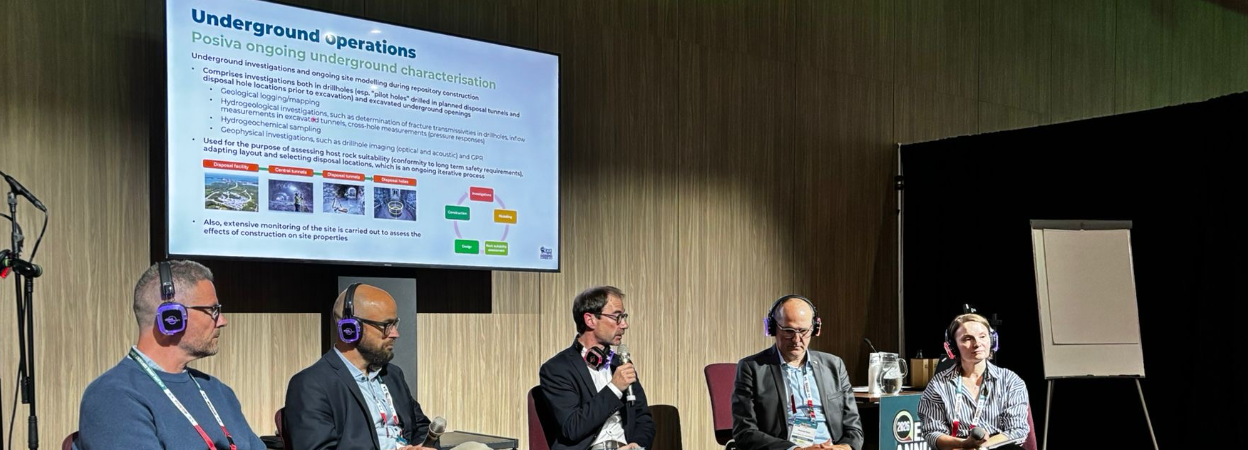
Speakers: Rodney Garrard (Arch Insurance International) | Matthias Riede (BASE, Germany) | Dave McCarthy (British Geological Survey) | Martin Wipf (AWEL, Canton Zurich) | Josef Urik (INSET, Czech Republic) | Marketa Dohnalkova (SURAO, Czech Republic) | Lee Hartley (WSP UK Ltd.) | Panel: Owen Mills (Jacobs)
Poster contributions: Jacobs (fluid flow through faults and fractures, Bristol Channel Basin) | INTERA (repository-scale performance assessment modelling; adjoint-state sensitivity analysis)

