
During the European summer season with more time outside, I get to practice my hobby of collecting walls and arches. You heard that right – while others are bagging Munros (Scottish mountains over 3000 ft), completing endurance marathons, lounging on Mediterranean beaches or swimming with sharks, I like nothing better than finding an old church or castle and adding it to my collection.
To be more precise, I was introduced to the free Scaniverse app by LinkedIn posts showing 3D movies of rock outcrops. I set to work scanning everything from beach outcrops, an old olive tree and my window frame before hitting on the theme of old buildings. By passing my phone along a wall five times to capture different orientations, within five-ten minutes I create a data cloud of points that my phone then processes into a 3D photo-montage of the object.
My scans of Dalton Abbey doorways (Furness peninsula south of the English Lake District) generated quite some engagement on LinkedIn in 2024. Follow these links to navigate them yourself:
Link to Dalton Abbey 1.
Link to Dalton Abbey 2.
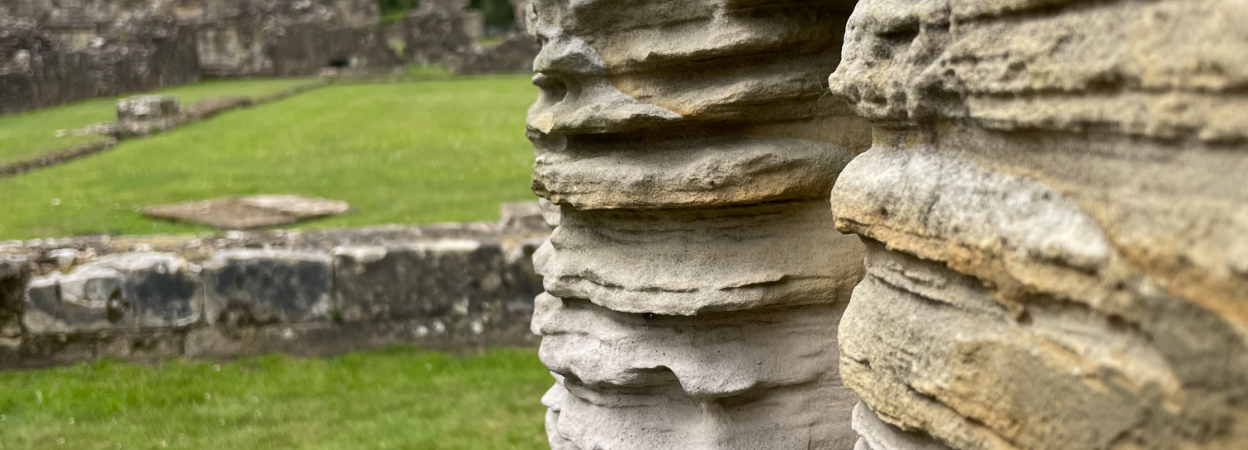
Their eroded nature clearly picked out heterogeneities in the sandstone blocks used by the monks for construction – and these same Sherwood Sands are the reservoir of the Morecambe Bay gas fields which have become a focus of UK’s Net Zero ambitions with CCS and energy storage potential. Creating a buzz was not my intention; it was the observation that eroded archways when viewed side-on look very much like porosity/ permeability well logs but at much higher resolution (photo in the header taken at Byland Abbey in Yorkshire; using the BGS Geology Viewer fluvial/palustrine/shallow-marine Jurassic Cloughton Formation-Sandstone).
But like all holiday snaps, it’s important to judge the interest of the audience before boring them to death. So far this summer I have scanned three walls for myself and one monument for showing off. For you I’ll share just one wall at Mount Grace Priory on the edge of the North Yorkshire moors (shallow marine Jurassic Staithes Sandstone Formation?) and the Temple of the Muses from Dryburgh near Melrose in the Scottish Borders (bedrock is fluvial Devonian Stratheden and Inverclyde Groups).
Notwithstanding rebuilding, the Mount Grace south-facing wall represents 600 years plus of erosion. What were originally smooth blocks now reveal their histories and I suggest you focus in on this structure within one block.
The Temple of the Muses in Dryburgh was built 200 years ago for the eccentric 11th Earl of Buchan as a tribute to a local poet. I scanned one of the eight columns, and the local stonemason has chosen to chisel oblique to bedding, giving a satisfying bedform.
If you look up images of the modern statue in the middle you will quickly see why that scan was one challenge too many.
Link to Wall at Mount Grace Priory, Yorkshire, UK.
Link to Column at Temple of the Muses, Dryburgh, Roxburghshire, UK.
So what will you have to show at the start of next term, and how will you answer the question ‘What did you do on your holiday?’
Header image: Archway at Byland Abbey, Yorkshire, UK
Peter Rowbotham is an independent consultant and previously was chair of First Break Editorial Board and EAGE Publications Officer.
Views expressed in this column are solely those of the author.

