
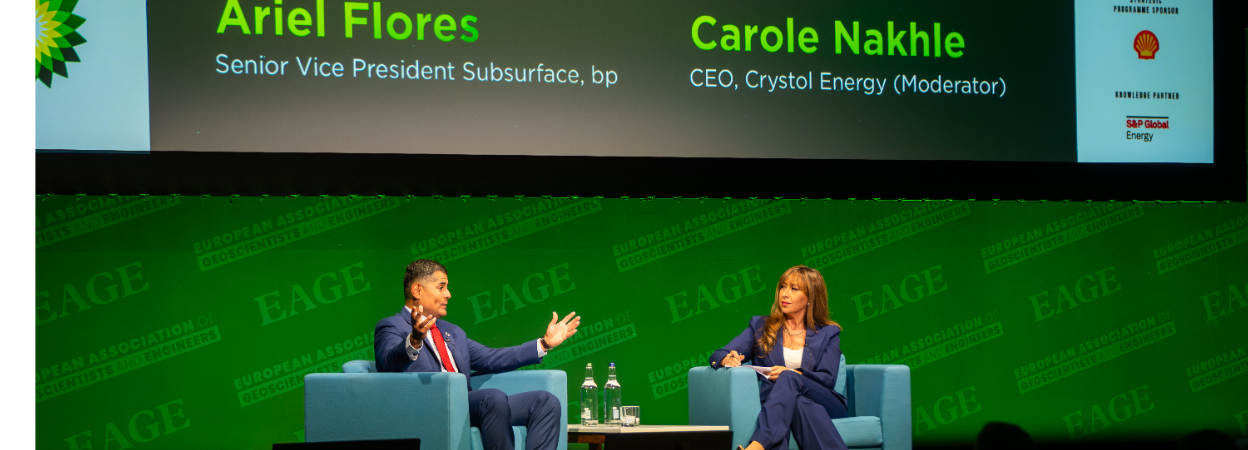
The EAGE Annual Conference and Exhibition in Aberdeen last June kicked off with an expert demonstration of a Highland jig. Ariel Flores, Senior Vice President of Subsurface at bp, was similarly upbeat in his assessment of the global energy industry. Here is a report on his ‘Fireside Chat’ with Dr Carole Nakhle, Founder & CEO of Crystol Energy.
Carole: How do you see the outlook for oil and gas industry?
Ariel: Many of you have spent the better part of your lives in this industry and are using geophysics and engineering to resolve some of the world’s biggest problems. At times there is turbulence and uncertainty, but we have to adhere to the principles of physics, chemistry and thermodynamics. It’s through the underpinning of this technical acumen that we can solve the biggest challenges. Challenges lurk at every corner.
It’s great to be back in Aberdeen. I lived here for three years. It’s a very special place and I have great memories of the castles I visited with my family. It really touches the heart. This conference brings together the geosciences and industry and together we can help to solve some of the world’s biggest problems. That’s what I always lean on when things get a bit tricky with forces beyond our control.
I was recently with an energy minister in Africa and he was talking to me about how to create customers in that continent with power plants that help to industrialise and grow economies. The reality is that there is a lot to build, a lot of infrastructure to create and that all requires energy that is hopefully more efficient when it comes to footprint. The ability to pivot to these requirements is hugely important. Energy and climate are a global problem. Building and infrastructure are also a global requirement.
Carole: What are the hottest Investment opportunities areas that are capturing attention today?
Ariel: I’ll name three. I’ll start with being able to manage the maximum potential of giant fields. We are the technical services provider to ONGC for the Mumbai High field and we are involved in Rumaila, Iraq’s largest producing oilfield, through Basra Energy Company, which is jointly owned by bp and PetroChina.
We use 4D seismic in order to understand fluid flow all the way through to maximising fronts, water floods and gas injection to infield drilling side tracks. I believe that when we use this technology the big fields get bigger and the giant fields always give a little more. If we can focus on the discovered resources around the world with the latest in technology, we can take recovery factors of oil in many cases all from mid-20s to 50/60 per cent.
The second is deepwater. Around two-thirds of the Earth’s surface is covered by water and our ability to image more of the earth is going to unlock more opportunities. It hasn’t been without its road bumps as we’ve gone into ultra-deepwater we’ve unlocked massive resources and I believe there’s a lot more to unlock across many waters.
The third thing is using the latest imaging technology to go deeper and with higher resolution across the board. Sometimes you lose confidence because you get underwhelming results. It gets to a point where you’re drilling wells and you don’t know exactly what you’re doing and you stop. In the industry I increasingly see an ability to distinguish what we have that 10 years ago we would not have been able to distinguish. That’s going to unlock vast opportunities in existing and frontier plays that will help to provide energy and solutions that are more capital disciplined and ultimately allow us to be more successful more of the time.
Carole: The North Sea is sometimes described as a dying province, but it’s not a dead province right?
Ariel: I met with our teams here last week and saw for myself how they are achieving things I was unable to do with them in 2018/19 when I was last here. New technology, such as drone technology, aerial surveys and real time data are now a reality. We are working hard to lower the cost base on a declining volume. Any business that sees a decline in volume has to look at its cost base. We have to embrace innovation. It will require multi-company collaboration to achieve a more competitive cost and I’ve seen a lot of that.
I worry about the long term and I have to think about the company 10 or 15 years on from now. At bp we’re still drilling in the North Sea. We’re still shooting seismic in the North Sea, both OBN and 4D, because we see accretive value. Yes, you could argue it’s less accretive than in the past but there is still value and we need to focus on what we need to do now to create a little bit of growth. That’s what our teams are focused on now.
Carole: What is the secret formula to remain as competitive as possible for a winning firm?
Ariel: Stakeholders, ministers and decision makers have to understand the potential and what that could yield in development costs and what it can yield in power needs. There are a lot of examples of where we have discovered something like the Forties field in the North Sea and how that’s led to industrialisation and growth in GDP.
I was recently with Meg O’Neill [CEO of bp] and the president of Azerbaijan and we were talking about what happened after Azerbaijan gained independence in 1991 and signed the “Contract of the Century” in 1994. We were able to take rates of poverty in that country from 80% to 5 per cent as a consequence of unlocking the Azeri-Chirag-Gunashli (ACG) and Shah Deniz fields. It starts with the rocks as we access opportunities in Central Asia and elsewhere. We have to describe what the potential is with technical underpinning on capital development and cost. If there is something of mutual interest then we need stability and then we can make decisions. If there is clarity and direction on fiscals, ultimately leading to sanctity of contract, that’s what leads to a great powerful long-term relationship.
Carole: Tell us about the role of talent and what kind of talent we are still looking for especially in the light of technological developments and AI in particular?
Ariel: I come across young people who ask ‘why should we want to enter this industry when we can’t see a long-term career?’ These are the sort of discussions I have with my 14-year-old daughter who is not keen. It’s still a big battle for me and industry to be attractive.
People will still be the most valuable asset to our companies. I see AI as a massive enabler. In the past we would have tapes that took a very long time to process. We would have massive amounts of data but with the compute power we had in the past it would take years to converge. We are increasingly able to converge this data, allowing higher resolution to employ the judgment required.
We will absolutely still need geoscientists, geologists and engineers to employ their judgment. For the past five years many of them have been bending my ear saying that 80% of their time is spent looking for data, organising data, identifying good data versus bad data. That is the opportunity that AI presents. We will spend less time getting the right data and more time employing judgment. Things in the past have been repetitive and cumbersome, getting the right documentation and permits and working out what documents are required in a particular basin. These things can be vastly automated so that geoscientists can spend more time using their judgment to identify opportunities.
We need people who have been in the industry a long time and new people who can code in Python and do things I could never do.
Carole: How do you see successful partnerships and who will be the main players from an industry perspective?
Ariel: For many years we have been pressing for deeper alliances, stronger for longer, which can be a win-win for everyone. We want to partner with our supply chain, universities and of course IOCs and competitors to tackle some of the world’s biggest challenges. No one can do it alone and it is impossible to solve things in isolation. We have to drive transparency with all the cards on the table to make the right decisions.
Everyone has to succeed. We have to make profit and society has to benefit from what we are doing.
There are pain points of course but if we are constantly speaking to each other and adjusting and pivoting that is what a strong long-term partnership should look like and there will always be give and take. Transparency is key. Trying to pull something over someone else rarely leads to a good outcome.
Carole: Tell us one thing you are most concerned about and one thing you are most excited about in the next five to ten years?
Ariel: I’m concerned if people stop listening to each other. A world where dialogue is not possible will spiral downwards. We have to keep lines of communication open on all fronts.
The thing I’m most excited about is that I think we’re on the cusp of something revolutionary in terms of technology, a new industrial revolution. We will see disruption and opportunities. In many countries data centres will provide the ability to tackle things that were impossible five years ago.
That will require energy of all kinds and human capability. That should get people excited about creating an outlook for generations to come. It will be different and exciting.

