
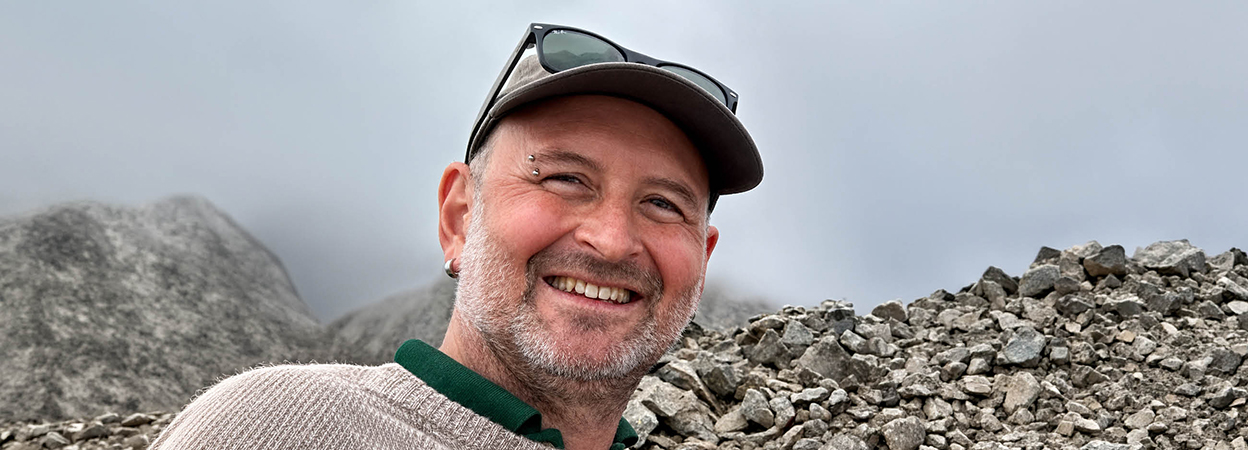
As incoming EAGE vice president, Andi Pfaffhuber will certainly be advocating forthe recently renamed Environment, Minerals and Infrastructure Circle (EMI) of which he was first chair. Brought up in Austria, his early pursuit of engineering has ended up as a career in airborne geophysics. Six years ago, he led a company spinoff from the Norwegian Geotechnical Institute, which this year merged with Xcalibur Smart Mapping.
Austrian roots
I grew up in Steyr, a relatively small engineering town in Upper Austria, about halfway between Salzburg and Vienna. The Alpine setting, the town’s significant engineering history — Steyr was the first city in Western Europe to have electric street lighting — and the fact that my father was a motor engineer all contributed to my early interest in mountains and engineering.
Academic meander
Graduating with a PhD in applied geophysics from the University of Bremen in 2006 was not what I had expected when I embarked on environmental engineering at Montanuniversität Leoben in 1994. A series of fortunate events saw me move from Leoben to Berlin and then to Bremen, with my area of interest shifting from engineering to geoscience, and my focus from groundwater to applied geophysics. Various individuals influenced this journey, but I was always clear about wanting to pursue a career outside the fossil fuel industry.
Eureka moments
A fantastic introduction to geoscience during a seminar in Leoben inspired me to move away from engineering, while a great applied geophysics lecture series in Berlin sparked my interest in geophysics — a subject I had avoided in Leoben because of the heavy mathematics. I ended up with a PhD project at the Alfred Wegener Institute, developing airborne electromagnetics for polar research to measure sea-ice thickness. Why? This time, it was a conference presentation that triggered my interest.
Researcher sweet spot
Over the next 12 years, my first job as a newly qualified PhD turned me into an EM geophysicist: a consultant, researcher, innovator and leader at the Norwegian Geotechnical Institute (NGI) in Oslo. During my first years there in the late 2000s, my EM specialism drew me into the heyday of CSEM, and I suddenly found myself consulting for oil and gas companies, which had not been my ambition. However, the focus later shifted to infrastructure projects, where I learned first-hand what geotechnical engineers deal with and how geophysics, remote sensing and GIS can improve — and perhaps even disrupt — traditional workflows. These insights set the scene for my next major chapter.
Rollercoaster startup
During a semi-sabbatical in 2016/17 in Perth, Western Australia, I had time to publish some illustrative case studies in First Break and to reflect on my next challenge. I became inspired to spearhead the commercialisation of technology being developed in my department at NGI. In October 2019, I founded the spin-off company EMerald Geomodelling together with three co-founders.
Our aim was to reduce geological risk in major infrastructure investments, helping to avoid the unnecessary cost and time overruns that have unfortunately become standard across the industry. Our approach was to advocate the use of airborne geophysics as an efficient tool for surveying large near-surface areas for construction projects such as railway lines, integrating direct observations from boreholes, samples and other sources. Over six years, we successfully transferred our technology from Norway to projects in Brazil and India, while navigating the typical ups and downs of startup life.
Taking on a partner
In February 2026, a new and exciting chapter began for both me and the company I founded when we proudly announced the acquisition of EMerald by Xcalibur Smart Mapping, the world’s largest airborne geophysics provider, at one time associated with Fugro and, more recently, with CGG. Our companies view geoscience as product-driven, with our combined expertise providing clear added value by enabling end users to access and integrate geospatial data that is too often hidden in maps, reports and expert knowledge. We intend to leverage the potential of AI to further enhance our offering and services.
“Sharing knowledge and bringing people together is what makes us all better as a community.”
Joining the EAGE family
For me, active membership of EAGE has been a natural part of being a geoscientist since my MSc at the Technical University of Berlin. Sharing knowledge and bringing people together is what makes us all better as a community. This applies not only to technical questions, but also to the friendships and long-term relationships that are built through conferences and other events.
My first committee activity was helping to establish the first European Airborne EM conference, held in parallel with NSG in 2015. A few years later, I joined the Near Surface Geoscience Circle, serving as chair from 2024 to 2026. During this period, we were authorised to change our name to the Environment, Minerals and Infrastructure Circle (EMIC), which better reflects our focus at a critical point in the global transition.
As Circle chair, I have tried to bring greater clarity to what EMIC represents, and I intend to continue this mission as incoming Vice President of the Association — a position I am very proud to have been chosen for.

