
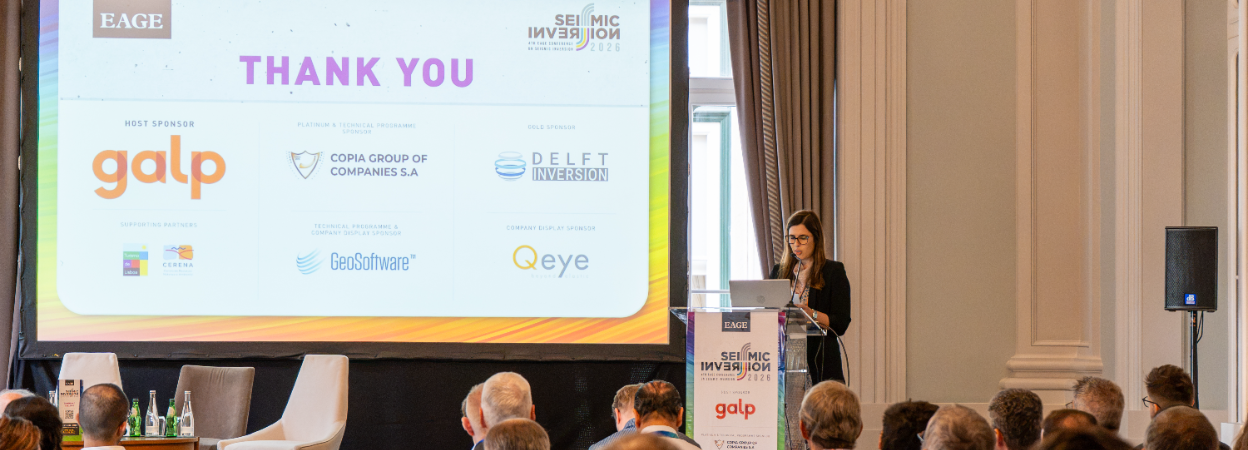
The Fourth EAGE Conference on Seismic Inversion was held in Lisbon, Portugal, from 6–8 October 2026. It brought together 120 delegates from 64 organisations and 24 countries to discuss how inversion is evolving and how its results drive subsurface decisions. With record numbers of both participants and submissions, the conference continues to grow.
The week opened with a one-day short course by Dario Grana, Geostatistical Seismic and Rock Physics Inversion. The poster session and icebreaker reception sparked lively discussion. The conference dinner at Casa do Alentejo, a 17th-century palace with a striking neo-Arabic courtyard, opened with traditional fado. After the conference, participants visited CERENA’s GEOLAB and Multi-scale Imaging Laboratory at Instituto Superior Técnico.

Opening and keynote
After an opening by the co-chairs, Ana Mafalda Lopes of Galp welcomed participants. In his keynote, A Personal Perspective on the Evolution of Seismic Inversion, Arild Buland, head of Geophysical Methods and Analysis at Equinor, drew on some 35 years across geophysics, statistics and subsurface decision-making, including pioneering work on Bayesian inversion. He traced how the discipline has moved from deterministic impedance estimates towards probabilistic answers that decision-makers can act on.
Technical themes
The technical sessions covered the whole inversion chain, from feasibility and data conditioning to well placement and reservoir management. Several themes stood out.
Uncertainty is the expected output
Stochastic, geostatistical and Bayesian approaches are now mainstream rather than specialist tools. Examples included ensemble-based Bayesian elastic inversion (ES-MDA) in the Santos Basin pre-salt, Iman-Conover sampling as a practical alternative to MCMC in rock physics inversion, and AVO fluid classification conditioned to local geology and burial history.
An SPDE approximation to kriging showed that geostatistical inversion now scales to large surveys. The focus was on carrying uncertainty through to volumetrics and decisions, not just reporting it. Careful parameterisation also paid off: narrow angle stacks, extended elastic impedance attributes and a richer facies model revealed missed pay without reprocessing, and a regional inversion of legacy North Sea data achieved an 87% success rate against 164 wells.
4D, multicomponent and anisotropy
At the Snorre field, joint inversion of 4D amplitudes and time-shifts removed spurious artefacts, and a comparison of time-shift methods favoured modelling the kinematic effect directly within pressure–saturation inversion. Relaxation algorithms were presented for multi-vintage joint elastic and litho-fluid inversion. In Abu Dhabi carbonates, joint PP–PS inversion of broadband ocean-bottom node data constrained Vp/Vs where PP-only AVO could not. Other talks extended AVO inversion to VTI and HTI media, predicted shale anisotropy with a rock-physics-guided random forest, and showed that including VTI improves density estimates for separating commercial from residual gas.
AVO, rock physics and QC
Running inversion during reprocessing as a quantitative QC exposed Q-compensation timing shifts and shortened the final inversion. Speakers advised interpreting AVO classes in the reflectivity rather than the impedance domain, and never in isolation. Q compensation stabilises AVO inversion beneath attenuating overburden but risks ringing within the target. New tools included a precomputed exact-Zoeppritz operator for density ratio and a wavelet-independent reflectivity inversion that matched pre-stack results without well ties. Two talks tackled subjective parameter choice: particle swarm optimisation cut sparse-spike tuning from hours to minutes, and adaptive Tikhonov–total-variation regularisation imaged both smooth compaction trends and sharp intrusive contacts in Japan Trench sediments. Feasibility remained central: gas detection in the Dnieper–Donets Basin reached about 70% drilling success in Class II sands, and a deepwater QI study was carried through to well placement, while acknowledging that cemented and hydrocarbon-bearing sands remain hard to tell apart before drilling.
FWI meets QI
FWI velocities served as low-frequency models for Bayesian inversion of thin West African carbonates and the Agogo field offshore Angola, and to scale wavelets for fast-track inversion without well calibration. Well-constrained demultiple and 15 Hz FWI recovered reliable AVA from legacy shallow-water Arabian Gulf data, while amplitude-versus-angle FWI on ocean-bottom node data delivered a stable density section. Looking further ahead, one speaker argued that viscoelastic multiparameter FWI makes reflectivity redundant as an intermediate step, shifting QI expertise into the low-wavenumber prior; another showed that recovering attenuation (Q) remains far more fragile than velocity.
Machine learning
Two sessions showcased physics-guided machine learning, including rock-physics-informed diffusion models, physics-informed neural networks, well-constrained few-shot learning and AI-based super-resolution inversion, with field applications from the North Sea, the Middle East and India.
Integrated workflows
Case studies showed inversion embedded in exploration and reservoir management. In the Norwegian North Sea, elastic inversion of 1,000 km² of AVO-preserving dual-azimuth data mapped Paleogene injectites and separated hydrocarbon from brine sands. In Namibia’s Orange Basin, Vp/Vs proved the most robust hydrocarbon indicator and guided well placement. In pre-salt carbonates, linking inversion attributes to silica helped predict non-matrix permeability, informing sweep and breakthrough risk. In Ukraine’s Carpathian foredeep, the region’s first full QI workflow found Vp/Vs and AVO attributes far more diagnostic than acoustic impedance in thin interbedded sands, with AVF (Amplitude-versus-frequency) attributes reducing false positives.
Inversion for the energy transition
A session on CCUS, wind and other new-energy projects showed inversion applied to seal and overburden characterisation and CO2 storage assessment. Applications outside hydrocarbons, from concrete structures to near-surface soils, underlined how transferable these methods are: one semi-analytical scattering method modelled deformed layers in about one second, against two minutes for a full finite-element simulation.
Dedicated sessions
Driving Subsurface Decisions: The Value of Seismic Inversion Across Integrated Workflows brought together speakers from TotalEnergies, Aker BP, GeoSoftware and Dig Technology. They discussed how clustering and classification turn attribute volumes into facies and fluid volumes for exploration, how inversion results feed geological, geomechanical and reservoir models, and how uncertainty can be carried through to business decisions.
High Resolution FWI: Successes and Expectations for Quantitative Interpretation asked whether FWI and traditional AVO inversion compete or complement each other. Presenters from Petrobras, Aker BP, BP and Shell shared operator and research perspectives on what FWI can already deliver for QI and where its limits lie. The recurring question of whether elastic FWI or machine learning will replace amplitude inversion was again described as wrongly framed. The methods have fundamentally different strengths, and the sweet spot lies in combining them, each applied where it performs best.
Looking ahead
The conference showed a community moving from producing elastic volumes to delivering decision-ready answers with quantified uncertainty. FWI, machine learning and probabilistic methods are converging, and inversion is reaching from mature fields to carbon storage. The challenge now is integration: linking inversion results to geology, geomechanics and reservoir management so their value is clear to decision-makers. Concerns about job security in the face of AI and agentic large language models met a clear response: the ability to question results and understand the pitfalls of such tools makes real expertise perhaps more important than ever. A meeting place that fosters collaboration across disciplines matters.
EAGE, the co-chairs, Øyvind Kjøsnes (Aker BP) and Tanya Colwell (GeoSoftware), thank host sponsor Galp, along with Copia Group, Delft Inversion, GeoSoftware and Qeye, for their support, as well as the technical committee and every presenter and delegate who made the conference a success. The conference is now firmly rooted in the community, and many delegates are looking forward to the next edition in 2028. We hope to see you there.
Interested in the submitted proceedings for this event? Find them now at EarthDoc here (exclusively for EAGE members).

