
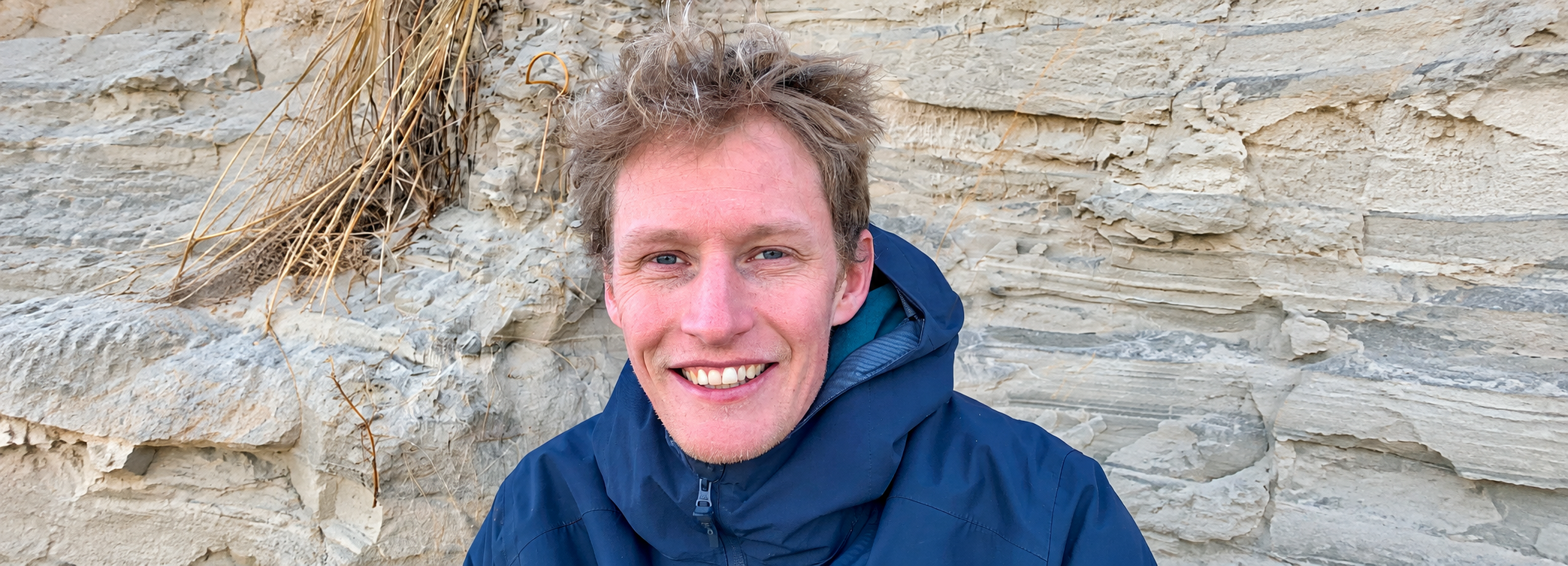
From childhood orienteering in Denmark to founding a subsurface investigation company for the offshore wind industry, Esben Dalgaard says its mapping that has inspired him. The course to his current entrepreneurial role has taken some detours, including a cross-country running scholarship in Hawaii and coping with the cyclical ups and downs of being a geoscientist in the oil and gas business.
Highlights of growing up
I grew up in Fredericia, a working-class harbour town in Denmark. My mother was a nurse, my father a welder who retrained as a teacher in his forties. I did well in what interested me, poorly in what did not. The constants were music, running and orienteering. Running with a map since I was six taught me to read a landscape fast and to accept being wrong about where you are, which turns out to be most of geophysics.
What drew you to geophysics?
Orienteering is reading a map of what you can see. Geophysics is making a map of what you cannot. When I found out at Aarhus University in 2005 that you could map the ground from the surface with ingenious instruments, that was it. Later, Professor Esben Auken offered me a PhD in hydrogeophysics on surface NMR. I have made maps of the invisible ever since: groundwater, oil and gas, now below the seabed. My first EAGE event was Near Surface in Leicester in 2011. I was nervous presenting, and even more so making myself ask other speakers questions. It got me started.
'The fundamentals are a lifeboat whenever you find yourself in deep water.'
How the Hawaii scholarship came about
Cross-country running got me a scholarship to Hawaii Pacific University in 2006. There was no geophysics, so I read oceanography for eighteen months. Hawaii taught me a lesson that has repeated ever since: the deeper you dive into any subject, the more you realise how little you know. There are worse places to find that out. The physics professor, Stephen Dye, saw something in me and said so, which pushed me to learn the fundamentals properly. The fundamentals are a lifeboat whenever you find yourself in deep water.
Oil and gas years
Academia was not for me: it asked too much of dedicated postdocs, more talented than me, for too little security. One month before my PhD defence, in May 2014, I joined Qeye doing seismic inversion and rock physics for oil and gas fields. At Qeye I saw how far ahead industry was in developing and applying technology, and I liked seeing my work used. The physics was new, but inversion is inversion, and that transferred. The oil price peaked a month after I started and had halved by the new year. I have never worked in a stable market since.
Career transition
In 2020 the oil price collapsed again, and Qeye went to a four-day week. I used the spare day on the groundwork for SolidGround, an idea I had long talked through with my wife, Margrethe, who is also a geoscientist. Qeye backed the idea of a dedicated offshore foundations company. With Qeye we had already shown that inversion worked on shallow seismic, but we lacked the geotechnics to make it credible. Then I found a video of Bruno Stuyts scripting geotechnical tools in Python, the way we work. We shared the same vision and, with Covid keeping us apart, founded SolidGround together with Qeye without ever meeting in person.
'Geotechnics runs on standards and decimal places. Geophysics runs on interpretation and uncertainty. Managers run on risk and cost.'
What does SolidGround do?
We do geodata integration for offshore foundation projects like wind farms and energy islands, from survey planning through ground modelling to foundation design support. We still do seismic inversion, but only in the top hundred metres. Currently we are working on the Green Volt floating wind farm off Scotland. The hard part is communication between disciplines. Geotechnics runs on standards and decimal places. Geophysics runs on interpretation and uncertainty. Managers run on risk and cost. Our job is to make them all speak in a common language.
'The tools that matured in oil and gas are exactly what renewables need now.'
State of the wind energy market
When we started SolidGround, the industry was in fear of missing out: everyone was expanding into wind and trying every new tool. Now it is fear of investing. This is my third downturn and the hardest: there is no price recovery to wait for; the problems are interest rates, tender design and politics. But the geology does not care about the market cycle, so getting the most out of your data and geoscientists matters even more in a downturn. Countries now want to be more energy independent, and better-designed tenders are bringing bidders back, with record awards in Europe and Canada’s first offshore wind auction later this year. Wind is looking at busy years again.
Future interests?
The need for geoscientists will never stop. We will always need clean water, more energy, and minerals. The tools that matured in oil and gas are exactly what renewables need now. Wind adopted machine learning for site characterisation before the physics-based phase. I think that order will be corrected: physics first, machine learning on top.
'Time spent doing what you love is never wasted.'
Outside work
I live in Silkeborg with Margrethe and our three kids, surrounded by lakes and forest. I still run, mainly to keep up with the kids. My advice: follow your interests and get really good at the fundamentals. You will not work on the same thing all your career, but a solid foundation gives you confidence, and it transfers. Time spent doing what you love is never wasted.

