
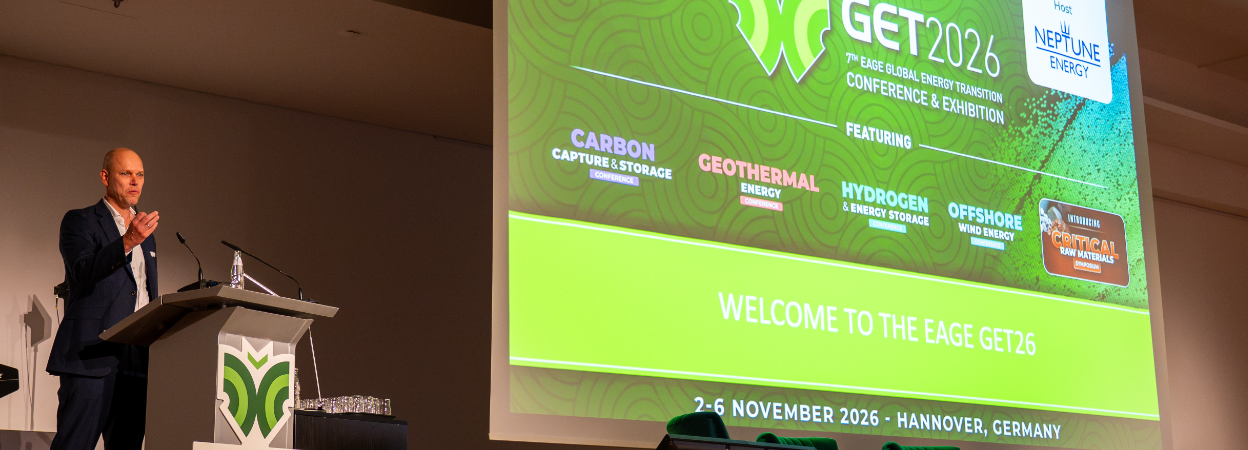
GET2026 Executive Committee chair Axel Wenke (Neptune Energy) reports:
Perhaps the most important message emerging from EAGE GET 2026 was not the advancement of any single technology, but the increasing convergence of energy, resources, and the subsurface. Across discussions on critical raw materials, geothermal energy, hydrogen storage, carbon capture and storage (CCUS), and offshore wind, a common theme became evident: the subsurface is evolving from a traditional source of energy and resources into a multifunctional platform that will play a central role in the energy transition.
As Chair of EAGE GET 2026, I had the privilege of engaging with experts from industry, academia, government, and finance. While the technologies discussed vary significantly in maturity and commercial readiness, they increasingly rely on the same foundation: robust geoscience, deep subsurface understanding, and the ability to integrate multiple value chains within a single energy system. Throughout the conference, it became clear that geoscience is no longer operating in support of individual sectors. It is becoming a connecting discipline that links energy security, industrial competitiveness, and decarbonisation.
One of the most prominent topics was the growing importance of critical raw materials. Electrification, energy storage, and digitalisation all depend on secure supplies of lithium, copper, nickel, rare earth elements, and other strategic commodities. Yet the discussion is no longer limited to conventional mining. Increasing attention is being given to the recovery of valuable elements from subsurface fluids. Lithium extraction from geothermal and deep formation brines emerged as one of the most compelling examples presented at the conference, demonstrating how the subsurface can simultaneously provide energy, resources, and economic value.
Several presentations highlighted the intensifying global race to establish resilient and sustainable lithium supply chains. South America continues to dominate production from near surface world-class brine resources, while the United States is accelerating deployment of shallow and deep brine resources, the latter particularly in the Smackover Basin, where upcoming investment decisions are expected to shape the next phase of growth. Europe is pursuing a distinctive strategy that combines resource extraction, renewable energy generation, and local industrial development. Projects such as Vulcan Energy, Lithium de France, and Neptune Energy's Altmark Lithium initiative illustrate how deep subsurface brines could strengthen European resource security while supporting broader energy transition objectives.
Beyond critical raw materials, the conference demonstrated the growing maturity of subsurface energy storage and carbon management. Hydrogen storage in salt caverns and depleted reservoirs is increasingly recognised as a critical component of future energy systems, providing the flexibility required to balance fluctuating renewable power generation.
At the same time, CCUS projects are progressing from concept to implementation, reinforcing the essential role of geoscience in industrial decarbonisation. Discussions highlighted that Europe is entering a crucial phase where technical feasibility is no longer the primary barrier. Instead, regulatory frameworks, permitting processes, transport infrastructure, and public acceptance are becoming increasingly important determinants of project success.
While the Net-Zero Industry Act (NZIA) provides an important signal of political support and recognises the strategic role of geological CO₂ storage, questions remain regarding the strength of the underlying business case. In many regions, commercial deployment continues to depend on policy incentives, carbon pricing mechanisms, and the development of integrated capture, transport, and storage value chains. As a result, economic viability remains a key challenge alongside technical execution.
Furthermore, societal acceptance is emerging as a critical success factor for large-scale deployment. As experience grows across Europe, it is becoming increasingly clear that transparent stakeholder engagement, public trust, and clear communication of benefits and risks will be as important as engineering excellence and subsurface understanding. The discussion around CCUS is therefore shifting from whether CO₂ can be stored safely to how projects can be implemented at the scale and pace required to achieve climate objectives. Encouragingly, there are growing indications that onshore CO₂ storage may also become part of Europe's future storage portfolio, provided projects can demonstrate both technical robustness and broad societal support.
Offshore wind continues its impressive expansion, with subsurface characterisation remaining fundamental to safe, efficient, and cost-effective project delivery.
Hosting EAGE GET 2026 in Hannover added additional significance. As one of Germany's traditional centres of geoscience and home to Neptune Energy's German operations, Hannover provided a fitting backdrop for discussions on the future role of the subsurface. In many ways, the city reflects the transformation currently taking place across our industry: building on decades of subsurface expertise while adapting that knowledge to the challenges of a rapidly changing energy landscape.
Looking back, my strongest takeaway is that the future will not be defined by individual technologies operating in isolation. The energy transition is increasingly becoming a system challenge, requiring integration across resources, infrastructure, and value chains. EAGE GET 2026 demonstrated that geoscience is uniquely positioned at the intersection of these developments. More importantly, it showed that the subsurface is no longer merely a resource base beneath our feet. It is emerging as one of the key enablers of a secure, resilient, and sustainable energy future.
See you at GET2027 in Aberdeen!

