
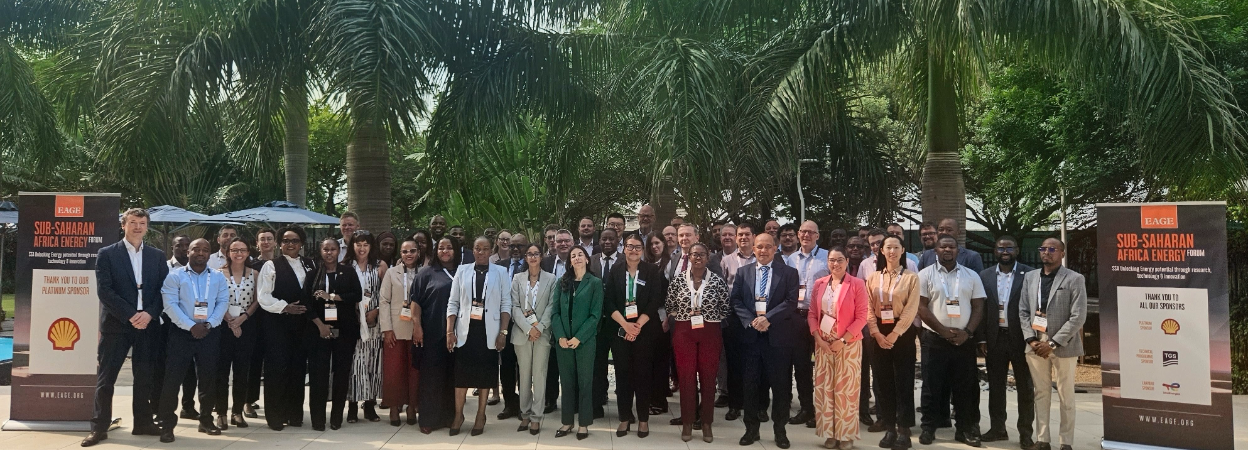
The recently held EAGE Sub-Saharan Africa Energy Forum in Mozambique offered a timely view of a region variably moving from frontier promise toward disciplined, data-rich exploration and development. Since the previous biannual event in Windhoek, Namibia, in 2024, significant industry activity has unfolded across Sub-Saharan Africa, adding to the high level of interest and underlining the forum’s importance as a regional technical meeting point.
Opening addresses demonstrated strong Mozambican support, with contributions from Mr. António Eugénio Manda, Permanent Secretary, Ministry of Mineral Resources and Energy; Mr. Milton Zibane, Executive Vice President for Exploration and Production at INP; and Ms. Monica Juvame, Executive Vice President for Exploration at ENH. The event was generously supported by Platinum Sponsor Shell, with additional sponsorship from TotalEnergies and TGS. Across sessions on Mozambique, East Africa, West Africa, technology and a core workshop, one message emerged: future value creation will depend on regional play-scale thinking, integrated subsurface characterisation, calibrated geophysics, core-based reservoir understanding and realistic commercial appraisal.
East Africa remains one of the world’s most compelling underexplored margins. Presentations on offshore Tanzania, the Pemba–Zanzibar area, Lamu Basin, Angoche and the Zambezi Delta reinforced the scale of remaining potential, while emphasising uncertainty in source presence, heat flow, charge access and reservoir distribution.
After recent limited exploration activities in offshore Mozambique, Mr. David Dutton, Exploration Manager at CNOOC, gave an encouraging keynote on seismic acquisition and drilling plans across CNOOC’s licences in the Angoche and Save basins. Strong contributions showed how seismic interpretation, tectonic reconstruction, petroleum systems modelling and calibrated amplitude analysis can sharpen play definition. In Mozambique, improved full-waveform inversion imaging, AVO analysis and geobody extraction are illuminating deepwater channel systems previously difficult to resolve, yet amplitude anomalies alone remain insufficient: migration risk, anisotropy, maturity and lithological ambiguity remain first-order controls.
“Remaining potential is not simply a function of wells drilled, but of the quality of questions asked of existing data – good geodetective work is key!”
Mozambique’s proven provinces offered a complementary lesson: mature datasets can still yield insight when interrogated with modern workflows. Re-evaluation of Southern Mozambique Basin wells suggested that legacy interpretations may have underestimated stratigraphic pay in the Lower Grudja Formation. Onshore and nearshore examples showed the value of reprocessed seismic, inversion, rock physics and well calibration in mapping subtle traps, discontinuous sands and compartmentalisation. Remaining potential is not simply a function of wells drilled, but of the quality of questions asked of existing data – good geodetective work is key!
The core workshop added an engaging, practical dimension by grounding regional exploration and development themes in Rovuma Basin and onshore Mozambique core material. Presented by Core Laboratories and INP, with seismic lines kindly provided by Viridien and SLB, it showed how core description, petrophysics and seismic interpretation can improve confidence in reservoir prediction. The displays highlighted the variability of deepwater depositional systems and the need to understand how architecture, facies changes and post-depositional modification influence reservoir performance.
The workshop also reinforced the value of moving between scales, from core to well logs to seismic architecture. Examples from different stratigraphic intervals illustrate that even successful reservoir systems can contain significant heterogeneity, with implications for connectivity, deliverability and development planning. It provided a clear reminder that seismic attributes and geobody interpretations are most powerful when calibrated against real rock evidence, linking frontier play evaluation to the reservoir characteristics that ultimately determine commercial outcomes.
“Seismic attributes and geobody interpretations are most powerful when calibrated against real rock evidence.”
West Africa provided a wider Atlantic-margin perspective. Talks on Namibia, Angola, South Africa and Sierra Leone highlighted diverse play types, from pre-salt carbonates and Albian post-salt clastics in Angola to Cretaceous deepwater channels and mass-transport-complex-influenced turbidites in Namibia. Orange Basin discussions with Shell and TotalEnergies were particularly instructive: discoveries have confirmed reservoir presence and hydrocarbons across Albian to Santonian intervals, but quality, connectivity and permeability remain critical uncertainties. In Namibian turbidites, mass-transport complexes may erode or compartmentalise reservoirs, but can also create stratigraphic traps and preserve remnant sand bodies.
A recurring technical theme was the shift from qualitative interpretation to quantitative, uncertainty-aware workflows. Rock physics, seismic inversion, CSEM, broadband reprocessing and petroleum systems modelling featured prominently. Several presentations stressed that direct hydrocarbon indicators must be embedded in geological context. Offshore Tanzania illustrated how anisotropy in shale-rich overburden can generate gas-like AVO responses unrelated to fluids, while the core workshop reinforced the need to calibrate seismic attributes and geobody interpretations against real facies, mineralogy and diagenetic overprint.
Technology and development sessions added a forward-looking dimension. Full-waveform inversion is now central to seismic imaging, supported by high-performance computing and increasingly sophisticated elastic approaches. In development settings, facies-based inversion, geosteering, real-time petrophysics and drilling automation are influencing operational decisions. Machine learning and AI were presented as practical tools for reducing non-productive time, predicting permeability while drilling, improving reservoir characterisation and accelerating decisions, but their value depends on good training data, physical calibration and transparent uncertainty management.
The forum also underscored the long journey from discovery to monetisation. Presentations from TotalEnergies and ENI on world-class Rovuma Basin gas developments showed the progression from frontier exploration to commercial development, supported by recently sanctioned investment decisions. These case studies, including Coral, Mamba and Golfinho–Atum, demonstrated the scale of East African gas opportunity, but also the time, capital and integration required to move deepwater resources to production. FLNG, onshore LNG and regional gas supply sit within the same conversation as exploration risk, reservoir description, energy security, infrastructure, local capability and investment confidence.
“The most persuasive contributions acknowledged uncertainty, used multiple datasets to constrain it, and linked geoscience interpretation to commercial and development realities.”

Overall, the meeting portrayed Sub-Saharan Africa as neither a simple frontier success story nor a mature province in decline, but a mosaic of proven systems, under-tested margins, legacy opportunities and new technical frontiers. The most persuasive contributions acknowledged uncertainty, used multiple datasets to constrain it, and linked geoscience interpretation to commercial and development realities.
The core displays added an extra dimension, reminding participants that regional exploration narratives ultimately rest on real rocks. Beyond the technical programme, delegates valued the chance to reconnect and continue discussions informally. Judging by the survey feedback, the event was well received and enjoyed, being in Mozambique was a great experience for many, and you could sense the excitement and ongoing industry interest in the region.

