
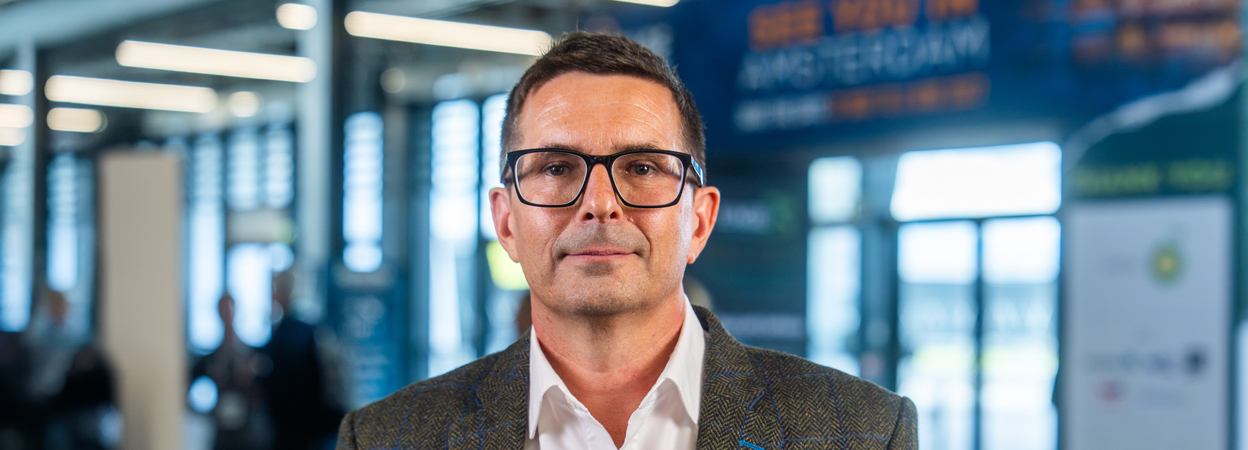
Mike Branston’s career trajectory attests to the diversity of the geoscience industry and that is something he wants to celebrate in his year as EAGE president. He talks to First Break Online.
Tell us about your early life and background?
I grew up in the village of Ackworth, in a coal mining area near Pontefract, West Yorkshire, in the north of England. The area is famous for two things beyond coal, liquorice and cricket. I learnt to play the game at the club where Sir Geoffrey Boycott played as a boy and he used to come in sometimes. If you were polite, you would say I was an all-rounder, that is to say that I batted once all the batters had finished batting and bowled when the bowlers finished bowling. But I loved it and still do! The area has changed a lot since I grew up. There are no more mines, cricket today is no doubt unrecognisable to Sir Geoffrey, and demand for the humble Pontefract cake is not what it was. But the area is thriving and has rebuilt itself around a sense of community.
How did you become a geoscientist?
My father was a civil engineer and gave me an early understanding of geology and the subsurface. His company did site investigations for many significant infrastructure projects across the UK and as a child he would take me with him on site visits, which often also became part of our family holidays.
At school I did maths, physics, and geology A levels and it was the geology I really enjoyed. It came naturally and tapped into my love of the outdoors and the landscape around us. When thinking about university it was my dad who encouraged me to go down the geophysics route, combining my love of geology with physics to secure what he thought of as an employable skill base.
I studied at the University of Liverpool’s School of Earth Sciences which proved to be a wonderful experience, a reputable department with excellent lecturers. I am regularly surprised by how many of my peers passed through the same department.
How did your career start?
I wanted to travel, so in 1998 I joined the seismic industry to work on the vessels after graduating. However, the industry was not booming at the time, and it is fair to say opportunities were limited. My first offshore posting came in the same month I was accepted onto a PhD programme, and after a brief period offshore, I decided to step back into academia.
I think those early years at Geco-Prakla showed me early on that the industry is cyclical and that you must be proactive to have an impact and shape your own career.
The PhD was at Keele University in the UK, and it took me into engineering geophysics and near surface applications. I researched time-lapse microgravity and microseismicity for monitoring subsidence. I had a great time in the field doing surveys monitoring salt caverns and sink holes around the UK, visiting many towns still affected today by past mining activities.
Immediately following my PhD, I worked for a company called Met Surveys, project managing near surface investigations for engineering and archaeological applications. Then my partner Julie, who I met in 1998 while we were both working for Geco-Prakla, was offered a position in WesternGeco’s Oslo Technology Centre (Geco-Prakla having merged with the Western Geophysical division of Baker Hughes in 2001). It was a big change for us, as Julie was working on the vessels offshore at the time and we were living in Leeds. I’ve always believed life is more interesting if you grab the opportunity in front of you, so I resigned and we moved to Oslo in 2004.
In Norway I joined NORSAR, a research institute that also commercialised software. I worked in the technical marketing space for oil and gas applications and managed their messaging at conferences, exhibitions, and trade shows, including those of the EAGE. The move to Norway was a great success, we met some wonderful people, began to understand the importance of the term work-life balance, and ultimately married in 2007.
How did you end up in Malaysia?
One of the great benefits of working for SLB is the dual career program and the flexibility it has shown Julie and I over our careers.
In 2008, Julie took on the position of Asia Marine Sales Manager in Kuala Lumpur. NORSAR offered me the chance to go to Malaysia and set up an office for it. It was challenging, but exciting, setting up a business in a new region, meeting new customers and learning from a different culture.
In late 2010 I rejoined WesternGeco and worked in their seismic acquisition design team based in Malaysia. It was problem solving, working out why the legacy data wasn’t performing and how to improve it either via different type of acquisition, a different processing workflow, or through the deployment of a new technology. I really enjoyed that problem-solving and communicating the value of the outcome to the customer and their stakeholders. It was about understanding people’s objectives managing perception and helping them move towards a successful solution.
I stayed in the solution design and modelling group for 12 years. Moving from Kuala Lumpur to Aberdeen in the depths of winter 2011, down to Gatwick in the summer of 2015, and then to Doha in Qatar during a Covid lockdown in 2021. Each move brought with it more responsibility, a broader geographical reach, and an increase in the diversity of geophysical challenges we were asked to help solve.
In 2020 I began looking into carbon capture and sequestration (CCS), which evolved into the role of New Energy Domain lead in 2022. I now advise on the technical integrity and strategic direction for new energy applications within SLB Exploration Data and Geosolutions.
Since moving back to Kuala Lumpur with my family in 2024, most of my focus has been related to understanding what is needed within CCS monitoring to allow the solution to scale, which has taken me more towards the world of research and engineering in recent years. This has been an interesting journey, and I am very optimistic about the future of geoscience within the future energy mix.
How did you get involved in EAGE?
I’ve always recognised the value of EAGE. I joined when I was doing my PhD, because it gave me access to geoscience publications. My involvement accelerated when I was working on exhibition floors and during my role in solution design, I was fortunate enough to publish several papers summarising the projects we worked on. It was a natural transition from there into giving courses on marine seismic acquisition as part of the EAGE’s education programme.
Then I got involved in serving on committees for various events and chairing technical committees, first PETEX for the PESGB and then the CCS content for the EAGE’s Global Energy Transition (GET) conference. At one of these conferences, I spoke to the EAGE board about doing more for the EAGE and they felt that given the diversity of my experience I would be a good fit for the vice-president role and ultimately taking on the role of president.
Why is EAGE important?
EAGE provides a framework for knowledge sharing and innovation. Industry events and global networking expose members to that culture and diversity. The Association provides a framework to respond to the challenges of securing energy resources and the energy transition.
It’s interesting and rewarding for members to meet people from different cultures. Organisations around the world respond to challenges and opportunities differently and we can learn a lot from that by volunteering within an organisation like EAGE. It has certainly benefited my career development.
What are your priorities as EAGE President?
My focus is balance and the importance of the domain of geoscience within society. We need to continue to support the core application of geoscience within the oil and gas industry. We also need to continue to accelerate the diversification of the Association’s professional scope and recognise the growth of applications such as critical minerals, infrastructure, and subsurface energy transition. Addressing talent gaps, digital transformation, and the public understanding of our related industries, remains integral across all our activities.
We are broadening outreach activities to address the challenge of finding the geoscientists of the future, as well as addressing the piece that often comes last on the list, but I think is really important, which is public communication and social impact, leveraging the diversity and global reach of the Association.
Furthermore, the domain of geoscience is fundamentally based on data. We go into the field to acquire data, interpret it, and apply what we learn to the real world. We are therefore extremely well placed to benefit from AI innovation. How we support geoscientists through the adoption of digitalisation and AI will continue to be a key opportunity for the Association and the industries it supports.
My predecessor as EAGE president, Sanjeev Rajput, began initiatives to maximise that. Those initiatives are having a tangible impact, for example in how members can access and manage documents within EarthDoc and mine that incredibly rich resource. This innovation will continue.
What about education?
Education will always be a core focus for EAGE. In the last few years there has been a lot of activity to help the membership re-skill and pivot to the changing needs of the energy industry. In terms of bringing in new talent, it’s important that we focus on the fundamentals of geoscience and engineering and communicate that to the membership and the public.
There are initiatives in the Association to empower members technically, peer-to-peer and scientist to public. For example, we are doing public outreach and putting on courses to engage more with non-geoscientists.
At EAGE Annual we brought in secondary school pupils to explore the industry and demonstrate how geoscience is applied to the world around them.
We need to give a more rounded picture of how geoscience is fundamental to applications within hydrocarbons, CCS, geothermal, critical minerals, and beyond. From a graduate’s perspective, I think the industry can become more attractive when you realise how diverse it is. Geoscience is at the forefront of the digital revolution. AI allows us to do incredible things with data, and it is therefore a very interesting and dynamic field to work in.
I’m a big fan of the impact of mentoring and the value of volunteering. The EAGE will continue to recognise and support the excellent work that volunteers do with the newly launched Ambassador Programme. Volunteers really are the foundation of the Association, and I want to recognise and celebrate that.
What is the main strength of the Association?
We operate in many countries around the world, and we now have more than 50% of our members residing outside Europe. That diversity of culture brings a lot to the Association. We need to apply that diversity of thought across the different domains — the oil and gas circle, the sustainability circle, and the environmental minerals and infrastructure circle.
One of the reasons I got into the industry was to travel and experience different cultures. I think the EAGE is very successful at capturing that diversity from the different regions of the world and cross-pollinating ideas and outlooks across the domain of geoscience and the different applications and industries that geoscience contributes towards.
Events such as the Near Surface conference in Thessaloniki, Greece in September, the Global Energy Transition (GET) conference in Hannover, Germany in November and the digital conference in Milan, Italy next year demonstrate the diverse and agile activities under the Association’s banner, which is what makes the domain of geoscience so interesting. The core function of the society is to facilitate knowledge transfer and innovation. With these events, in addition to the EAGE Annual conference, we have a very good structure and framework and there’s a strong opportunity for volunteers to get involved, and benefit from that, just as I have.
How did you enjoy the Annual in Aberdeen?
Aberdeen has been central to the UK oil and gas industry for decades, so it was very rewarding to see Aberdeen hosting a global event of this scale, demonstrating that it is a major player in terms of people, technology, and access to world class assets.
Oil and gas were the core activities at the Annual, and exploration was very much back on the agenda, but it was good to see the event reflecting the growing needs of sustainability, critical minerals, energy transition, hazard mitigation, and the growing opportunity of digital and AI.
What do you enjoy doing in your spare time?
From my early days playing cricket in Yorkshire, I’ve always enjoyed sport. Aside from the pure enjoyment, it teaches you how to learn and improve and, how to recover from failure. It teaches you to communicate across different age groups and cultures and importantly, it also teaches you how to relax. I’ve never been a specialist, instead I’ve always tried to get as much out of wherever I have been based. In Kuala Lumpur, I play rugby and tennis. In Qatar, I did a lot of sailing, in Aberdeen it was triathlons, and in Norway it was skiing, cycling, and hiking. More recently I’ve been trying to give back by coaching a girls’ under-18 rugby team in Kuala Lumpur, which is very rewarding.
Mike Branston
Early Life:
Mike was raised in the West Yorkshire mining village of Ackworth in the UK, studied at Liverpool University and has a PhD from Keele University.
Current job:
He is New Energy Lead for the Exploration Data business at SLB based in Kuala Lumpur.
Life away from work:
He lives in Kuala Lumpur with his wife Julie, who works for SLB as Digital Services Operations Manager for Asia. They are the parents of twins.
Hobbies:
Sport, both playing and coaching.

