
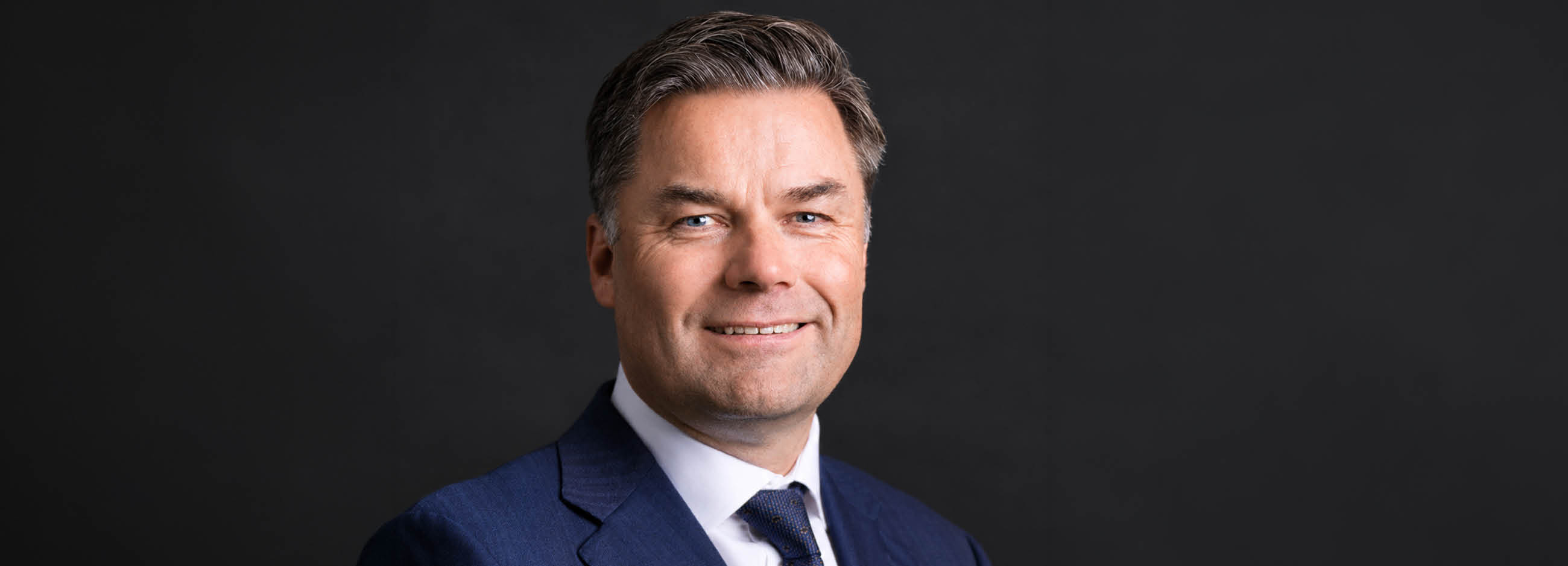
Kristian Johansen is celebrating 10 years as CEO of TGS. He tells First Break why he loves the roller-coaster ride of a fast-changing sector and what innovations we can expect to see in the seismic industry.
Tell us about your background?
Until the age of 20, I lived in my hometown of Narvik in the far north of Norway and north of the Arctic Circle. I attended university in New Mexico on a skiing scholarship.
My background is in finance, though I had my first job with ExxonMobil. I finished my MBA in the late 1990s and spent the first decade of my professional life as an investment banker and in CFO positions for two public companies in Norway. Then, in 2010, I was appointed CFO of TGS, COO in 2015, and CEO in 2016. I’ve been based in the US since 2015.
What do you enjoy about your job?
Working with seismic and energy data, as we call it, is extremely interesting. But, because of its cyclical nature, it can also be very challenging. There can be great pressure on making the right strategic choices, and I like working in an environment where things can change quickly. It fits my personality as I have a lot of urgency in the way I work. I love working in challenging, fast-paced environments, and I think you get exposed to all of that within this industry. In fact, you get exposed to many strategic challenges. Through all the up cycles and down cycles I’ve experienced over my 16 years at TGS, there have certainly been stressful moments, but it has also been an incredibly exciting journey. There can also be challenging situations, but I enjoy the responsibility and pressure that come with making the right decisions. Because it’s a global industry, it’s also rewarding to work with colleagues from so many different cultures and backgrounds.
What are the main challenges?
The main challenge is the cyclical nature of the industry. We are sorting problems that typically yield returns 5-15 years in the future. If you start exploring today, you’re not going to be in production until year 5 to 10. However, our shareholders and clients’ shareholders look at it quarter-by-quarter. Managing short-term pressure with long-term needs is always a challenge.
“Managing short-term pressure with long-term needs is always a challenge.”
What are TGS’ strengths as a company?
We are uniquely positioned, having assets and technology across the value chain in the acquisition of data, both OBN and streamer, multi-client, where we are the clear market leader, as well as processing and interpretation of data. We also have a very strong balance sheet, which enables us to invest counter-cyclically when no one else does. At all levels, we have a dynamic, engaged team.
What is your vision for a sustainable business model for seismic/geoscience over the next few years. What needs to happen?
We will gradually see a pick-up in global exploration activity. Clients underinvested for too long, particularly post-COVID, and we are now expecting a gradual return to global exploration of oil and gas, which is likely to benefit our business going forward. There is increased pressure now on growing exploration budgets. The perception of peak oil has been extended by two decades to at least 2050. If you go back three or four years, people thought we would see peak demand for oil and gas in 2030.
Energy security is back on the agenda because of the war in the Middle East. Countries, governments, and E&P companies are putting energy security at the top of the agenda, and they need more diversified sources of supply. The third point is that the reserve life of our largest clients has been reduced quite dramatically over the past five years. They produce more than they find. They need to find more and need to explore more. Even Wall Street has started to give credit to companies that are really reinvesting in their business. They seem to be the favourite stocks at the moment rather than companies that use their entire cash balance to pay dividends or buy back shares.
How successful do you rate the acquisition of PGS in 2024?
It was our strategy to be a more diversified player with a fully integrated business model, but for the first 12 to 18 months after buying PGS, we faced market headwinds. Recently, we’ve seen things are moving in the right direction. I would say it was the right move at the time. I would have done it again for sure. And I think even the stock market has now realised that was the right move by TGS. The fact that we are now a fully integrated player means that we are far more diversified and therefore better prepared for a pickup in the market. Also, as a result of that acquisition and other acquisitions we have made, we now have an industry-leading technology suite.
We are not planning to bring any other vessels out of storage. I think the number of vessels in the world has shrunk from about 65 in 2013 to about 14/15 right now. At maximum capacity, we will operate seven vessels, and at minimum, six, giving us the flexibility to adapt our deployment strategy based on market conditions and commercial opportunities.
How is the New Energy part of the business going to develop in the next few years?
I’m very optimistic about the growth outlook for solar and wind. CCS will also be a part of our offering in the future. We need all resources. TGS believes it should play in all markets. There will still be growth in O&G for many decades to come, which remains the majority of our business and the core business for TGS.
How is AI already transforming the industry and how is it going to transform the industry?
With AI, we can improve efficiency substantially, from imaging and interpretation to corporate functions such as HR, marketing, and business processes. Over time, we also see AI creating opportunities for new services, capabilities, and revenue streams. AI also has the potential to accelerate interpretation workflows and reveal greater value from large-scale datasets. As a company with the industry’s largest subsurface data library, we believe we are well-positioned to support new applications, services, and business opportunities enabled by AI.
What other innovations do you expect to see going forward?
There are continuing technology advancements on the acquisition side, including the integration of streamer and OBN data to deliver greater subsurface insight. We continue to improve efficiency through evolving source technologies and acquisition approaches, while vessel operations are becoming increasingly optimised through greater remote capabilities and digitalisation.
“We have all the pieces needed to be successful in the next up cycle.”
Can we expect TGS to make acquisitions in the future and if so in what areas?
I wouldn’t rule it out. If it were to happen, it would mainly involve adding technologies we don’t have today. Overall, though, we are happy with our position in the market, given our full integration. A lot has already been done, and we have all the pieces needed to be successful in the next up cycle.
Can you tell us how important the EAGE Annual is and how it supports the work that TGS does?
It’s very important to TGS as a meeting place to discuss technology and R&D, and a great way for our technical people to stay on top of what’s going on in the industry. We have a lot of papers being presented there. It’s also a very important avenue to discuss commercial deals and arrangements.
Can you tell what TGS is going to do going forward to improve the share price?
The only way is to improve underlying earnings and growth prospects, in combination with continued improvement in the markets we operate in, while capitalizing on the investments we made during the down cycle.
Across the industry there is a lot of discussion about where tech investment is actually delivering measurable impact. Where is TGS choosing to invest and how are those decisions translating into real results for your customers?
We are investing in new source technologies, including Gemini, and improved streamer technologies, plus applying technology to reduce the cost of OBN operations. We are already seeing great benefits in this regard. On the processing side, we’ve seen significant advancements in technologies such as Elastic FWI. A couple of years ago, we were talking about it, and now the whole industry is doing it. Overall, you will see far better imaging than five years ago. Data costs have remained stable due to efficiency gains across both processing and acquisition, while cloud technology has enabled us to process data significantly faster.
We are seeing increased complexity across basins. How is acquisition technology evolving to address that and can you give examples of different basins where you see improvements in efficiency in data quality?
The Gulf of America has always been a showcase for new acquisition technology, and we actually had a breakthrough in one recent survey where we applied OBN technology without having underlying data. Until recently, we deployed what we call sparse nodes on top of existing datasets and then stitched the data together. With a new survey, however, we achieved a breakthrough that eliminated the need for underlying legacy data, driven by technology developments completed in-house over the past 12 months.
We see significant opportunities to make OBN acquisition more efficient and cost-effective in the years ahead, expanding its role beyond traditional 4D seismic applications into exploration programs across complex basins such as Brazil, Angola, Nigeria etc.
That said, there are practical limits to how cost-efficient OBN can become, as it remains a more complex acquisition method compared to streamer seismic, where vessels can tow up to 16-18 streamers, each 10 kilometers long, covering large areas efficiently at speed. Even so, we continue to invest in new technologies aimed at making OBN substantially more cost-effective in the future.
What do you like to do away from work?
Unfortunately, I spend way too much time working and traveling, but I like to spend time with my family, play golf and ski.

