
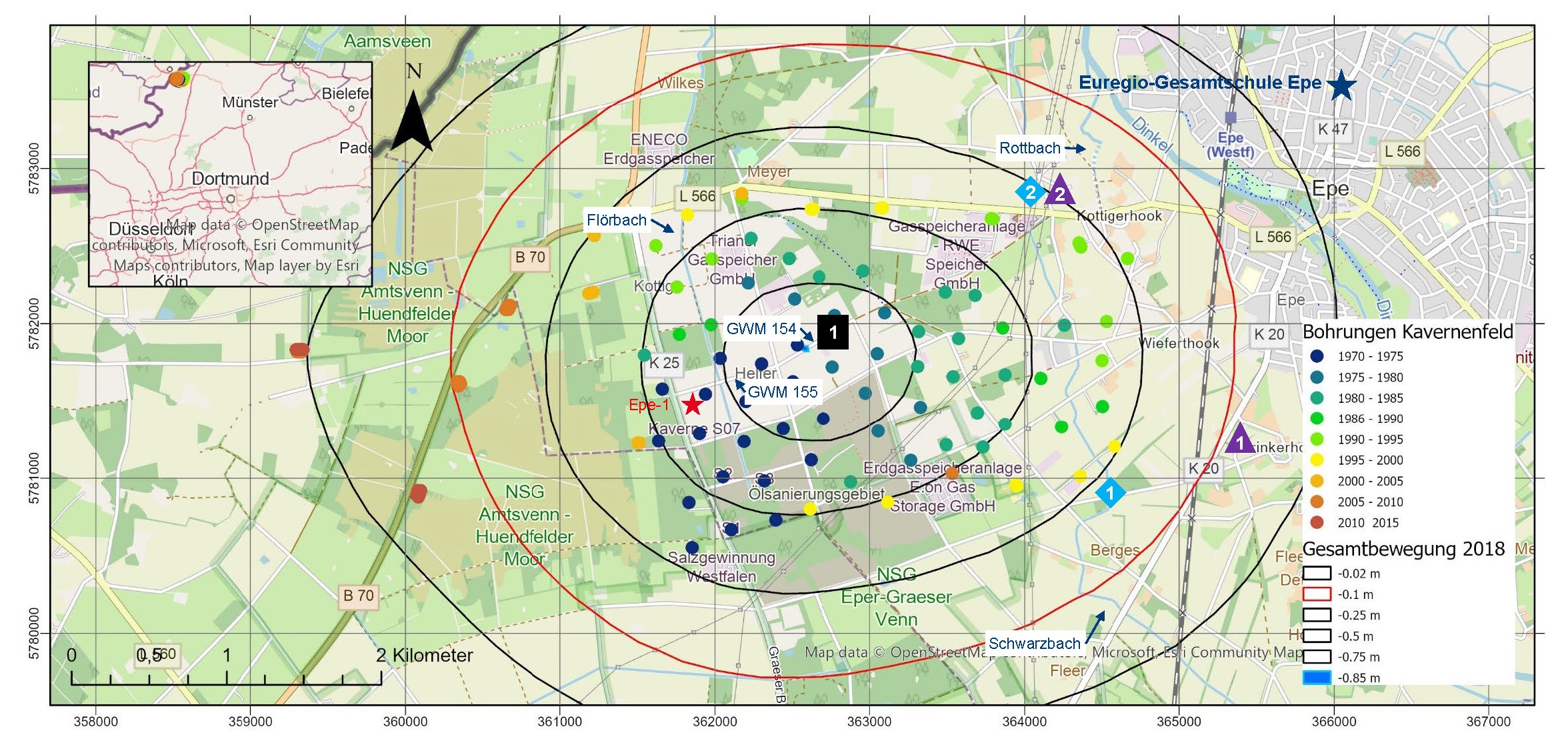
Building trust in subsurface projects remains one of the most persistent challenges facing the mining, energy and geoscience sectors. While technical excellence and regulatory compliance are essential, public acceptance increasingly depends on transparent communication, stakeholder involvement and access to understandable information about what happens beneath the surface. A project in western Germany is demonstrating how schools can play a role in bridging that gap.
Researchers from the Technische Hochschule Georg Agricola (THGA) and educators from the Euregio Comprehensive School in Epe have developed an innovative citizen-science initiative that places secondary-school students at the centre of environmental monitoring and subsurface communication activities associated with the Gronau-Epe cavern field, Europe's largest underground gas storage complex.
Bringing the subsurface into the classroom
The Gronau-Epe cavern field has a long history of underground storage, including brine, crude oil, natural gas and helium. Looking ahead, hydrogen storage is expected to become an increasingly important component of the site's future use. As energy systems evolve, so too does public interest in understanding the environmental and geological implications of subsurface operations.
To help address this challenge, a dedicated school project course was established during the 2024/2025 academic year. Twenty-four students participated in a programme combining geoscience, environmental monitoring, science communication and digital technologies. Rather than learning about subsurface processes solely through textbooks, students became active contributors to scientific investigations.
The project was organised into four research groups:
- Hydrological and environmental field investigations;
- Development of a physical 3D geological model of the cavern field;
- Social media and science communication activities;
- Organisation of a public information event for local stakeholders.
Monitoring the local environment
One of the most significant aspects of the project involved field-based environmental monitoring. Students conducted runoff measurements in local streams, documented environmental conditions and collected soil samples. The investigations aimed to understand hydrological behaviour in areas influenced by underground storage operations and subsidence.
The results indicated that local watercourses exhibited normal precipitation-driven discharge behaviour, with no evidence of abnormal flow patterns attributable to mining activities. While relatively simple in methodology, the measurements generated scientifically useful environmental data and provided students with practical experience in data collection, interpretation and quality assessment.
"We are the future. This means that we will have to live with both the advantages and disadvantages."
Visualising the underground
One of the most visible outcomes of the project was the development of a true-to-scale physical 3D model of the subsurface cavern field using open geodata. The model provided a tangible representation of geological structures that are normally inaccessible to the public and often difficult for non-specialists to visualise.
According to the authors, the model created a bridge between expert geological knowledge and community understanding. It allowed students, local residents and other stakeholders to better appreciate how the cavern field is organised underground and how geological formations are utilised for resource storage. Such visualisation tools are increasingly recognised as valuable communication instruments for complex subsurface projects, whether related to mining, gas storage, geothermal energy or carbon storage.
Science communication as participation
A notable feature of the programme was the emphasis on communication rather than purely technical research. Students documented activities through social media channels and ultimately organised a public information event that brought together local residents, municipal representatives, scientists and industry stakeholders.
The event included opportunities for direct engagement between the public and project participants. The authors argue that such formats enable low-threshold knowledge transfer, making scientific information more accessible while encouraging dialogue around environmental and resource-development issues. By presenting their own findings, students became ambassadors for science within their communities.
What the students learned
Beyond the scientific outcomes, the project also provided insight into how young people perceive subsurface activities and their role in future resource-development discussions. A follow-up survey among participating students revealed that many had gained a completely new understanding of the region beneath their feet.
Several students reported that they had learned for the first time about the existence and significance of the cavern field beneath Epe, the role of underground storage, and the geological processes associated with subsidence. Others highlighted that the project exposed them to the perspectives of different stakeholder groups, including local residents, farmers and industry operators. One student noted that the project helped them understand both the advantages and disadvantages associated with the economic importance of the cavern field to the region.
While only a minority indicated a direct interest in pursuing environmental monitoring as a future career, many described the project as interesting and educational. Some students said the experience had broadened their understanding of environmental processes and the influence of human activities on soil stability and the local landscape. Others suggested that they could imagine working in related fields in the future.
Perhaps most significantly, several participants recognised that younger generations have a legitimate stake in discussions surrounding subsurface resources and environmental management. One student observed that "we are the future" and that their generation will ultimately have to live with both the benefits and consequences of today's decisions. Others emphasised the importance of continuing discussions on geological issues and acknowledged that the effects of subsurface activities may be felt most strongly by future generations.
These responses suggest that school-based citizen-science initiatives can achieve more than simply communicating scientific knowledge. They can foster a sense of ownership, responsibility and engagement among future stakeholders who will inherit the outcomes of today's energy, mining and environmental decisions.
Lessons for the geoscience community
The project highlights a broader challenge facing many subsurface industries: public understanding of geology and georesources often remains limited, despite growing societal dependence on technologies such as underground hydrogen storage, geothermal energy, carbon capture and storage, and critical-mineral extraction.
Public understanding of geology and georesources often remains limited
By combining environmental monitoring, geological visualisation and science communication, the Gronau-Epe initiative demonstrates how citizen-science approaches can contribute both to data collection and to stakeholder engagement. While the scale of the project is educational, the underlying principles are relevant to much larger industrial developments.
For geoscientists, the initiative offers an interesting example of how participation processes can evolve beyond traditional public consultations. Instead of simply informing communities about subsurface activities, projects can actively involve citizens in data gathering, interpretation and communication.
As the energy transition increasingly depends on technologies that utilise the subsurface—from underground gas and hydrogen storage to geothermal energy and CO₂ sequestration—the need for scientifically informed public dialogue is likely to become even more important. The experience from Epe suggests that schools may have a valuable role to play in that conversation, helping to create not only a better-informed public but also a new generation of citizens capable of engaging constructively with the opportunities and challenges of the subsurface.
Source: Tobias Rudolph, Raphael Untied and Daniel Terbeck, Modern Participation Processes in Mining Through School Science Projects, EEK – Technology & Transformation of Fossil and Green Energies, February 2026.

