
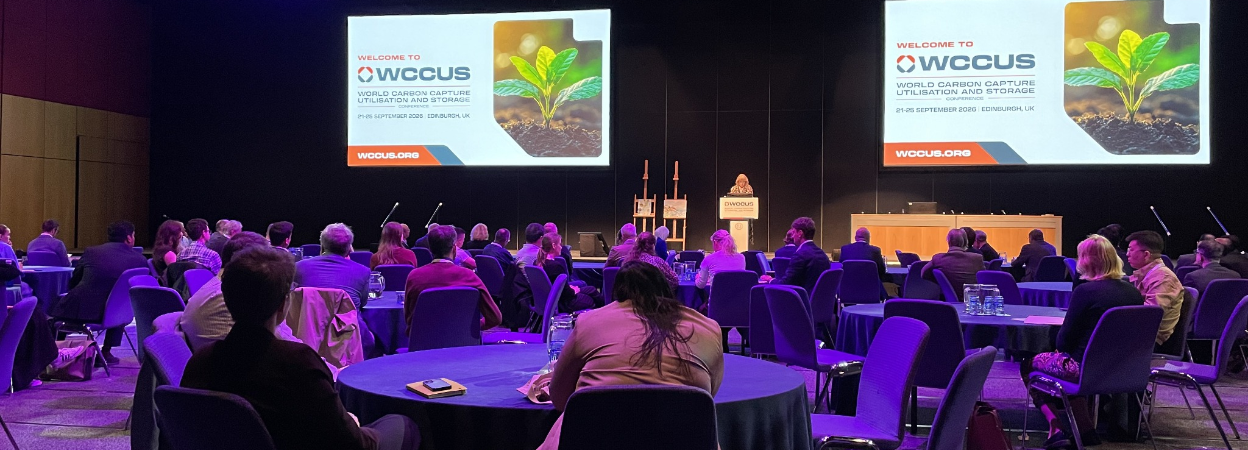
More than 300 delegates from across the globe gathered in Edinburgh from 21-25 September for the 2026 World CCUS Conference (WCCUS), bringing together experts, industry leaders, researchers and policymakers for five days of knowledge sharing, technical exchange and collaboration across the CCUS value chain.
From capture technologies and CO2 storage to transport and infrastructure, policy, regulation and public engagement, the conference explored the opportunities and challenges shaping the next phase of CCUS deployment.
We were honoured to welcome the Depute Lord Provost, Lezley Marion Cameron, who delivered the opening address on behalf of the city, sharing Edinburgh’s efforts to reduce carbon emissions and address wider environmental challenges. A fantastic link to the conversations driving our conference and the future of carbon management!

Across the Strategic Programme, discussions focused on three key questions: how to build public confidence in CCUS, how to overcome technical and operational barriers, and how to make projects bankable and investable.
Building public trust and social licence emerged as an important part of successful project development. Olivia Powis (Carbon Capture and Storage Association), Raffaella Ocone (Heriot-Watt University), Nihal Darraj (Imperial College London), Hannah Galbraith-Olive (Global CCS Institute), Eva Halland (CarbonGeo) and Gregory Symons (Scottish Government) explored how transparent, credible and meaningful engagement with communities can help build understanding and trust from the outset.
At the same time, Chris Page (Viridien), Philip Ringrose (NTNU), Stuart Haszeldine (University of Edinburgh), Catherine Witt (Storegga), Tao Yang (China-Europe Institute for Energy Transition) and Saravanan Janakiram (Aqualung Carbon Capture) highlighted the need for continued innovation across the CCUS value chain. Shared confidence metrics, open benchmarks and evidence of what works will be essential to overcome technical challenges and enable solutions to scale globally.
Investment was another major theme, with Sally Benson (Stanford University), Paul Fennell (Imperial College London), Håvard Halland (Heriot-Watt University), Kristian Brandsegg (TGS), Andrew Cavanagh (SCCS, Edinburgh Climate Change Institute) and Nick Richardson (UK North Sea Transition Authority) examining the conditions needed to turn CCUS projects into viable investments. With significant private capital required to deliver projects, effective policy, funding and investment frameworks will be critical to managing cost and risk and moving projects forward.
The Technical Programme reflected the breadth of the sector, covering advances in CO2 capture, carbon removal, transport, infrastructure and storage. Emerging technologies are opening new opportunities across hard-to-abate sectors, while progress in CO2 transport, stream management and system integration is helping connect the different parts of the value chain. Advances in storage capacity assessment, plume behaviour, geochemistry and monitoring are strengthening confidence in safe and secure CO2 storage. Policy, regulation, governance and public perception also remained central to the conversation, alongside emerging opportunities for AI and the wider socioeconomic benefits of CCUS.
The conference proceedings are available with open access on EAGE's EarthDoc.
A selection of outstanding presentations and abstracts was recognised:
BEST ABSTRACTS
- Grazia De Angelis (University of Bologna, INSTM, University of Edinburgh) for the paper “Pumping CO2 from Air: Feasibility of Moisture-Driven Membrane Direct Air Capture (MD-DAC)“
- Stuart Haszeldine & Andrew Cavanagh (University of Edinburgh) for the paper “The Storage Bottleneck, CCS Limits are Redefining Global Net Zero Timelines Beyond 2070”
- Ingvild Ombudstvedt (IOM Law) for the paper “The Impact of Classifying CO2”
BEST ORAL PRESENTATION
- Jacob Ladenburg (Technical University of Denmark) for the paper “Economic and Social Trade-offs in CO₂ Storage Location Choices: Estimating Willingness-to-Pay for Offshore, Nearshore, and Onshore CCS”
BEST POSTER
- Ting Hu (China University of Petroleum, Beijing) for the paper “The Intrinsic Nature of Rapid Mineralization of CO2 in Peridotites—Data Reproduction from a pilot test site”
BEST STUDENT ORAL PRESENTATION
Chioma Emehel (Heriot-Watt University) for the paper “Tailoring sodium accessibility in RuCu-Na2ZrO3 catalyst for tuneable CO2 hydrogenation pathways”
BEST STUDENT POSTER
Maryam Nasiri Ghiri (University of Lancashire) for the paper “Mathematical Formulation of Sigmoidal Water Adsorption: Klotz vs Weighted Dual-Site Langmuir in mmen-Mg2(dobpdc)”
Reflecting on the week, Raffaella Ocone, Chair of WCCUS 2026, said: “The aim of the conference to bring together researchers, engineers, practitioners, and stakeholders working across carbon capture, utilisation, and storage was truly achieved. It was inspiring to see such a diverse community come together, exchange ideas, and discuss the challenges and opportunities ahead. There were many takeaways from the conference, but one message stood out to me: we need transdisciplinary approaches and multidisciplinary input.”
we need transdisciplinary approaches and multidisciplinary input.”
Beyond the main programme, Workshops, Short Courses and Field Trips gave delegates opportunities to explore specialised topics and gain practical insights. Workshops covered areas including CCS site monitoring, CO2 storage in mafic and ultramafic rocks, subsurface engineering, risk management and storage characterisation. Short Courses offered deeper learning on CO2 storage project design and optimisation in saline aquifers, as well as rock physics, seismic interpretation, risk assessment and optimisation. Field Trips added both technical and historical perspectives, including a visit to the National Engineering Laboratory focused on CO2 flow measurement and testing, and a guided walking tour exploring Professor Joseph Black’s pioneering work on CO2.
The programme also created plenty of opportunities to connect outside the conference sessions. The Networking Reception brought attendees together in a relaxed setting, while the Conference Evening at The Caves combined dinner, lively conversation and Edinburgh’s distinctive historic atmosphere.
RECOGNISING EXCELLENCE
Alongside its mission of knowledge exchange, WCCUS was proud to introduce the WCCUS Awards, recognising outstanding innovation and leadership helping to accelerate CCUS deployment worldwide. Congratulations to the 2026 recipients:
WCCUS Breakthrough Technology Awards:
NEG8 Carbon Technical Team
for their pioneering Electrostatic Direct Air Capture technology, combining low-temperature regeneration, waste heat utilisation and a TRL 6 prototype to advance scalable, cost-effective carbon removal.
WCCUS Rising Leader Awards:
Saravanan Janakiram
for outstanding leadership in advancing membrane-based CO2 capture from research to industrial deployment, with TRL 7 pilots, patented innovations and expertise spanning materials, manufacturing and process integration.
and Nihal Mounir Darraj
for exceptional contributions to CO2 storage, bridging pioneering research with practical deployment and connecting science, industry and policy to support international project development and capacity building.
Together, the formal and social programmes at WCCUS 2026 demonstrated the value of bringing different perspectives to the carbon management conversations, with progress depending not only on technological innovation, but also on expertise spanning industry, government, academia and communities.
As we concluded the successful WCCUS 2026 in Edinburgh, we’d like to extend our huge thanks once again to everyone who helped make it such an engaging and memorable week for the global CCUS community. To our delegates, speakers, session chairs, committees, reviewers and volunteers: thank you for bringing your energy, expertise and enthusiasm.
A special thanks to A special thanks to our sponsors Viridien, SpotLight Earth, Core Laboratories, CO2GeoNet, our supporting academies Royal Academy of Engineering, Norwegian Academy of Technological Sciences, Danish Academy of Technical Sciences, Royal Society of Edinburgh, as well as all endorsing organisations and media partners.
The WCCUS community will meet again in Kuala Lumpur, Malaysia, in Spring 2028. With Southeast Asia playing an increasingly important role in the development of CCUS, Kuala Lumpur will provide an ideal base to connect regional activity with the global CCUS community and explore the opportunities ahead.
Stay connected and follow the latest updates from the conference on the WCCUS website and LinkedIn.

