
From lunar seismic surveys to the search for in situ resources, geoscience is playing an increasingly important role in the next era of space exploration. A dedicated session at the 2026 EAGE Annual Conference in Aberdeen in June 2026 shone a spotlight on this growing momentum, bringing together speakers from public institutions, industry and innovative start-ups. Together, they took participants on a journey beyond the traditional boundaries of geoscience, showcasing how expertise developed on Earth is helping to shape the future of exploration on the Moon and beyond. Bruno Pagliccia reports.
Bruno Pagliccia (TotalEnergies) first reviewed the geophysical activities carried out on Mars and the Moon to date. These have consisted primarily of seismological experiments, although a few attempts at near-surface imaging were made during the American Apollo and China’s Chang’e missions.
In recent years, however, several countries, including the United States, China and Luxembourg, have shown strong interest in the exploration of lunar resources. Abigail Diaz, from ESRIC (European Space Resources Innovation Centre), gave an extensive presentation on the ecosystem established by Luxembourg to stimulate the emergence of a new lunar economy and support a sustainable return of humankind to the Moon. She also emphasised the need to acquire subsurface data, which are currently almost non-existent but crucial to the development of permanent facilities on the lunar surface.
Pagliccia then turned to future lunar missions, notably pointing out that no legal framework is currently in place to regulate these activities. Although a first step has been taken with the Artemis Accords, signed by more than 50 countries and setting out several principles for responsible conduct, there is still a long way to go to avoid a somewhat uncontrolled race to the Moon.
Turning to lunar exploration technologies, Simone Probst (ETH Zurich) presented what an ideal fibre-optic cable for distributed acoustic sensing (DAS) would look like when deployed on the lunar regolith to provide permanent monitoring of seismic activity.
Seismology was also represented by Mark Beker (Innoseis Sensor Technologies), who presented a seismic sensor scheduled to travel to the Moon in late 2026. For two weeks, it will record seismic activity on the far side of the Moon—the first experiment to do so. This represents both a scientific and a technological milestone, involving a three-component MEMS sensor based on technology that is also deployed in industry.
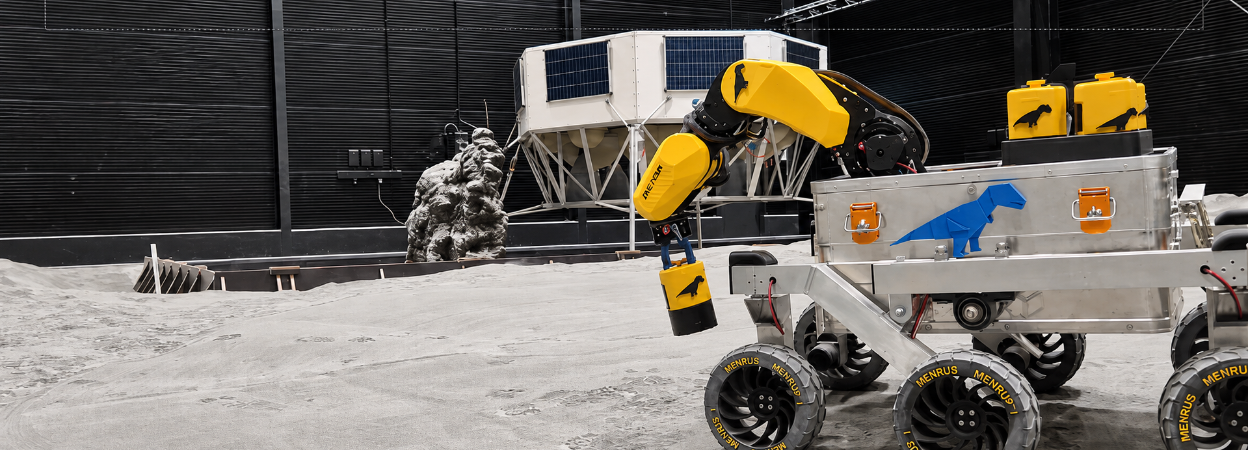
Olav Cornelius, from the start-up Imensus GmbH, then presented the concept of an autonomous rover-based seismic acquisition system designed both to deploy sensors and operate the seismic source. The overall objective is to enable seismic surveys to be carried out on the lunar surface for subsurface investigation and mapping.
Finally, in the last part of this dedicated session, Pagliccia presented what a possible first seismic mission could look like. After establishing a mass budget for the equipment required for a small-scale 3D survey and applying a realistic assumption for the cost per kilogram of transporting payloads to the lunar surface, it was possible to estimate the budget required for such a mission.
Unsurprisingly, the figure is somewhat daunting. However, by adopting a multi-client approach—widely used in petroleum exploration on Earth—and building on the strong interest that such a mission would likely generate, it becomes possible to envisage a promising business model. Indeed, producing images of the Moon’s subsurface using today’s technologies could represent the first sustainable commercial activity to arise from this renewed interest in our satellite.
Don’t believe me? Below, you will find an image of the seismic sensor scheduled to fly on a SpaceX rocket at the end of the year, as well as a photograph illustrating the test campaign currently being carried out by Imensus to develop a future lunar seismic rover.
Above all, stay tuned: EAGE 2027 in Amsterdam has more surprises in store for us…

