
As the energy industry intensifies efforts to reduce carbon emissions, Carbon Capture, Utilisation and Storage (CCUS) is becoming increasingly important in supporting climate targets and the transition to a lower-carbon future. Moving from technological development to large-scale implementation, however, requires integrated solutions that address technical, commercial, regulatory and environmental challenges across the entire value chain.
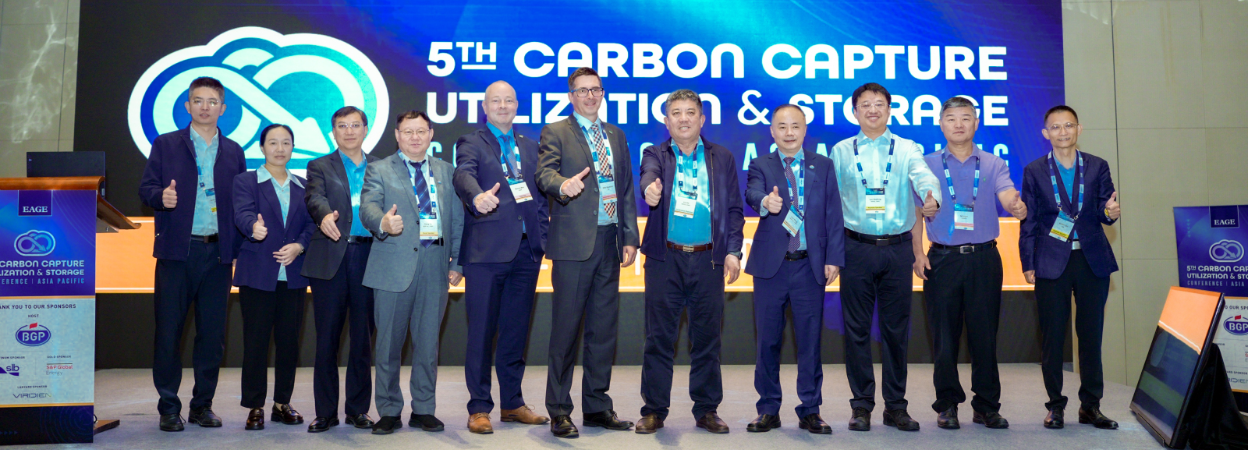
The 5th Carbon Capture, Utilization & Storage (CCUS) Conference Asia Pacific, held in Qingdao, China, provided a platform for industry leaders, researchers, policymakers and technical specialists to examine these challenges and explore opportunities to advance CCUS across the region. Organised by EAGE and hosted by BGP, the conference welcomed nearly 200 delegates representing 42 organisations across 17 countries. The strong international participation reflected growing interest in CCUS and underscored the importance of knowledge exchange and cross-sector collaboration in advancing carbon management solutions.
The opening remarks by Conference Co-Chair Dr. Cao Hong, President of BGP, the executive keynote address by Conference Chairman Prof. Liu He, and the welcome remarks by EAGE President Dr. Mike Branston established the strategic context for discussions on the development and deployment of CCUS.

A central feature was the Strategic Programme, which combined keynote presentations from industry and technical leaders with a panel discussion on the practical considerations involved in developing and implementing CCUS projects. Contributions from BGP, SLB, CNPC and CNOOC highlighted the importance of subsurface understanding, technological innovation, geomechanics and offshore applications in supporting the development of integrated carbon management solutions.
The CCUS Projects panel, featuring representatives from BGP, TNO, Shell and PTTEP, further explored the realities of project execution. Discussions covered technology selection, regulatory requirements, cost management and stakeholder engagement, drawing attention to the interconnected challenges that influence project feasibility and long-term success.
A key takeaway from these discussions was that the success of CCUS extends beyond demonstrating the effectiveness of individual technologies. Achieving successful deployment requires an integrated approach that balances technical performance, commercial viability, regulatory compliance and stakeholder engagement throughout the project lifecycle. This means addressing the entire value chain, from CO₂ capture and transportation to injection, storage, monitoring and long-term stewardship.
China's CCUS sector is entering an important phase of development, with carbon management expected to feature increasingly prominently in the country's 15th Five-Year Plan. This evolving landscape presents opportunities to expand the domestic CCUS ecosystem, bringing together national oil companies (NOCs), oilfield service providers, research institutions and specialist technology companies.
The conference provided an important forum for these stakeholders to exchange expertise and discuss the technical and commercial considerations associated with project development. It also highlighted the potential to strengthen connections between China's growing CCUS capabilities and the wider Asia Pacific region. Greater exposure to developments, partnerships and emerging opportunities across Asia Pacific and beyond could help broaden perspectives, encourage knowledge transfer and support the development of new collaborative initiatives.
International engagement is particularly relevant as Chinese companies explore opportunities beyond their domestic market. Sinopec, for example, has expressed interest to expand the international reach of its CCUS activities, including through cross-border collaboration in Kazakhstan. Such initiatives illustrate how Chinese technical expertise could contribute to international carbon management projects while creating opportunities for further technical and commercial cooperation.
Beyond the individual presentations and panel discussions, the conference reflected a broader shift in the CCUS sector: the emphasis is moving from proving individual technologies to delivering integrated projects that can be implemented safely, efficiently and commercially at scale.
The diversity of participants at the conference reinforced the multidisciplinary nature of this challenge. Geologists, geophysicists, reservoir engineers, petrophysicists, project managers, researchers and other industry professionals brought complementary perspectives to the discussions. Their participation, alongside organisations spanning different parts of the energy value chain, highlighted the value of closer cooperation among operators, technology providers, research institutions and other stakeholders.
Regional collaboration will be particularly important given the diversity of geological conditions, CO₂ sources, regulatory frameworks and levels of CCUS maturity across Asia Pacific. Approaches that are suitable for one country or basin may not be directly applicable elsewhere. Sharing project experience, technical knowledge and lessons learned can help accelerate progress, avoid duplication of effort and strengthen regional capabilities.
Establishing these connections will also be important as CCUS projects become more complex and capital-intensive. Continued engagement among industry, academia, governments, technology providers and the financial community can help address common challenges, improve project confidence and create the conditions needed for commercially viable deployment.
The 5th CCUS Conference Asia Pacific in Qingdao underscored the growing importance of moving beyond technological feasibility towards the integrated and responsible deployment of carbon management solutions. It reinforced that CCUS is not simply a carbon storage or engineering challenge, but a complex undertaking spanning geoscience, infrastructure, environmental management, regulation and commercial development.
For China, the expanding CCUS landscape offers opportunities to strengthen domestic capabilities while building closer relationships with regional and international initiatives. For the wider Asia Pacific region, greater cooperation can support the exchange of technical expertise, encourage the development of cross-border partnerships and help address shared challenges in scaling up CCUS.
Ultimately, the conference demonstrated that the future of CCUS in Asia Pacific will depend not only on technological progress, but also on the industry's ability to translate expertise into integrated, scalable and commercially viable projects. Sustained regional engagement and international collaboration will be essential to building a more connected CCUS community and accelerating the deployment of effective carbon management solutions.
Interested in the material presented at this event? Access it now at Earthdoc (exclusively for EAGE members).

