
TGS has signed an agreement with Ghana’s Petroleum Commission to develop a new offshore 2D-cubed seismic project covering the Keta Basin.
Phase one of the Gulf of Guinea project will integrate approximately 5500 km² of existing 3D seismic data with more than 14,700 line-km of 2D data from multiple surveys. These inputs will be used to generate a structural conformable 3D volume spanning 25,300 km² across the shelf and deepwater parts of the basin.
TGS’ 2D-cubed technology combines multi-vintage 2D and 3D seismic datasets within an interpolation workflow designed to fill gaps between seismic lines and suppress artefacts associated with legacy migration.
The resulting continuous volume is intended to provide a consistent regional subsurface framework for exploration screening and prospect evaluation.
The project will allow companies assessing the Keta Basin to work from a unified dataset instead of separately interpreting and reconciling multiple legacy surveys. TGS said the volume could support regional geological interpretation, lead identification and prospect maturation ahead of potential licensing and exploration activity.
The Keta Basin forms part of the West African Transform Margin and extends offshore eastern Ghana towards the maritime boundary with Togo. It contains an extensive deepwater fan system but remains comparatively underexplored.
“The Keta Basin holds real untapped potential, and our customers need a clear, reliable view of it to act with confidence,” said David Hajosky, executive vice-president, Multi-Client at TGS.
“By bringing decades of 2D and 3D data together into a single 2D-cubed volume, we are giving explorers a ready-to-use foundation for prospect maturation.”
Delivery of the final products is expected during the first quarter of 2027.
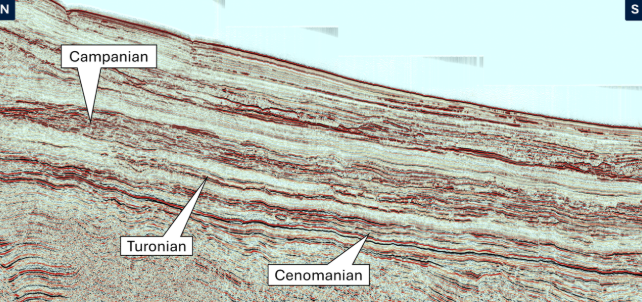
Image: TGS, Stacked fan and channel systems at the Cenomanian, Turonian and Campanian within the Tano Basin, Ghana

