
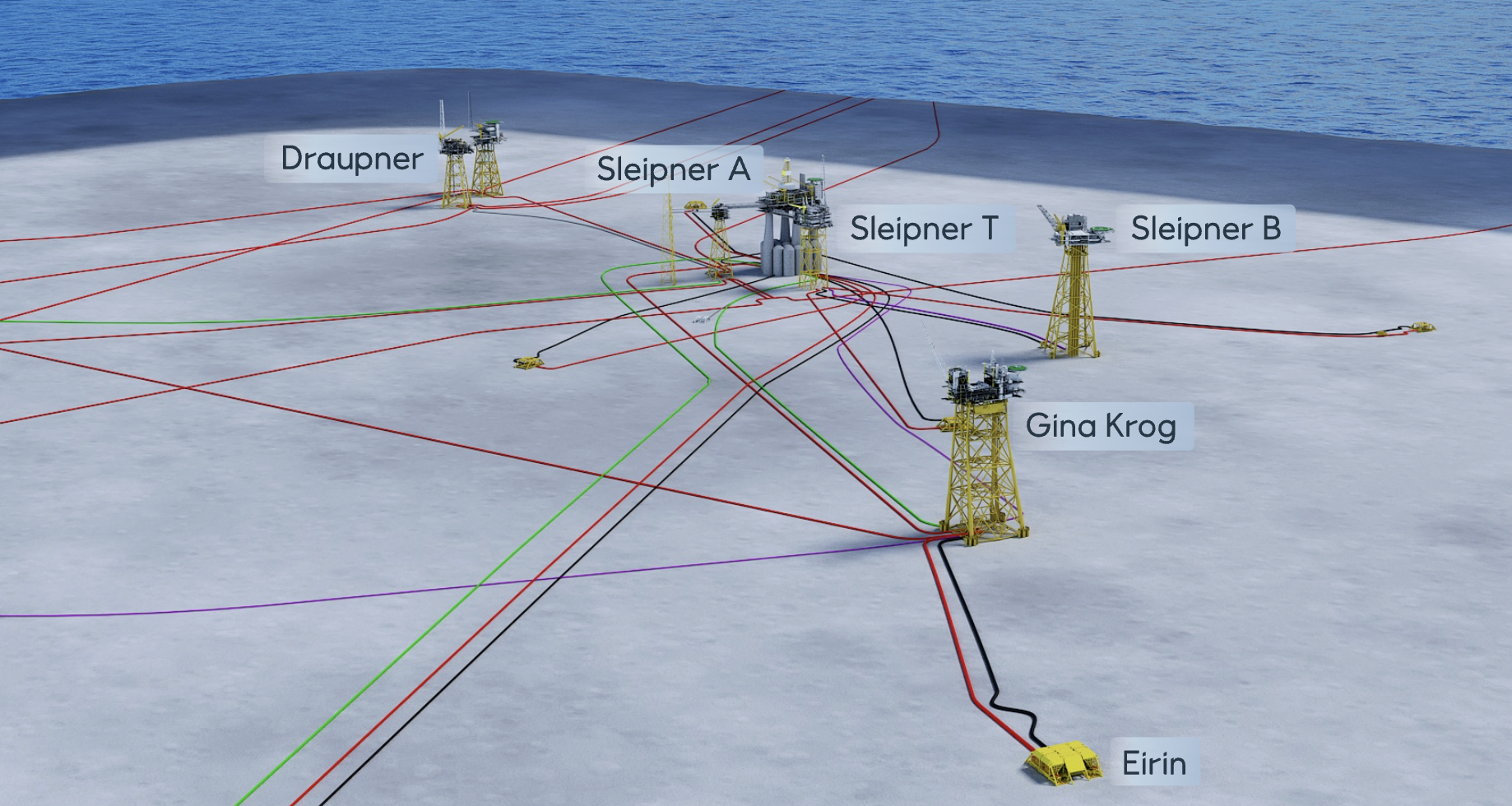
The key message from Equinor’s Eirin case is that the future of the Norwegian Continental Shelf — and likely many mature basins globally — will increasingly depend on fast-track development of smaller discoveries tied back to existing infrastructure rather than giant standalone fields.
(visual/ ©Equinor)
1. “Good enough” subsurface work is becoming strategically important
Equinor explicitly states that Eirin moved forward without building a full reservoir model before investment decisions were made. Instead, teams worked with limited data, one exploration well, and focused on understanding the key uncertainties rather than eliminating all uncertainty.
For geoscientists, this signals a shift:
- faster subsurface screening,
- risk-based interpretation,
- quicker maturation cycles,
- and prioritisation over perfection.
The traditional multi-year appraisal mindset may increasingly be replaced by agile subsurface decision-making for smaller tieback opportunities.
2. Existing infrastructure is now a major exploration driver
A core lesson is that exploration near existing platforms and export systems has become economically critical. Eirin only became viable because it could be tied back to the Gina Krog and Sleipner infrastructure.
This changes exploration strategy:
- proximity to hubs matters more,
- smaller accumulations can become commercial,
- infrastructure-led exploration gains value,
- mature basin “left-behind” discoveries may become attractive again.
For interpreters and basin analysts, infrastructure context is now as important as pure volumetrics.
3. Cross-disciplinary integration is accelerating
Equinor repeatedly emphasises close collaboration between geologists, subsea engineers, flow assurance specialists and operations personnel. Decisions were made in days rather than months.
The implication for geoscientists:
- siloed workflows are becoming less viable,
- operational understanding is increasingly valuable,
- subsurface teams need stronger commercial and engineering awareness,
- communication and rapid decision support are becoming core technical skills.
4. Standardisation may reshape subsurface workflows
Equinor highlights a move away from bespoke solutions toward repeatable and standardised developments.
This could influence geoscience through:
- reusable interpretation templates,
- standardised subsurface screening workflows,
- repeatable tieback evaluation processes,
- AI-assisted ranking of near-field prospects.
The emphasis is increasingly on scalability and speed.
5. Mature basins still contain significant value
Eirin was discovered in 1978 but considered too small to develop at the time. It only became commercial decades later due to changed economics, infrastructure availability and geopolitical energy demand.
This is an important geological and strategic lesson:
- mature basins are not “finished,”
- stranded discoveries may become viable,
- re-evaluation of old data can create new opportunities,
- late-life infrastructure extension is becoming a key value driver.
6. Geoscience is becoming more tied to energy security and emissions performance
The project was partly reframed after Europe’s energy-security concerns increased following Russia’s invasion of Ukraine. Equinor also stresses the low emissions intensity achieved through electrified infrastructure reuse. For geoscientists, this means future developments will increasingly be evaluated not only on:
- resource size, but also on:
- carbon intensity,
- infrastructure reuse,
- development speed,
- and strategic energy-system value.
Bottom line
The Eirin story suggests that the future geoscientist in mature offshore basins will need to operate in a world of:
- smaller discoveries,
- faster timelines,
- infrastructure-led exploration,
- cross-disciplinary collaboration,
- standardised workflows,
- and higher tolerance for uncertainty.
Read the full story on the Equinor website

