
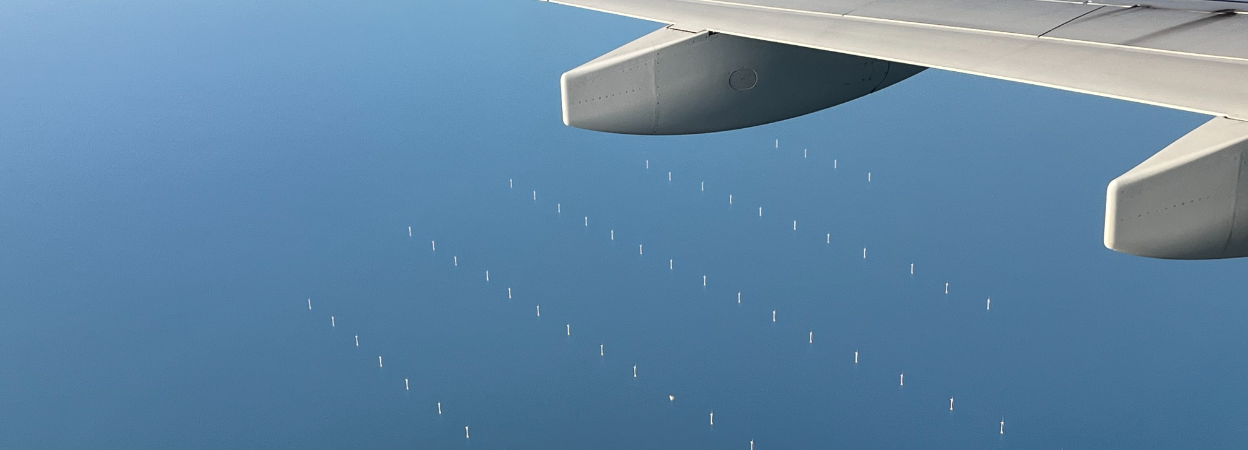
Ørsted and Nuveen Infrastructure have commissioned the 913 MW Borkum Riffgrund 3 wind farm, bringing one of Germany’s largest operational offshore wind projects into commercial service.
Located approximately 72 km off Germany’s North Sea coast, the 75 km² development comprises 83 turbines, each with a capacity of 11 MW. Turbines and foundations were supplied from Germany and Denmark, cables from Germany and France, and installation vessels from the Netherlands and Belgium. Around 100 German companies participated in its construction.
Borkum Riffgrund 3 is Ørsted’s sixth operational offshore wind farm in Germany, following the commissioning of the 253 MW Gode Wind 3 project in early 2025. The new development increases Ørsted’s installed German offshore wind capacity to approximately 2.5 GW, representing around a quarter of the country’s operational capacity.
The project is supported by long-term corporate power purchase agreements covering 786 MW. Amazon has contracted 350 MW, BASF 186 MW, Covestro 100 MW, Energie-Handels-Gesellschaft and REWE Group 100 MW, and Google 50 MW. The agreements run for periods ranging from 10 to 25 years and will supply electricity to data centres, retailers and Germany’s chemical industry.
The commissioning illustrates the scale now being reached by offshore wind in Germany—and the geoscience and engineering work required to deliver projects in increasingly complex marine environments. Offshore developments depend on integrated seabed and near-surface characterisation, geohazard assessment, foundation engineering, cable-route evaluation and long-term monitoring to reduce construction and operational risks.
These challenges will be examined during the EAGE Offshore Wind Energy Conference, part of the GET 2026 Global Energy Transition Conference and Exhibition, taking place in Hannover, Germany, from 2–6 November 2026.
The conference will bring together geophysicists, geologists, hydrographers, geotechnical engineers, environmental specialists, developers, survey contractors and researchers. Its programme explores how geoscience can support offshore wind through improved site characterisation, risk mitigation, monitoring and the application of data science and artificial intelligence.
The arrival of Borkum Riffgrund 3 provides a timely German example of how these disciplines contribute to moving offshore wind projects from initial site assessment through construction to commercial operation.
Learn more about the EAGE Offshore Wind Energy Conference at GET 2026

