
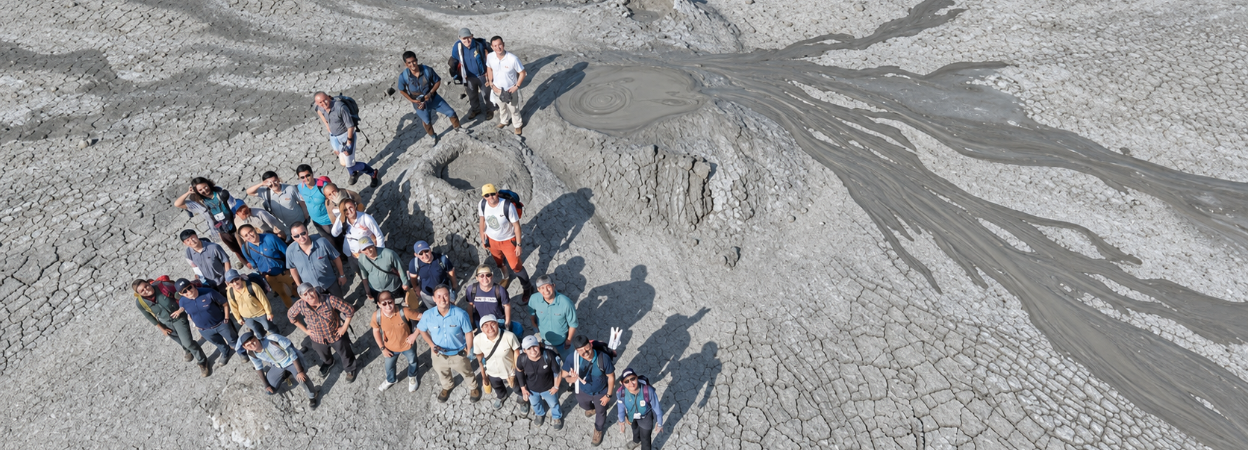
The ‘First EAGE Workshop on Mobile Shales’ was held in Bucharest, Romania, on 7–9 October 2026, with the support of AAPG Europe. Co-Chairs Juan Soto (Granada University, Spain & Bureau of Economic Geology at the University of Texas at Austin) and Alexandra Tamas (Babeș-Bolyai University, Romania) report:
The meeting brought together 31 participants from about 17 countries, representing a broad international community from Europe, the United States, Taiwan, Malaysia, Saudi Arabia, and elsewhere. Attendees ranged from established researchers to a strong group of PhD students and postdoctoral researchers. The workshop brought together participants from a broad range of universities and research institutions, as well as from industry (Aramco, Eni, GeoPark, PETRONAS, Shell, TGS, and TotalEnergies). The workshop concluded with a field excursion to the Eastern Carpathian Bend Zone, including the Pâclele mud volcanoes, led by Dan Mircea Tămaș, Alexandra Tămaș, and Călin Baciu of Babeș-Bolyai University.
This first EAGE workshop specifically devoted to mobile shales came twenty years after the AAPG/ GSTT Hedberg Conference on Mobile Shale Basins held in Trinidad and Tobago in 2006. One of our aims as organizers was to renew discussion around a topic that remains important but is still fragmented across different disciplines and geological settings.
The scientific programme comprised two days of presentations and discussion, with 33 scientific contributions including three keynote lectures. Michael Hudec discussed the origin and geological interpretation of suprasalt mobile shales in the northern Gulf of Mexico using new OBN-FWI seismic data. Christopher Morley presented an outcrop-based perspective on mobile-shale geometries and mechanics, and on how field observations can guide seismic interpretation. Emily Kay of TGS focused on new seismic imaging techniques applied to complex mobile shales, using a case study from offshore Nigeria.
Beyond the keynote lectures, the technical sessions reflected the broad range of settings and processes in which shale mobility occurs. Contributions examined mobile shales in delta systems and fold–thrust belts, their role as detachments and in basin evolution, and their relationships with mud volcanism and fluid migration. Case studies covered a broad geographical range, including Australia, Brazil, Colombia, the Gulf of Mexico, Italy, Malaysia (Sabah and Sarawak), the Niger Delta, Romania, Taiwan, and Trinidad. Other presentations addressed deformation mechanisms and mechanical behaviour, field observations, physical and numerical modelling, and new seismic and geophysical approaches to image and characterise these systems.
These themes were examined from complementary geological, geophysical, experimental, and numerical perspectives. The workshop also addressed the broader implications of mobile-shale systems for surface deformation, seismicity, geohazards, and engineering.
We felt that the workshop was particularly timely. Recent advances in seismic acquisition, processing, and velocity modelling are improving our ability to recognise and constrain low-velocity shale bodies that were previously poorly imaged. Techniques such as full-waveform inversion and increasingly sophisticated depth-imaging workflows are making it possible to image mobile shales more clearly, particularly where their seismic expression was previously masked by poor illumination and limited seismic resolution.
These technological advances allow us to revisit long-standing questions with new data. What processes allow shale to become mobile? What deformation mechanisms enable an initially consolidated, and commonly cemented, shale to develop diapiric geometries similar to salt?
The discussions also highlighted that mobile-shale systems should not be reduced to their most visible surface expression, mud volcanoes. These represent only one manifestation of broader subsurface systems involving complex shale deformation in the presence of fluids and gases. This also prompted discussion on how the concepts of mobile shales and shale tectonics can be more rigorously framed and applied across different geological settings. Several fundamental challenges remain in the subsurface, particularly regarding their physical properties, mechanical behaviour, deformation mechanisms, diagenetic changes, and gas-related processes.
We hope that this workshop has helped to foster new and exciting directions for future research on mobile-shale systems.
Interested in the proceeding of this workshop? Find them here on EarthDoc (exclusively for EAGE members).

