
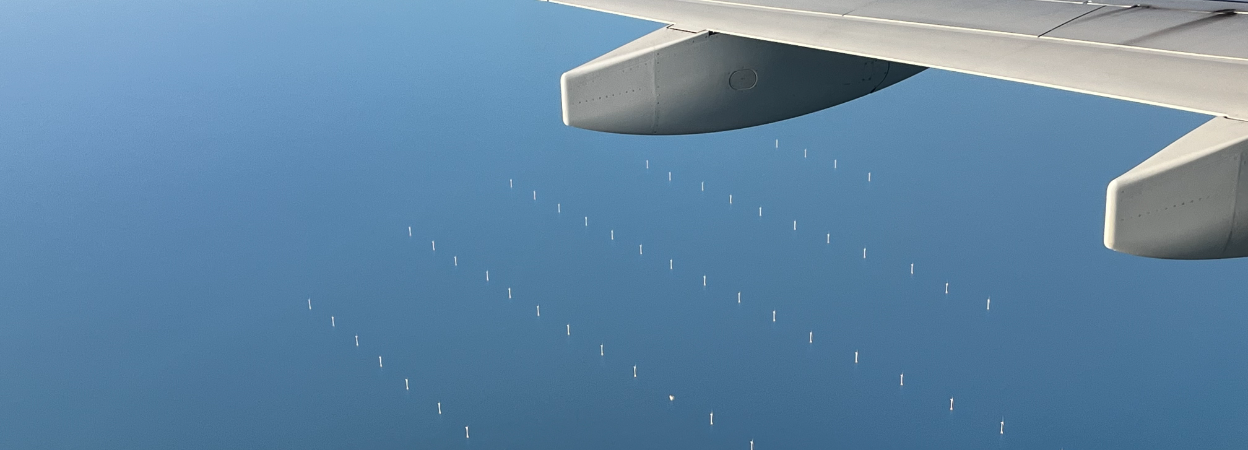
The inauguration of Germany’s largest offshore wind farm comes as more than 12 GW of new capacity is expected to enter operation worldwide in 2026, despite continued weakness in investment decisions for the next generation of projects.
EnBW Energie Baden-Württemberg, Allianz, AIP Management and Norges Bank Investment Management have inaugurated the 960 MW He Dreiht offshore wind farm in the German North Sea. Comprising 64 turbines, He Dreiht is expected to generate enough electricity to meet the annual needs of approximately 1.1 million households. The €2.4 billion project was developed without government subsidies and is financed through long-term power purchase agreements (PPAs). EnBW holds 50.1% of the project, with the remaining 49.9% owned by a consortium comprising Allianz Global Investors on behalf of Allianz companies, AIP Management and Norges Bank Investment Management.
“He Dreiht is EnBW’s largest single investment in the renewables sector,” said Dr Georg Stamatelopoulos, Chairman of the Board of EnBW. “And it’s also a perfect example of how renewable energy can prevail in the market when the framework conditions are right.”
Electricity from the wind farm is covered by long-term PPAs with companies including Evonik, Google, PASM, Fraport, Bosch, Salzgitter, SHS Stahl-Holding Saar, Deutsche Bahn and DHL Group. These contracts provide long-term price and planning certainty while supporting corporate decarbonisation targets. The technology sector is expected to become an increasingly important customer for PPAs as digitalisation and artificial intelligence drive growth in electricity demand.
Strong delivery but weaker investment pipeline
The inauguration illustrates the contrasting outlook described in TGS | 4C’s latest quarterly Global Market Overview.
More than 12 GW of offshore wind capacity is expected to enter operation during 2026, but only 2.1 GW has reached final investment decision (FID) so far this year. TGS | 4C expects the total to reach 5.6 GW by year-end, which would make 2026 the second-lowest year for offshore wind investment decisions since 2020. Final consent awards are progressing more strongly. Approximately 22.2 GW is forecast to receive consent in 2026, making it the second-highest year on record.
The figures indicate that projects already under construction and assets in the development pipeline are continuing to advance, while developers remain cautious about committing capital to new projects.
“2026 is turning into a year of contrasts for offshore wind,” said Ivar Slengesol, Managing Director and VP of TGS | 4C. “While energy security concerns are giving offshore wind a political boost, general market uncertainties are making financing more challenging.”
Global offshore wind capacity currently stands at approximately 92.7 GW in operation, with another 41.2 GW under construction and 7.1 GW at FID.
Prolonged geopolitical uncertainty, higher financing costs and rising commodity prices continue to place pressure on project economics. TGS | 4C estimates that a one-percentage-point increase in the cost of capital can raise the levelised cost of electricity from an offshore wind project by approximately 9–11%.
He Dreiht demonstrates how private capital and long-term corporate offtake agreements can enable a large project to proceed without direct government subsidy. However, replicating that model across the wider project pipeline will depend on market conditions, policy certainty and the ability of developers and customers to agree bankable long-term contracts.
European supply chain supports construction
Construction of He Dreiht began offshore in May 2024, with more than 500 people and over 60 vessels involved at peak activity.
The project drew on a European supply chain. Its 64 foundations — steel structures measuring nine metres in diameter and 70 metres in length — were manufactured in Germany. Transition pieces were produced in Belgium, the UK, the Netherlands and Poland, with components transported from Esbjerg in Denmark and Eemshaven in the Netherlands.
TGS | 4C forecasts that approximately 19,400 offshore wind foundations will be installed globally between 2026 and 2040. Monopiles are expected to remain the dominant foundation type, while floating foundations are forecast to account for 11% of demand. Available European monopile and jacket manufacturing capacity means that a structural supply shortage is considered unlikely.
The individual He Dreiht turbines are now being connected, tested and commissioned, with the first units already supplying electricity to the German grid. The wind farm is expected to become fully operational in the coming months.
EnBW is also developing the 1 GW Dreekant project in the German North Sea and the 2.9 GW Morven project off Scotland. Meanwhile, TGS | 4C has revised its worldwide offshore wind outlook to approximately 474 GW of installed capacity by 2040, reflecting continued uncertainty surrounding financing, policy, project economics and delivery schedules.
The challenges involved in moving offshore wind projects from consent to investment and operation will also be among the key industry themes surrounding the EAGE Offshore Wind Conference, taking place under the umbrella of GET 2026 in Hannover from 3–5 November 2026. The conference will bring together geoscientists, engineers, developers and other energy professionals to examine the subsurface, technical and commercial requirements for delivering the next phase of offshore wind development.
More information on the GET2026 event on the event website.

