
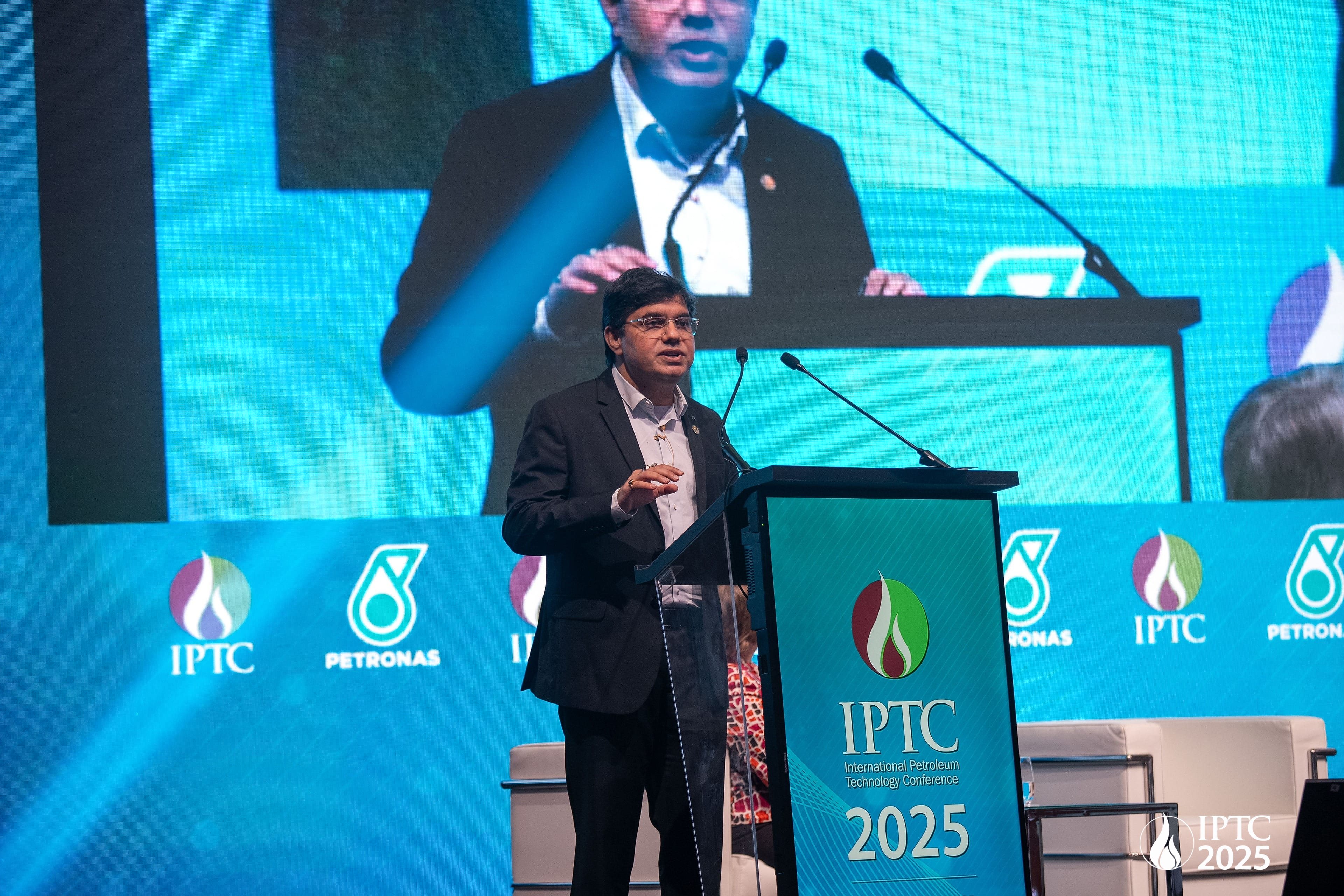
As his term comes to a close, EAGE President 2025-2026, Sanjeev Rajput, shares a personal reflection on his year leading EAGE and the key themes that defined the association during his presidency:
A presidency is a temporary stewardship. One does not own the signal. One carries it for a short distance, strengthens it where possible, and passes it forward. As my year as President of EAGE comes to a close, that is the spirit in which I look back: with gratitude for those who carried the signal before me, and confidence in those who will carry it next.
This was the year EAGE turned seventy-five. The anniversary was more than a celebration. It was a reminder of what endures. For three quarters of a century, our community has helped the world see beneath the surface through better science, better technology, and the patient building of trust across disciplines. Our 75th Anniversary Book captures that arc beautifully, and those involved in its production are to be commended. However, the deeper record lives elsewhere: in the careers EAGE has shaped, the projects it has improved, the friendships it has created, and the young professionals it has given a home. If I had to name the work of this year in a single word, it would be connection.
Knowledge has never been more abundant. What is scarce now is connection: the link between information and use, between talent and opportunity, between ideas and the field. EAGE sits naturally at the intersection of these worlds. This year, we tried to use that position deliberately.
One Board discussion stays with me. The subject was artificial intelligence, and the question hanging in the air was one many professional societies now face: do we observe this change from a safe distance, or help shape it with scientific discipline and professional responsibility? AI was already entering interpretation workflows, literature search, learning, modelling and decision-making. My view was simple. If EAGE waited too long, others would define the conversation for us. If we moved with courage and care, we could help our community adopt AI without losing judgment, uncertainty awareness or scientific standards.
EarthDocAI grew from that conviction. For decades, EarthDoc has held the technical memory of our profession: papers, abstracts, proceedings, and the accumulated thinking of generations. EarthDocAI marks the moment when that memory begins not only to store knowledge, but to help us question it, retrieve it and work with it more intelligently. Alongside it, LearnEnergyAI extends the same principle into education, helping members learn faster while keeping first principles in view. These are not technology launches in the marketing sense. They are part of a larger responsibility: to ensure that as our profession adopts AI, it does so with judgment intact, uncertainty preserved, interpretation sharpened, and weak assumptions challenged rather than accelerated.
The same instinct shaped another door we opened this year: innovation itself. We created a dedicated vehicle to give startups space within the EAGE ecosystem and connect them with industrial partners who can help ideas mature into field-ready solutions. Innovation rarely fails because ideas are absent. More often, it fails because the right door does not open at the right time. We tried to open a few.
For students, the year carried particular meaning. The BP India Student Challenge brought young geoscientists into direct contact with one of the energy industry’s most demanding technical environments, not as observers, but as contributors. We also worked to connect universities more deliberately with placement organisations and employers, because a degree without a pathway into the profession is a promise only half-kept. The next generation will not be retained by inspiration alone. It must find work that matches its training, ambition and sense of purpose.
I will remember this year less for its milestones than for its conversations: a student in a poster session defending an interpretation with quiet confidence; a founder explaining her idea to a senior executive who truly listened; a volunteer working late on a technical programme few would ever credit. These moments are easy to miss. They are how you know a professional society is alive.
The pressures on our profession are real. Energy must be secure, affordable and sustainable at the same time. Talent must be renewed. Trust must be earned. None of these challenges can be solved in isolation, and none can be solved well without geoscience at the table. EAGE’s task is not only to preserve what has been built, but to keep evolving: serving members better, drawing younger professionals more deeply into the work, and ensuring the discipline remains central to the decisions society must make.
The renewed First Break, now a digital platform, is part of that evolution. A journal becomes a conversation when it travels further, faster and into more hands. That is what our community needs from its voice in the years ahead.
For me, leadership this year came down to something simple: not claiming to have all the answers but helping the community ask the right question at the right time. Are we prepared to lead the future, or only respond to it?
As I hand over to the next President, my message is plain. EAGE’s future is strong if we remain scientifically rigorous, open to change and committed to community. The Earth keeps its secrets, but it answers those who keep listening.

