
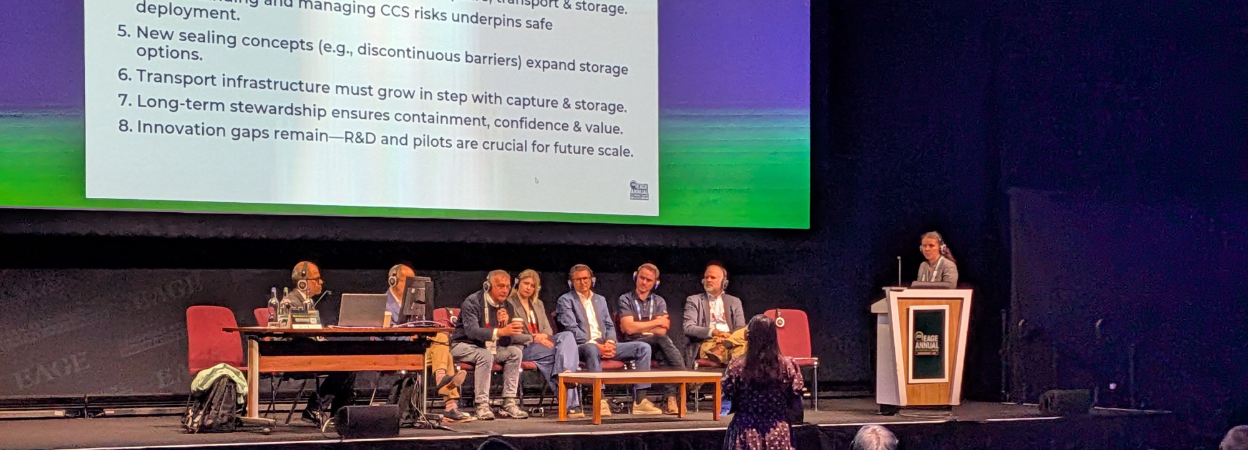
The panel on 'CCS Across Sectors: Collaboration between Industry, Academia & Government' at the EAGE Annual in Aberdeen was the perfect scenario to share experiences and learn from each other.
The biggest takeaway from the discussion was that achieving large-scale CCS deployment will require integrated spatial planning, cross-sector cooperation, and a balanced approach to risk that aligns geological insight, engineering capability, and policy support.
The technical conversation underscored the importance of geological characterisation, containment integrity, and long-term monitoring. New modelling results demonstrate that discontinuous barriers and heterogeneous stratigraphy can provide effective long-term containment, challenging the assumption that continuous caprock seals are always required. Enhanced dispersion, residual trapping, and solubility trapping in heterogeneous systems expand the range of viable storage sites, particularly in saline aquifers previously considered unsuitable.

Discontinuous barriers and heterogeneous stratigraphy can provide effective long-term containment, challenging the assumption that continuous caprock seals are always required.
In the more strategic and conceptual vein, participants highlighted the value of leveraging transferable subsurface skills from oil and gas, the need for adaptive regulation, and the role of robust measurement, monitoring, and verification (MMV) frameworks in building public and investor confidence. Case studies from collaborative innovation programmes, including joint industry projects and government-supported technology development, illustrated how structured partnerships reduce uncertainty, accelerate technology readiness, and distribute cost and technical risk.
The panel also navigated how risk is not something to be eliminated but something to be understood and managed. This premise involved the discussion and combination of technical expertise and vision and strategy for skills like effective communication and adaptation skills to a fast changing sector. Explanations on geological uncertainty, containment integrity, reservoir behaviour, legacy wells, and long-term monitoring all contribute to a complex risk landscape. Yet these risks are familiar to subsurface professionals.
Risk is not something to be eliminated but something to be understood and managed.
Participants agreed that effective communication tailored to regulators, investors, and the public will be essential. Adaptive regulation, probabilistic modelling, and robust MMV frameworks will underpin confidence in long-term storage performance.
Even more important, the panel focused on collaboration as a catalyst for innovation as no single sector possesses all the capabilities required for CCS at scale. Mike Branston and Iain Martin highlighted how structured collaboration through joint industry projects, government-funded innovation programmes, and developer-led pilots, accelerate technology readiness and reduces uncertainty.
No single sector possesses all the capabilities required for CCS at scale.
The conversation was rich, questions were answered and doors remained open to further discussions around how CCS is not a standalone solution but a strategic enabler within the wider energy transition.
This panel was organised by EAGE’s Technical Community on CCS. Also interested in this community, please join this group on Linkedin: https://www.linkedin.com/groups/13026321/

