
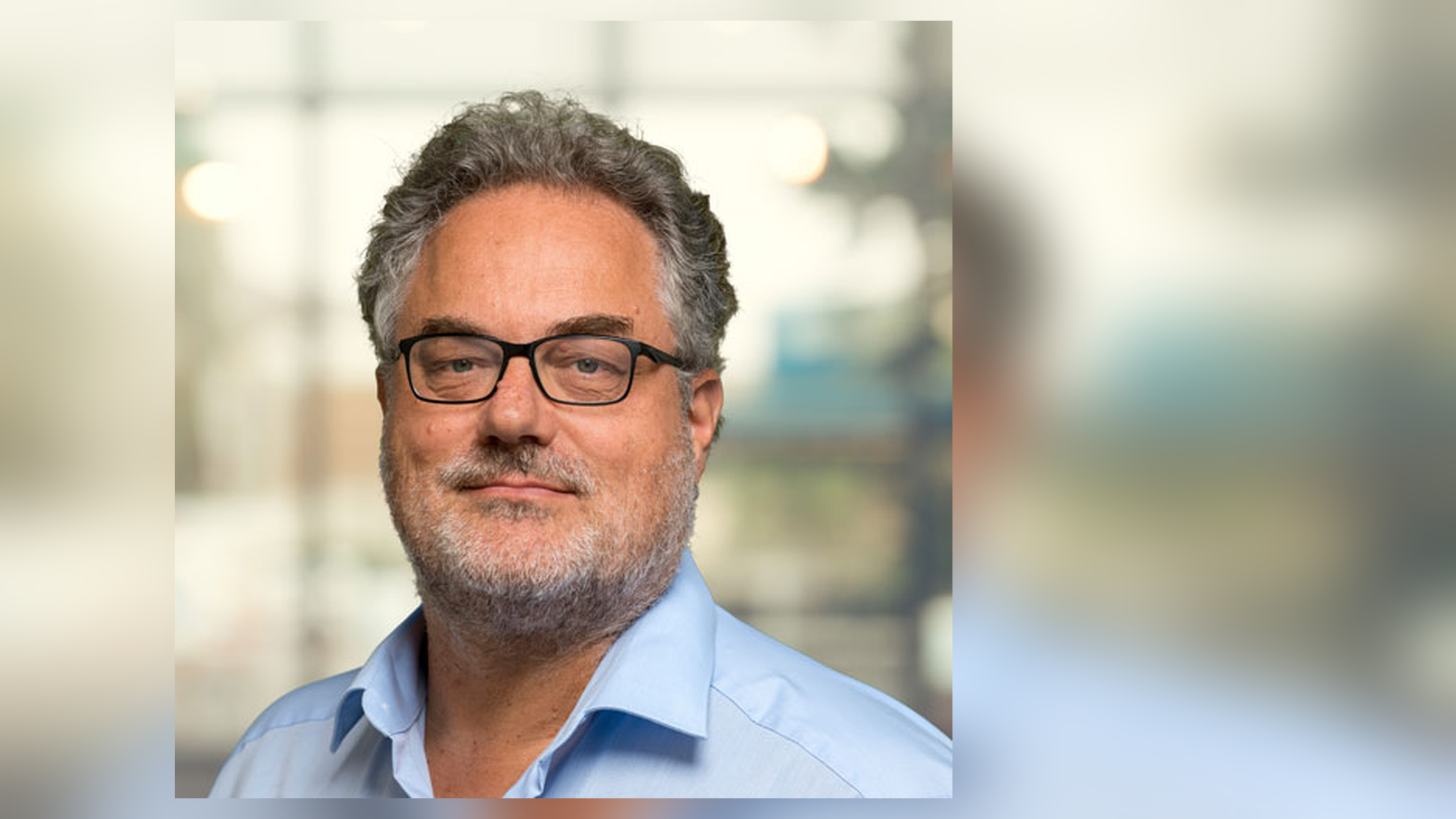
Michiel van der Meulen, chief geologist at the Geological Survey of the Netherlands at TNO, was recently awarded the prestigious Medal of Merit by the European Federation of Geologists (EFG) for his outstanding contribution to geology. The honour could not recognise his lifelong involvement with music, these days recording in a contemporary modal style inspired by oriental influences.
Family background
My first encounters with geology came through my father, a palaeontologist at Utrecht University. I thought he had a very glamorous job, although I secretly felt it would have been even better if he had studied dinosaurs rather than small mammals. When I was about seven, my mother decided she did not want to stay at home during his yearly fieldwork in southern Europe. So, in 1977, she took my sister and me out of school, packed us into our Renault 4 and drove all the way to Greece to join him. My job was to read the map. I recall entering Greece by ferry and realising I could not read the road signs: ‘Mum, they write differently here!’ ‘Ah yes, I forgot; they do.’ A different script, soundscape, landscape, language, food and climate all contributed to the sense of adventure and freedom of this and later field trips. When I became big and strong enough, I became a field hand. We only ever had two traditional family holidays.
Becoming a geologist
Eleven years later, I finished school, did my military service and enrolled to study geochemistry. I was drawn to Earth sciences but felt that I should not follow in my father’s footsteps too closely. However, it took just one geochemistry class for me to realise that geology was what I wanted. I ended up doing a PhD in basin analysis at the very department where my father worked. The university was the first learning environment that suited me; at school I had been bored and unruly. This actually turned out to pay off: at the age of 17, I was transferred to another school, where I not only managed to graduate but also fell in love with a girl who is now my wife and the mother of our two children.
Early career
When I received my PhD in 1999, job opportunities for geologists were scarce. I found a single vacancy at Rijkswaterstaat, the Directorate-General for Public Works and Water Management. The job involved providing research support for minerals planning and policy development. Although I knew I would not spend my entire career there, I enjoyed it, learning to see research not as a goal in itself but as a means to an end.
Joining the Geological Survey
At Rijkswaterstaat, I got to know the Geological Survey of the Netherlands, part of the Dutch research and technology organisation TNO. I moved there in 2003, eventually becoming head of department and chief geologist with responsibility for our public information services.
We had already transitioned from traditional surface geological mapping to subsurface mapping. By the time I took on responsibility, it still required consolidation of the workflows and an independent quality-control system. We were pioneers in this shift, which I enjoyed as much as I had enjoyed those childhood drives to Greece. As the survey continued to grow, I stepped down as head of department to focus full-time on developing and expanding our geological information services. In essence, my role as chief geologist is to consider where we should be heading and make that happen. I like to think I have the best geoscience job in the Netherlands.
We focus on geological resources and hazards. Our work spans the built environment and spatial planning, covering the upper tens of metres of the subsurface; groundwater, covering hundreds of metres; geo-energy, covering thousands of metres; and raw materials. Our agenda is shaped by global change, the energy transition, geopolitical developments and the digital revolution.
Music
I love geology, but I love music just as much and consider it one of the greatest gifts my parents gave me. My father played the accordion, performing Balkan music - perhaps the closest he could get to the sounds of his youth in the Dutch East Indies. I began with the treble recorder, then learnt the violin, and started to play with and learn from my father. Today I primarily compose contemporary modal music, meaning music based on oriental modes. I have recently released my fifth album, recorded and produced largely in Greece.
For me, science and art are closely related. Both involve collaborating with talented people to create something meaningful. In art, however, you channel inspiration directly into the final product, while in science you first have to challenge your ideas rigorously. I consider science and art to be mutually reinforcing factors in my life. In fact, my last album is geologically themed. Full circle.

