
The past several years have presented significant challenges for the global scientific community. The COVID-19 pandemic shifted most professional communication into virtual space, substantially limiting direct scientific exchange and interdisciplinary interaction. For Ukraine, these challenges became even more severe following the full-scale invasion, which created additional barriers for research institutions, field operations, and international collaboration.
Despite these most challenging circumstances, Ukrainian conferences organized under the umbrella of EAGE continued their activities throughout the war years in online and hybrid formats. Since 2022, Ukrainian geoscientists, together with EAGE, have successfully organized a series of international events, maintaining scientific communication and professional exchange under extremely difficult conditions.
From the very beginning of the war, EAGE provided consistent support to the Ukrainian geoscience community through conference cooperation, participation support programmes, and continued integration of Ukrainian specialists into international scientific activities. This support played an important role in preserving professional continuity and maintaining international collaboration during wartime.
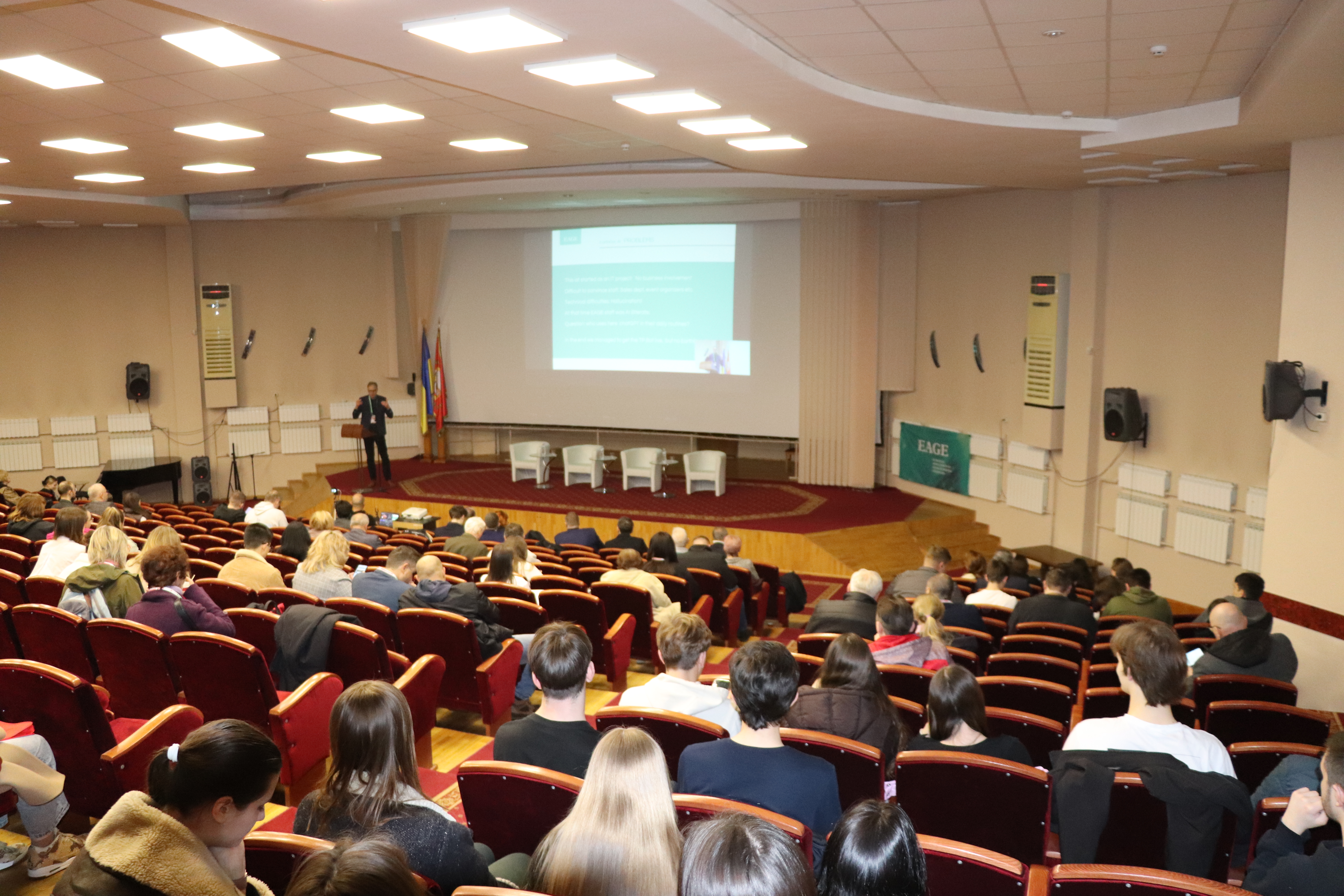
In April 2026, the XIX International Scientific Conference “Monitoring of Geological Processes and Ecological Condition of the Environment” (Monitoring 2026) marked an important milestone by returning to a fully in-person format for the first time since the start of the full-scale war. Held in the capital Kyiv, the conference brought together more than 250 participants from academia, industry, and government institutions.
The return to face-to-face interaction highlighted the continuing importance of direct scientific dialogue, networking, and interdisciplinary cooperation within the geoscience community. For many participants, Monitoring 2026 became the first opportunity in several years to meet colleagues in person, renew professional connections, and establish new collaborations.
The conference programme included 163 presentations delivered in oral and poster formats across eight technical themes, including:
- War Impact Monitoring & UXO Detection Technologies;
- Monitoring for Energy Transition and Decarbonization Projects;
- Digital Monitoring Technologies, Data Integration and AI in Geosciences.
A central event of the first conference day was the panel discussion “Geological Monitoring in Times of Crisis: From Data to Decision-Making.” The discussion brought together representatives of academia, industry, and governmental institutions to address challenges related to monitoring systems under conditions of limited field access, rapid decision-making, and increasing reliance on satellite observations, digital platforms, and integrated geospatial systems.
Particular attention during the conference was dedicated to technologies developed for environmental assessment and monitoring in war-affected regions. Several presentations demonstrated practical applications of UAV-based magnetic surveying, GIS-integrated environmental assessment, geochemical monitoring, and robotic systems for humanitarian demining support.
Particularly notable were studies combining magnetic and geochemical approaches for assessing war-related soil contamination, as well as UAV-based geophysical methods for UXO and landmine detection. Many of these technologies demonstrated strong potential for practical deployment not only in Ukraine, but also in other regions facing military, industrial, or environmental crises requiring rapid geospatial assessment and monitoring solutions.
The conference also highlighted the growing role of artificial intelligence and digital transformation in geosciences. One of the key presentations was “EAGE EarthDoc AI: an Agentic Approach” delivered by Peter Verweij. The presentation introduced new AI-driven approaches for interacting with geoscientific knowledge systems and demonstrated EAGE’s strategic focus on the development of digital tools for subsurface research and professional workflows.
The session attracted significant interest from both academia and industry representatives, particularly regarding practical integration of AI-assisted geological information retrieval into operational decision-making processes. The participation of EAGE representatives at the conference carried both professional and symbolic importance, demonstrating continued support for the Ukrainian geoscience community and encouraging broader international engagement with Ukrainian scientific events.
Monitoring 2026 also demonstrated a high level of international scientific cooperation. Numerous presentations involved collaborations between Ukrainian researchers and colleagues from Poland, Romania, and other European countries, emphasizing the importance of international integration and knowledge exchange during periods of crisis.
Beyond its scientific programme, Monitoring 2026 became an important demonstration of resilience, continuity, and adaptation within the geoscience sector. The conference showed that even under wartime conditions, Ukrainian geoscientists continue to develop new technologies, contribute to international scientific progress, and address emerging environmental and subsurface challenges with practical and innovative solutions

