
As a new graduate at the start of my geophysical odyssey more than thirty years ago I was looking around for a PhD research project. I chose a subject that at that time was not yet fashionable: controlled source electromagnetic sounding (CSEM).
The advice I received from many of many of my elders was clear: ‘Concentrate on seismic - that’s the geophysical tool of choice. You’ll never make a career in EM’. I was even told (by a rather eminent geophysicist) that ‘if EM told you anything about the earth then my telephone wouldn’t work’, a comment that bemuses me to this day. But I ploughed on regardless, precisely because it was a subject that was new and interesting and different, and it seems to have worked out all right.
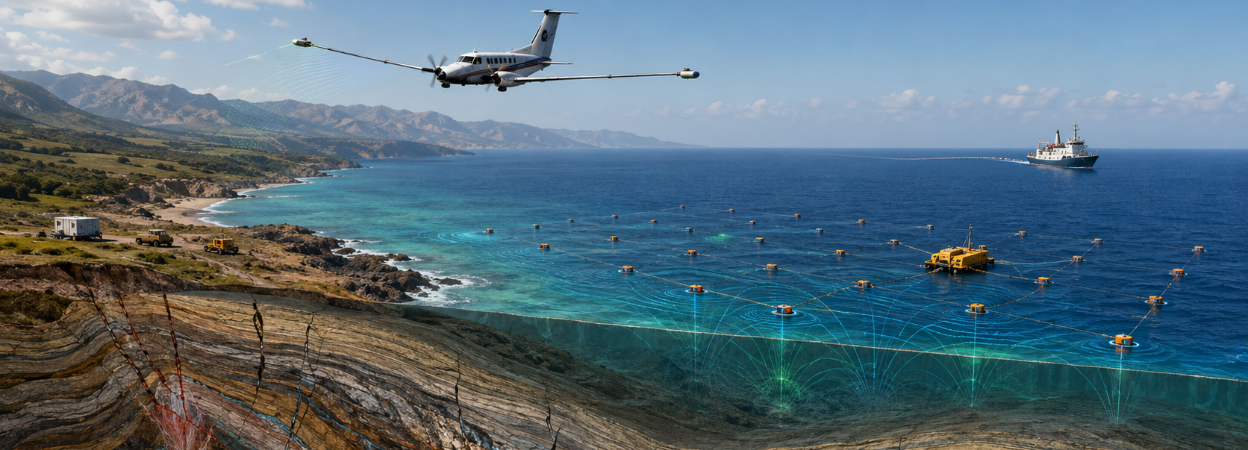
Indeed, non-seismic methods as a whole are enjoying a renaissance, as noted in the title of the excellent workshop at the EAGE 2026 in Aberdeen, convened by by Antony Price of Total, and Tony Bourne of BP. This brought together geoscientists from a range of disciplines to present applications of gravity, magnetic and electromagnetic methods in both oil and gas and energy transition applications.
What constitutes ‘non-seismic methods’? The obvious answer is ‘geophysics that is not seismic’. This blanket definition covers several very distinct disciplines, including gravity, magnetic and electromagnetic methods. Taking just these three, each has its nuances and requires specialist knowledge to acquire, analyse and interpret successfully. And yet often such methods are included as an afterthought in both university and professional training courses. Take for example an applied geophysics Masters course that I have been involved in teaching: in a six-week course, only three days were devoted to non-seismic methods. Often even less time than this is set aside to cover all things non-seismic. Whilst this provides an awareness of methods that are available and their application, it does not equip the next generation of geoscientists with the knowledge they need to apply them.
You could argue that this is because the primary tool used by geophysicists is still seismic, so of course more emphasis is placed on these methods. That has perhaps been true to date in the oil and gas industry. However, in other industries, notably mining, gravity, magnetic and electromagnetic, these methods form the backbone of exploration. The energy transition also sees more emphasis on non-seismic methods. Geothermal prospecting relies on non-seismic methods, as does the search for rare earth elements, both onshore and offshore. Exploration for natural hydrogen leans heavily on gravity, magnetic and electromagnetic (EM) approaches. There is also renewed interest in gravity and electromagnetic methods in the monitoring of CO2 stored in subsurface geological formations. Both methods offer a cost-effective complement (in some cases alternative) to seismic.
“The energy transition sees more emphasis on non-seismic methods.”
And yet the number of specialists in these methods remains relatively small. Recruitment is a challenge. Most large companies have a ‘non-seismic person’. I was this person in my previous role for a large national oil company. And I was busy: requests for input, analysis and data review came from all over the organisation, and ranged from gravity and magnetic support for regional exploration, through more focused EM and gravity applications (onshore and offshore) for exploration and CCS, to high resolution studies for infrastructure development and hazard mapping. The variety was interesting and exciting and spanned distinct aspects of both the traditional and new energy business. I had the benefit of a small, but excellent, multi-physics team to support me. Many non-seismic experts are not so lucky and work as a one-person department.
“The real renaissance will arrive when these methods start to be viewed as mainstream across industries.”
The range of applications for non-seismic methods continues to grow, and multi-physics approaches, combining seismic and non-seismic methods have developed rapidly in the last few years, and bring additional benefits in understanding the sub-surface. However, we need more people. The real renaissance will arrive when these methods start to be viewed as mainstream across industries. At a time when we need to encourage more young people to study geosciences, presenting non-seismic methods as a route to a successful career in either traditional oil and gas or energy transition benefits us all.
Lucy MacGregor is senior geophysicist and co-founder of Edinburgh Geoscience Advisors. Her career has included CTO of Offshore Hydrocarbons Mapping (also co-founder), Rock Solid Images and Ocean Floor Geophysics and, more recently, quantitative interpretation specialist with PETRONAS.
Views expressed in this column are solely those of the author.

