
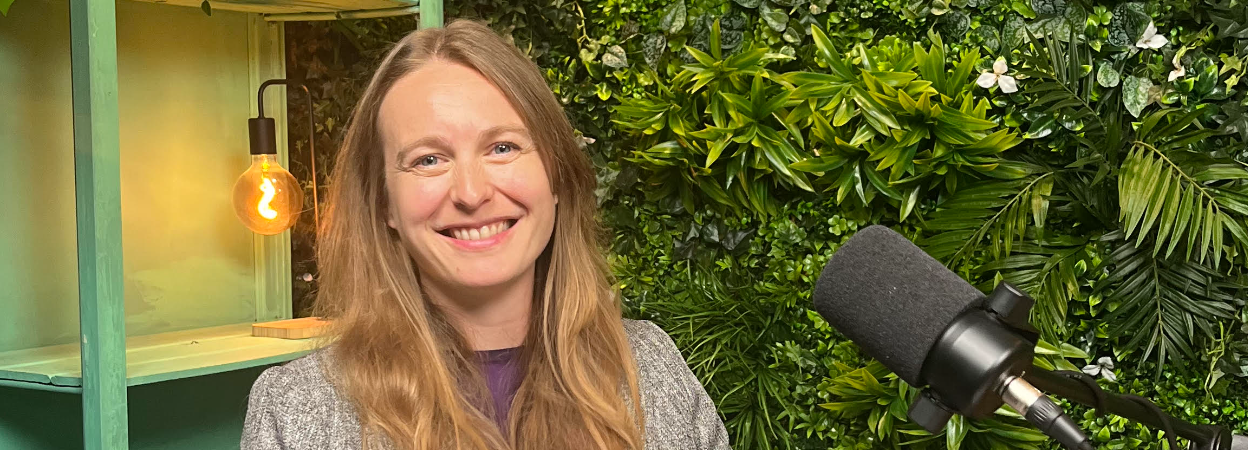
Myrna Staring has dared to steer away from a stellar career in innovation at Fugro to start out on her own, advising companies on how to develop and commercialise nascent geoscience and other products. Previously active with the EAGE’s Women in Geoscience and Engineering community, she is now becoming the face and voice of the Association’s podcast The Geoscience Channel.
Background and early years
I grew up in Middelburg, in the Dutch province of Zeeland. My mother was a nurse and my father worked for the Ministry of Justice, leading complex fraud investigations. I was curious and had many interests but wasn't the stereotypical science nerd. In fact, I dreamed of becoming a ballerina. I spent much of my childhood dancing and even auditioned for ballet schools, before realising it probably wasn't a realistic career for someone of 1.58 m. I still enjoy dancing today.
Maths and physics came naturally at school. One formative experience was a project in which a group of us built a solar-powered boat. We found an old boat, sourced solar panels and an engine, and raised sponsorship. We entered a competition against professional corporate teams and broke down halfway through the race. It was stressful and hilarious, but I loved the mix of science, creativity and teamwork.
Gravitation to science
My route through university wasn't straightforward. I initially enrolled in a soil, water and atmosphere programme at Wageningen University, but soon realized ecology wasn't for me. After a year working in supermarket customer relations, I moved to University College Roosevelt in Middelburg, where I could combine physics, mathematics and earth sciences with subjects such as history and economics.
When the university was privatised halfway through my studies, the fees doubled. I tutored schoolchildren in maths, worked as a receptionist and spent Saturdays and holidays in a lunchroom for young adults with intellectual disabilities. It helped me pay my way and taught me a lot beyond the classroom.
Geoscience rings a bell!
One summer, my mentor, a seismologist, gave me a project monitoring cracks in Long John, Middelburg's historic bell tower. Its resonance frequency was close to that of its largest bell, so ringing it could cause further damage. I was fascinated by the idea of using seismic interferometry and the bells themselves to monitor the cracks. I was hooked.
I found the IDEA League master's in Applied Geophysics online, received a Shell Scholarship and spent two years studying at TU Delft, ETH Zürich and RWTH Aachen. I loved seeing how different universities and cultures approached similar problems.
After my MSc, I returned to TU Delft for an industry-sponsored PhD on Marchenko imaging with Professor Kees Wapenaar. I particularly enjoyed working with industry partners and seeing what it took to make an elegant theory work on field data and become useful to seismic processors.
Innovation at Fugro
After my PhD, I joined Fugro to apply geophysics to new challenges, particularly offshore wind and the energy transition. I started as a technical contributor, but after a year was asked to take one of my projects beyond the technical stage and develop its commercial and operational aspects. I had no idea what I was getting into but said yes. That became GroundIQ, a flagship Fugro subsurface risk mitigation product.
I later moved into innovation leadership, building and leading a multi-disciplinary team of 12 geoscientists. I enjoyed coaching people and developing products together. I also led the commercial development of a corporate venture, working across strategy, business development and team leadership. I found that my strength wasn't inventing new theories, but connecting the dots: finding the right problems, matching them with technical solutions and bringing people together to make things happen.
International assignments
My work took me to Saudi Arabia, where I led a field campaign screening the ground for a city development. The crew were experienced drillers who had never worked with seismic nodes, and there was initial resistance to having a woman lead the campaign. I learned to listen first, understand the context and build engagement rather than assume people would immediately embrace a new technology.
Career change of direction
About a year ago, I decided to take a different path. I felt I was trying to find a single role in a conventional corporate structure that could accommodate my different strengths and interests, but began to question how much I was shaping my choices around external expectations.
I left Fugro and started a Global Executive MBA at Rotterdam School of Management. My father called to check he'd understood correctly: had I really quit my job and invested my house savings in yet another degree? I explained that the way I was working no longer fitted the life I wanted to build. Staying felt scarier than leaving.
I founded Myridian Advisory to help startups, scale-ups and corporates commercialise innovation, in geoscience and beyond. Clients came faster than expected, through a network I hadn't realised I'd built. My first client was QuAInt Geo, an AI-native subsurface technology venture, where I now work part-time as director of strategy and partnerships.
Getting behind the microphone
Hosting EAGE's podcast The Geoscience Channel podcast came through my involvement in the EAGE community. I enjoy talking to people pushing boundaries in the industry and exploring their ideas. It has also challenged me to become a better interviewer and ask more direct questions.
Women in industry
During my PhD, I founded Women in Geoscience & Engineering (WGE) in the Netherlands to help create a stronger community where women could connect, share experiences and find opportunities.
The energy industry has made progress, but getting more women into geoscience is only part of the challenge. They also need to feel they belong and have opportunities to develop and reach leadership positions. For years, I struggled to find a female mentor simply because there were so few women ahead of me.
Life philosophy
This year has been less about a career change and more about redesigning my life. Some things I cannot control, so I focus on what I can: my company, my learning and my network. My advice: take it seriously when you're drained without knowing why, play to your strengths and, when staying feels scarier than leaving, go.

