
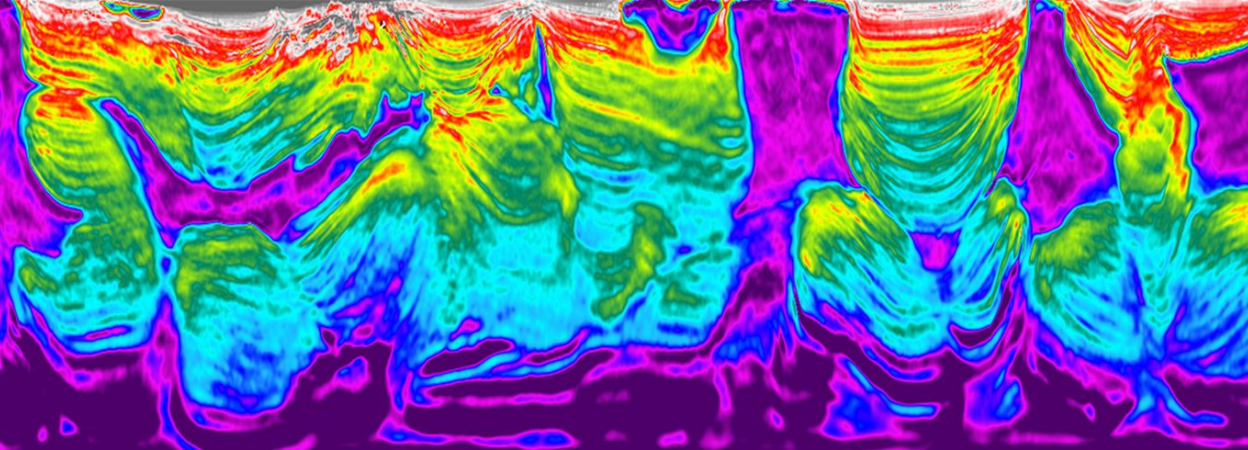
New full-waveform inversion solution connects seismic imaging directly with quantitative interpretation, reducing processing stages and revealing rock and fluid properties earlier in the subsurface workflow.
SLB has launched QI-FWI, a quantitative interpretation full-waveform inversion solution designed to derive reservoir properties directly from the seismic wavefield.
Unveiled recently, the data-driven solution uses elastic, multiparameter full-waveform inversion to produce compressional-wave velocity (Vp), P-impedance and Vp/Vs volumes. Additional properties, including shear-wave velocity, density and amplitude-versus-angle attributes, can subsequently be derived from these outputs.
Conventional seismic workflows commonly involve separate stages for imaging, amplitude analysis and AVO inversion. Each stage may require its own data conditioning, assumptions and handovers between processing and interpretation teams. By generating quantitative properties within the FWI workflow, SLB says QI-FWI can reduce these intermediate stages and keep the seismic data, earth model and reservoir-property estimates more closely connected.
“QI-FWI provides a more streamlined and data-driven approach,” said Andrea Lovatini, vice-president of exploration data and geosolutions at SLB.
The technology operates by comparing recorded seismic measurements with synthetically modelled wavefields and iteratively updating the subsurface model. Its analysis of both compressional and shear-wave behaviour provides information about rock density, stiffness and composition, as well as indications of potential fluid content.
QI-FWI can also convert FWI results directly into AVO intercept and gradient volumes, removing the need for a separate conventional AVO inversion stage. Outputs can be compared with synthetic responses derived from well logs, giving geoscientists a means of checking their consistency with borehole measurements.
According to SLB, potential applications range from prospect evaluation and appraisal to reservoir characterisation and development-well planning. The workflow can also be applied to seismic surveys acquired at different stages of production, supporting time-lapse reservoir monitoring.
The development reflects the continuing convergence of seismic imaging and quantitative interpretation. Rather than treating the subsurface image as the endpoint of processing, QI-FWI is intended to deliver interpretation-ready rock and fluid information as part of the imaging process itself.
Image courtesy of SLB

