
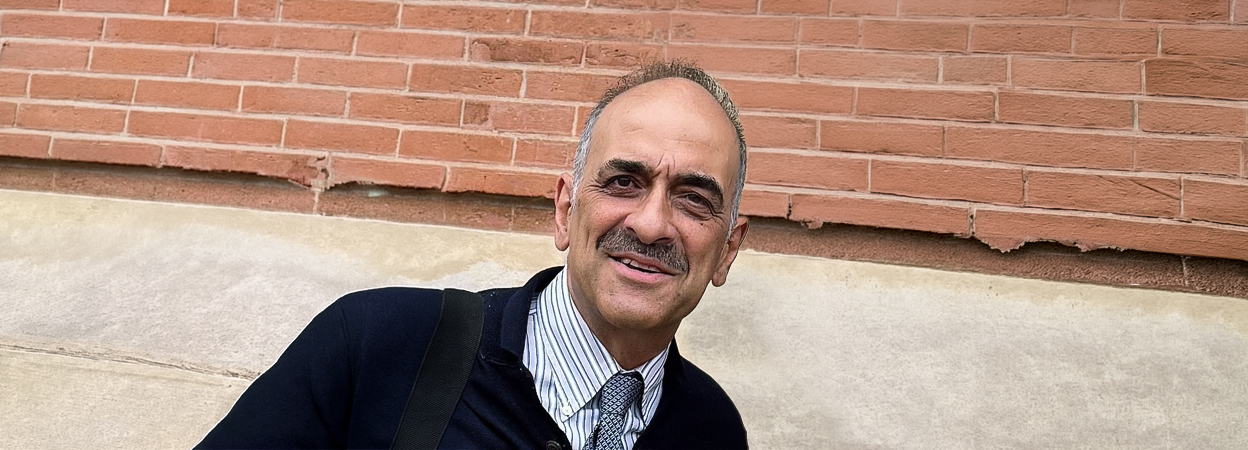
George Apostolopoulos, professor of applied geophysics and director of laboratory research at the National Technical University of Athens (NTUA), retires next year from academia after a career that, through field work, publications, presentations, and teaching, has helped define the development of near geoscience applications in Greece covering engineering, environmental and mining disciplines.
A favourite preoccupation has been his geo-archaeological investigations of classical Greece, including work with the Odysseus Unbound Foundation on Kefalonia Island to verify the contemporary geological references by Homer. Since his student days, Apostolopoulos has acknowledged the value of the EAGE community, recently serving as Board member representing what is now the Environment, Minerals and Infrastructure Circle (EMIC).
Upbringing
I was born in 1959 in Pyrgos, in the southern Peloponnese, Greece, and have lived in Athens since 1964. My father was in banking, my mother looked after the family. For some reason, physics always fascinated me, hence I enrolled at the Department of Physics at the National and Kapodistrian University of Athens (NKUA) to explore further.
Moment of truth
A defining moment came while taking an applied geophysics course under Prof Ioannis Louis. He invited students to participate in a field geophysical survey involving Schlumberger electrical soundings on the Lasithi Plateau in Crete. That experience was a revelation. I realised that, through physics, it was possible to investigate the subsurface for a wide range of environmental and engineering applications. I subsequently carried out my undergraduate thesis using data from Lasithi, continuing to work before embarking on an MSc at the University of Leeds. There, the academic staff were increasingly focused on seismic methods and petroleum exploration. It was a valuable experience, but I had already decided on engineering geophysics rather than petroleum geophysics despite more job opportunities and higher salaries.
“Even in those days, I liked to explore the past through geophysics.”
Back to reality
Returning to Greece, I embarked on my PhD at NKUA, again working closely with Prof Louis and supported by a scholarship. It focused on the application of geophysical methods to geothermal exploration in the Sperchios River Valley in Central Greece to investigate the tectonic structure of the area, including the identification of faults that could act as pathways for thermal circulation. Having completed my PhD, there were no academic or private-sector positions in applied geophysics that matched my interests, so I became a scientific consultant at the General Secretariat for Research and Technology in Greece, evaluating and funding industrial research projects undertaken by private companies, and then got involved in EU innovation projects. Even in those days I liked to explore the past through geophysics offered by privately funded projects, for example, travelling to the Sahara Desert and the Siwa Oasis in search of the tomb of Alexander the Great.
“I travelled to the Sahara Desert and the Siwa Oasis in search of the tomb of Alexander the Great.”
The dream job
My dream finally came true when I successfully applied for a lectureship in applied geophysics at the National Technical University of Athens (NTUA), a post which came out of the blue. It was to allow me to devote my career to engineering geophysics. European ventures have been a highlight. The ‘Bewexmin’ project proposed geophysical techniques for detecting hard formation obstacles ahead of bucket-wheel excavators in coal mines. We are currently working with Uppsala University as coordinator (headed by my good friend Prof Alireza Malehmir) on an international EU Horizon project ‘Intelligent II’, which continues collaborative research into improving mineral exploration technology employing geophysical methods.
Classical Greece uncovered
Our laboratory has undertaken more than 40 geophysical projects covering engineering and environmental applications, as well as archaeological and geo-archaeological investigations, my special interest. Geophysical methods have been used to detect the ancient Temple of Poseidon, believed to have been destroyed by Xerxes, but actually beneath the existing temple; to investigate under structures near the Temple of Zeus in Athens; and to reconstruct ancient palaeo-environmental conditions in important archaeological sites, such as the Thorikos Valley and Fiskardo. We have collaborated for a long time with the Odysseus Unbound Foundation on Kefalonia Island to determine whether the Paliki Peninsula could have been the ancient Ithaca described by Homer.
“The friendships created during our academic years can last well beyond graduation.”
Return to beginnings
In recent years, I have also returned to the subject of my PhD, coordinating geophysical surveys for geothermal exploration in volcanic areas. These studies have taken me to the Methana Peninsula and to the islands of Nisyros and Lesvos. It is a rewarding link to the research that introduced me to the integrated application of geophysical methods.
New generation
One of the things of which our NTUA laboratory is particularly proud is the contribution it has made to educating and inspiring a new generation of geophysicists, many successful in their careers. Through our Applied Geophysics Society, former students continue to meet every Christmas period over drinks, a wonderful reminder that the friendships created during our academic years can last well beyond graduation.
“I have always felt that I should give something back to EAGE for everything it has offered me.”
Importance of EAGE
One highlight as a student in the UK was attending my first EAEG (at that time) Annual Meeting, the beginning of a long relationship which continues today. I have always felt that I should give something back to EAGE for everything it has offered me. I therefore became involved in its committees, eventually serving as a member of the EAGE Board and as chair of the Near Surface Geophysics Section, now the Environment, Minerals and Infrastructure Circle (EMIC).

