
Full waveform inversion (FWI) reconstructs high-resolution subsurface velocity models by fitting observed shot gathers with wave-equation simulations, but strong nonlinearity, cycle skipping, incomplete illumination, and the need to repeatedly solve large forward/adjoint problems make robust Bayesian inference prohibitively expensive in realistic settings.
We propose a diffusion model-based posterior sampling framework that starts from an unconditional diffusion prior trained on 2D velocity patches and 3D cubes, and at selected noise levels uses the wave-equation operator with simultaneoussource (encoded) shots as a reconstruction guidance mechanism: from a denoised model, we predict encoded gathers, compare them with observed encoded data, perform a few Langevin steps in model space to reduce the encoded-shot misfit, and then re-noise the sample.
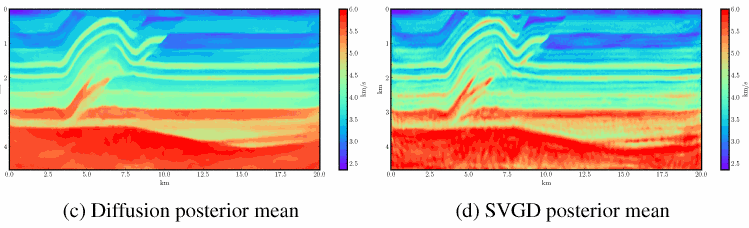
Applications to 2D and 3D synthetic and field datasets, including the SEG/EAGE Overthrust model, a 2D towed-streamer line from North West Australia, and the 3D BG Compass model, show that the proposed sampler delivers higherfidelity posterior means, more coherent uncertainty maps, and substantial reductions in velocity RMSE and normalized data misfit compared to Stein variational gradient descent (SVGD) driven by conventional FWI gradients.
Read the full paper (incl downloadable pdf) on EarthDoc here (EAGE members only).

