
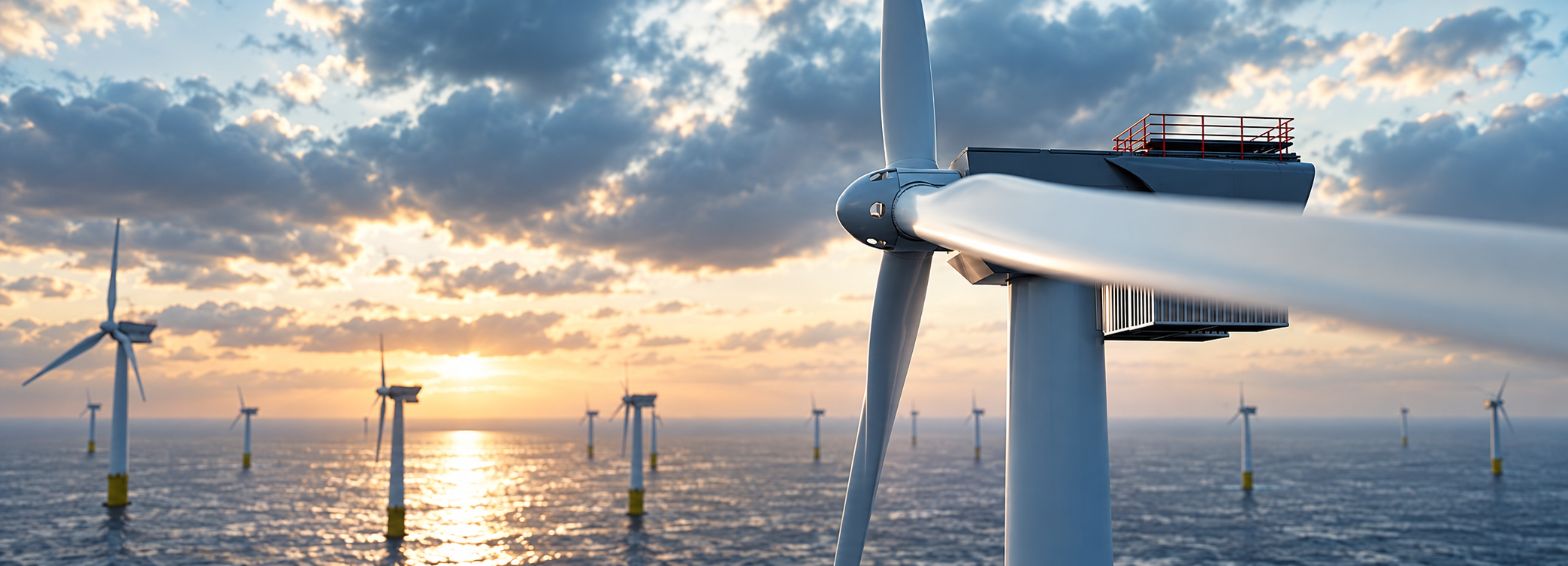
Ivar Slengsol of TGS I 4C talks to First Break Online about the global offshore wind industry and points to encouraging signs after a tough two years.
The question taxing developers of offshore wind energy is, can the industry stay on course to deliver 729 GW of global energy by 2050?
For two years the sector has suffered an ill wind. After a huge global expansion in 2020, 2021, 2023 and 2024, so far this year only 2.1 GW has reached final investment decision (FID) and 5.6 GW is expected by the end of the year. That would make 2026 the second lowest year for offshore wind investment decisions.
Geopolitical factors such as war in the Middle East and macroeconomic factors such as the cost of long-term borrowing reaching 15-year highs have contributed to the slowdown of investment decisions in offshore wind, says Ivar Slengesol, VP and managing director of its offshore wind intelligence division TGS I 4C. At the same time raw materials prices, for example steel (up 53% year on year) and copper, have soared as have vessel day rates in the last few years, he adds.
However, the underlying story remains a positive one. The year 2026 is forecast to be the second highest in terms of consented projects being brought towards the final stages of investment decisions (22.2 GW).
‘Political support in key markets remains strong. Ambitions are strong. Also, what’s happened in the Middle East and with the continued war in Ukraine has highlighted in many countries the need to be less dependent on energy imports. There is increased emphasis on energy security giving offshore wind a boost. That’s a positive driver,’ says Slegesol, who also points to the benefits of a maturing supply chain, improving technology and economies of scale as the global industry continues to grow and more projects are being built year on year.
Auctions
The biggest challenge facing governments now is how to attract enough competitive bids after a series of failed auctions. ‘Because of cost inflation and higher interest rates post Covid and the Ukraine War, a lot of projects became financially unviable. We saw auctions no longer receiving bids from developers.’
Germany wants to build 70 GW of offshore wind by 2045, but developers refused to participate in its August 2025 auction because there were no price floor or revenue protection. The country cancelled its 2026 auction as it remodels its wind auctions. To make matters worse for Germany, companies such as TotalEnergies and bp are trying to renegotiate Contract for Difference (CFD) leases awarded a few years ago.
‘Total Energies and bp committed 12.6 billion euros for rights to develop their German sites, and there are now talks about these sites being too costly. In addition, grid connection delays have created uncertainties. Total Energies has requested better financial terms and asked to exit some sites and are in ongoing discussions with the German government.’
‘Whereas in the past offtake or Contract for Difference auctions [based on an agreed price to sell the power once the project is operational] have generally been successful, in 2025 or 2026 auctions have been postponed or cancelled. There have not been enough bidders as developers are consolidating and focusing on fewer markets.’
As a whole the industry has been trying to reduce costs. In Denmark there was a failed auction in 2025. The country has reset the CFD to introduce more subsidies. The Netherlands, which has ambitious targets of 70GW by 2050, has reintroduced subsidies after project delays and cancellations.
‘At the end of 2025 and the start of 2026 things started to turn around a bit. Governments have introduced auction terms including higher contract for difference strike prices that meet the new economic reality, and developers are participating again in auction rounds. Governments are listening to developers and working with them.’
Which is good news for the geoscience industry, as there will be more geophysical and geotechnical surveys in the early stage of development to figure out the project and where to build it. ‘We are starting to see more projects winning auctions that will require those services.’
However, Slengesol warns. ‘Also, economics has been a bit challenging when it comes to getting the right strike price for Contracts for Difference, and that trend will likely continue into 2027. There’s a number of auctions planned for the rest of this year, and in 2027 we will likely continue to see a mixed auction track record. Some auctions will be delayed and may not be as successful as authorities hoped, particularly those with emerging offshore wind markets running auctions for the first or second time. Those are often at risk of having some bumps in the road.’
After poor results in Allocation Rounds 5 and 6, Allocation Round 7 in the UK in January was successful. The UK secured a record 8.4 GW of offshore wind capacity across 25 projects, if only because it doubled the overall strike price budget to nearly £1.8 billion.
Global ambition
According to TGS’ Q3 Wind Energy Report, there is currently 92.7 GW fully commissioned, with another 41.2 GW under construction, additionally, 7.1 GW has already made FID. This would equate to a 51% increase to global capacity.
China leads the world in offshore wind power, with nearly 47 GW operational. Its 15th Five-Year Plan will set an offshore wind installation target of 100 GW. The TGS | 4C database indicates that China may achieve 97.9 GW of capacity under construction by the end of 2030 given the current project pipeline, though this may increase as more wind farm auctions are introduced.
Asia Pacific as a whole is expected to add 308 GW by 2040. Other big markets there are Taiwan, which expects to deliver 55 GW by 2050; Japan, which will deliver 45 GW by 2040 including 15 GW of floating wind. South Korea, which plans to deliver 45 GW by 2040, had two successful auctions this year for fixed and floating wind. India wants to add 37 GW by 2040.
Europe’s leading offshore wind market remains the UK with 43/50 GW expected to installed by 2030, including 5 GW of floating wind. Allocation Round 8, which is expected to start announcing results this month, included 17.3 GW of eligible projects while Allocation Round 9 is expected to take place at the end of 2027.
What TGS calls ‘Established Europe’ will deliver 240.8 GW and Emerging Europe 152.3 GW in the coming years.
France has merged two lease rounds into one, which will now be a mixture of fixed and floating wind projects. Poland’s first CFD subsidy round at the end of last year was ‘pretty successful’. Ireland is a very active market with an ambition of 37 GW.
The Americas market, which is targeting a relatively modest 23.2 GW, is the most immature. With President Trump in the US having effectively declared war on wind energy, the country now expects to deliver just 5 GW of offshore wind. The US government has begun reimbursing developers of ‘early stage’ leases. In exchange, the leases are given up and investments are made into other energy projects, particularly fossil fuels. Canada is also getting started on offshore wind and is ‘an interesting one to follow’ says Slengesol.
South American countries are still focusing on trying to expand their oil and gas industries but at the same time are also making their first steps towards developing an offshore wind industry.
Construction
Up to now China has been an insular market in terms of developers and supply, but one of its major wind energy contractors is exporting more of its services globally. ‘It’s very difficult for international supply chains and developers to get into the Chinese market, but the Chinese supply chain is looking to expand into international markets now, including for turbines, cables and foundations. Chinese manufacturers will in some cases be able to deliver faster and cheaper than European competitors.’
Daijin Heavy Industries is a disrupter in the market in providing full-lifecycle manufacturing to supply foundations and install them. It is moving from a pure equipment manufacturer to a full supply chain provider that handles manufacturing, ocean logistics, European marshalling ports, and installation solutions – something experts agree could be very competitive and bring costs down.
Foundations
Around 18,000 foundations have been installed or are under installation globally, with a further 19,400 forecast for 2026-40. Monopiles remain the preferred foundation type, while floating foundations are expected to reach 11% of demand.
Hybrid foundations are being developed by a wind energy start up called NereTek, which has recently signed a supply agreement with Vestas. NereTek claims it could offer a 40% drop in capital spending compared to traditional foundations. In the latest UK allocation round 8, a new pot has been created for hybrid technologies for projects in transitional water depths of 60-90 m. The solution would integrate a fixed foundation with floating moorings which offer the potential to go up to 100 m or more depth. You could have areas of different water depths that have floating and hybrid foundations.
Turbines
The two main non-Chinese suppliers Siemens and Vestas have current turbine models based on 15 MW and have already told investors they are focusing on that, says Slengesol. In China suppliers are developing 26 MW turbines but it’s looking unlikely to be exported out, he adds.
Grids
In Europe innovation is focusing on building huge cross-country interconnectors that would enable surplus power to be shared between nations. The LionLink project will connect offshore windfarm power to either the Netherlands or the UK. GriffinLink will connect power systems of Germany and the UK via a subsea cable under the North Sea.
Next year
While some developers are signalling an upturn for the industry next year, it seems unlikely without global geopolitical reform and easing of macroeconomic constraints, says Slengesol.
‘On the positive side, 2026 has been a record year for offshore wind construction activity, and there is also a huge
inventory of projects under development globally, particularly in Europe, but also in Asia-Pacific. In 2027 we’re expecting to see more final investment decisions than this year, but with one major caveat: FID activity will be dependent on macroeconomic developments, including interest rates and general market sentiment. We expect auction activity to increase with projects awarded at better prices for developers.’
Interested in offshore wind in Latin America? Join the 1st EAGE/EEMa Offshore Wind Forum Latin America from 3-5 March 2027 in Cartagena, Colombia.

