
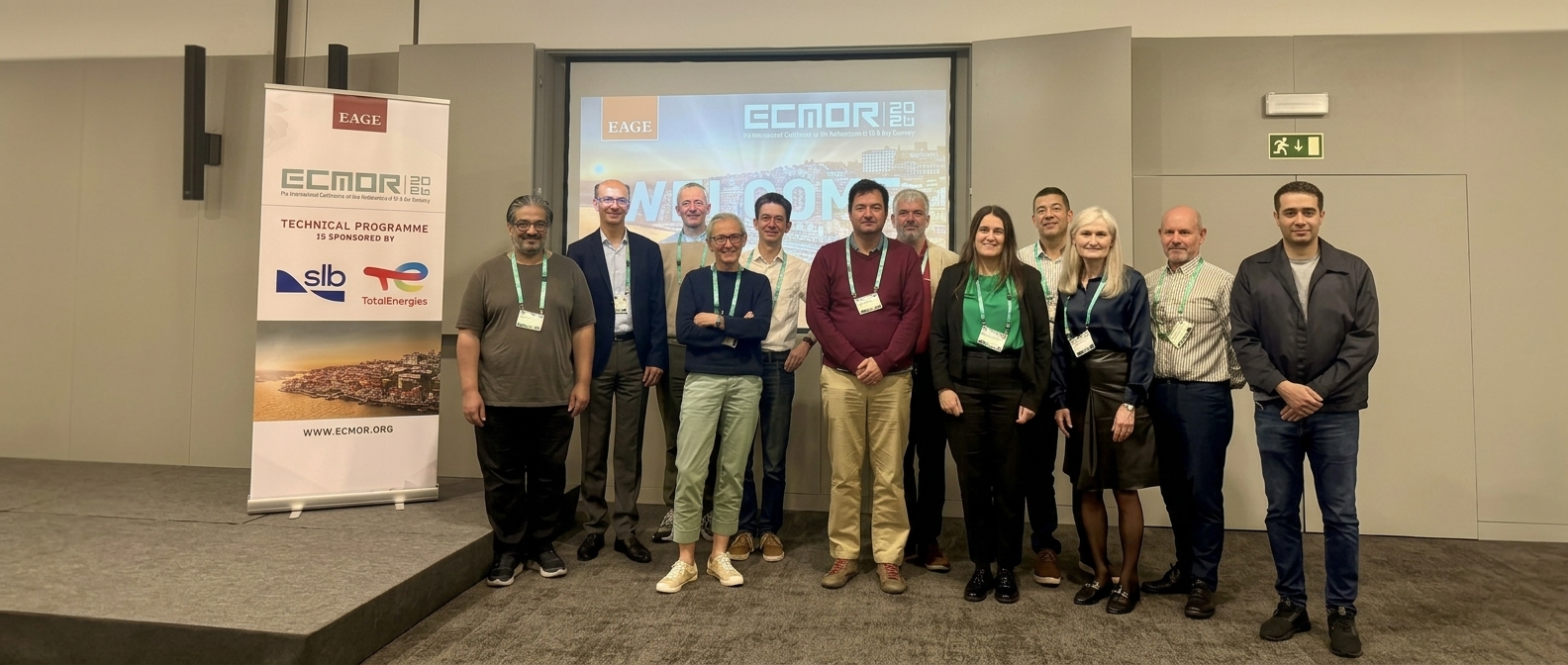
Event co-chairs Isabelle Faille and Arthur Moncorge report:
The 20th Conference on the Mathematics of Geological Reservoirs, ECMOR 2026, brought together 147 participants representing 24 nationalities for three days of technical discussion on the development and application of reservoir-simulation methods. Continuing a conference series that began in 1988, the event combined established mathematical and numerical foundations with emerging approaches based on machine learning, hybrid modelling and artificial intelligence.
A one-day workshop on large-scale underground hydrogen storage preceded the main programme. Together, the workshop and conference reflected the expanding role of reservoir simulation in the energy transition, particularly in the assessment and management of subsurface storage for hydrogen and carbon dioxide.
Large-scale underground hydrogen storage
The dedicated hydrogen-storage workshop addressed the complex physical, chemical and biological processes that must be represented when hydrogen is injected into and withdrawn from geological formations. Discussions included gas mixing, microbial activity, geochemical reactions and the prediction of produced-gas composition.

These issues distinguish hydrogen storage from many conventional reservoir-simulation problems. Hydrogen may interact with the formation, brine and resident gases in ways that influence recovery, purity and long-term storage performance. The workshop therefore highlighted the need for coupled modelling approaches that can account for multiphase flow, compositional changes and reactive or biochemical processes.
From challenging physics to robust numerical methods
The main conference programme covered a broad range of mathematical and computational developments in reservoir simulation. Multi-physics coupling, complex fluid behaviour and challenging computational meshes featured among the topics addressing the continuing challenge of making detailed physical models computationally practical.
Poro-mechanics and fractured-media modelling illustrated the importance of representing interactions between fluid flow and geological structure, while well–reservoir coupling approaches addressed the need to connect local well behaviour with field-scale reservoir dynamics. Other contributions considered reactive, geochemical, biochemical and compositional formulations, including the numerical treatment of systems involving multiple coupled processes.
A central objective for ECMOR participants is to develop numerical strategies that scale to realistic problems and can be incorporated into engineering workflows. Advances in nonlinear solvers, mesh generation, coupling strategies and high-performance computation therefore remain central to the field, helping to bridge the gap between sophisticated physical models and their reliable use in practical reservoir studies.
Energy-transition applications
Carbon dioxide and hydrogen storage were prominent applications throughout the programme. In both cases, reservoir simulation must support decisions involving injectivity, containment, pressure evolution, monitoring and the response of the surrounding geological system.
The keynote presentation by Prof. Ruben Juanes of MIT focused on induced seismicity and the potential for fluid injection to generate human-induced earthquakes. It provided an effective illustration of how mathematical and computational modelling can contribute to understanding and assessing the risks associated with subsurface fluid injection. The audience clearly appreciated the presentation. It was engaging and easy to follow, combining clear explanations of the underlying models with a real case study.
Uncertainty quantification and machine learning
Uncertainty quantification formed another important strand of the programme. Contributions addressed methods for characterising uncertainty, data assimilation and history matching, with the objective of improving model calibration and making predictions more informative for decision-making.
Machine-learning approaches were discussed in several forms, including proxy models, physics-informed methods and hybrid workflows that combine data-driven components with conventional numerical simulation. Such approaches can help reduce computational cost, accelerate repeated simulations and support optimisation or uncertainty analysis.
The programme nevertheless maintained a strong connection to physical modelling. The value of machine learning in reservoir applications depends on the quality of the available data, the appropriateness of the training domain and the extent to which the resulting models respect known physical behaviour. Hybrid methods may therefore offer a practical route in which machine learning complements, rather than replaces, established simulation technology.
First steps towards agentic scientific workflows
Another emerging theme was the use of agentic workflows to support, for instance, simulation setup, workflow coordination and result analysis. Still exploratory and developing rapidly, this field appears highly promising and, as one of the presenters put it, is likely to be “a game changer.”
Looking ahead
As subsurface technologies expand into hydrogen storage, carbon management and other energy-transition applications, reservoir simulation will remain essential for assessing performance, uncertainty and risk. ECMOR 2026 illustrated how the field is evolving, preserving its numerical foundations while exploring new ways to make scientific workflows more efficient, integrated and accessible.
The conference also highlighted ECMOR’s open and constructive atmosphere, where numerous questions and lively discussions encouraged the exchange of ideas and helped shape the perspectives presented.
The papers of ECMOR 2026 are now available on EarthDoc (exclusively for EAGE members).

