
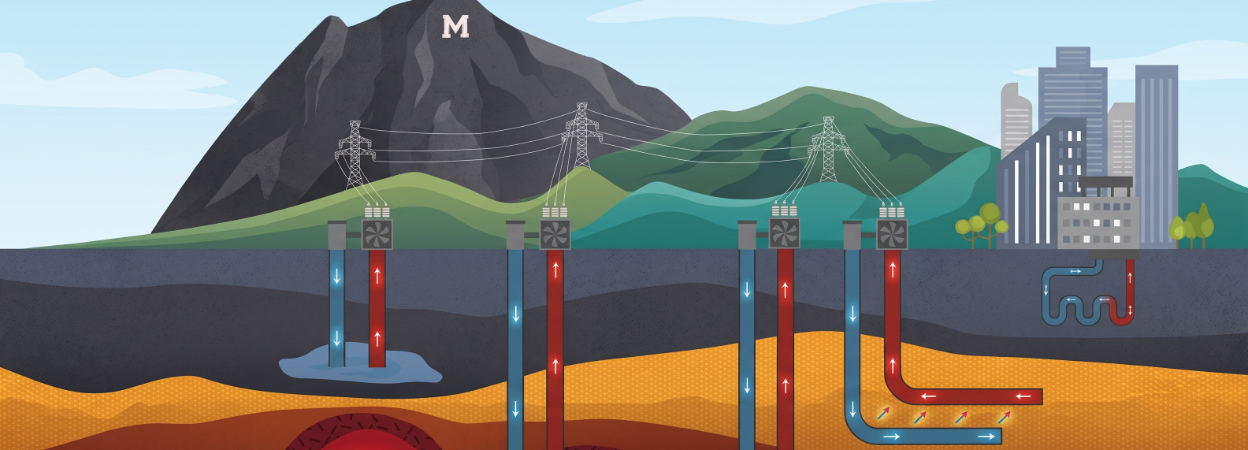
A new industry-academic research partnership at the Colorado School of Mines is developing advanced analytical tools to support drilling operations in deeper, hotter, and more demanding environments. The VERTEX Consortium integrates drilling, subsurface engineering, geoscience, and scientific modelling to improve well technology across its full life cycle, from exploration through to well repurposing.
As the energy sector pursues unconventional hydrocarbons, geothermal energy, carbon storage, and hydrogen, operators face significant challenges in high-pressure, high-temperature downhole conditions. Led by Mohamed Shafik Khaled, assistant professor of minerals and subsurface energy, VERTEX is building scientific machine learning (SciML) software that embeds the physics of the wellbore directly into machine learning models.
Current technologies developed by the consortium include WellTherm, a physics-informed neural operator for rapid downhole temperature modelling; GeoREV, a tool mapping near-wellbore fractures from drilling data; and the Wellbore Integrity Risk Assessment Model, which scores barrier reliability to help prioritise legacy wells for repurposing or abandonment.
The consortium validates its models at the university’s Edgar Experimental Mine and on-campus Earth Mechanics Institute. Diamondback Energy recently joined as the founding industry member, and VERTEX is currently recruiting additional partners across the subsurface energy value chain to help set future research agendas and provide field data for tool testing.
More on Vertex here.

