
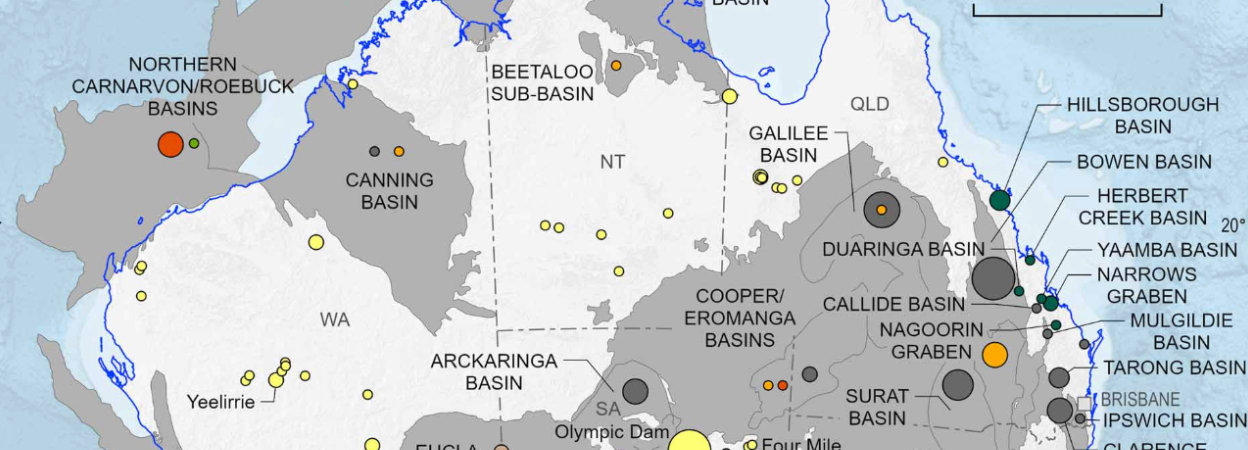
Australia’s subsurface is increasingly being viewed not only as a source of energy resources, but also as pore space for carbon storage, energy storage and emerging resources such as natural hydrogen, according to a new assessment by Geoscience Australia.
The Australia’s Energy Commodity Resources 2026 report shows that private-sector expenditure on energy exploration reached A$1.81 billion in 2024, an increase of 25% from A$1.45 billion in 2023.
However, the assessment highlights the continuing depletion of Australia’s conventional hydrocarbon resources. Total demonstrated conventional gas resources declined by 4.8% in 2024 as production continued to exceed the rate at which new resources were discovered. At 2024 production rates, the country’s conventional gas reserves have an estimated life of 15 years.

Crude oil resources fell by 15% during the year, with reserves estimated to support approximately eight years of production at current rates. By contrast, demonstrated unconventional gas resources increased by 23.4%, with the largest prospective resources located in the Bowen–Surat, Canning and Cooper basins and the Beetaloo Sub-basin.
The report identifies geological carbon storage as one of the fastest-developing areas of Australian subsurface activity. As of December 2025, the country had 19 commercial CO₂ storage projects, including the operational Gorgon and Moomba projects. Seventeen Commonwealth offshore greenhouse-gas storage assessment permits cover acreage in the Bonaparte, Browse, Northern Carnarvon, Perth, Otway, Bass and Gippsland basins, collectively representing work-programme commitments of approximately A$1 billion.
Australia’s demonstrated CO₂ storage resources reached 988 Mt in 2025, an increase of 47% year on year. A further 31 Gt of theoretical storage resources has been identified, although these remain sub-commercial and will require additional geological characterisation and appraisal.
Natural hydrogen exploration is also expanding. Geoscience Australia notes increased uptake of exploration permits targeting naturally occurring hydrogen, although the geological controls governing its generation and accumulation are not yet fully understood. Australia reported an estimated 8 PJ of contingent natural-hydrogen resources in 2025.
Geothermal activity remains at an earlier stage, with numerous exploration permits but limited deployment. Direct geothermal and ground-source heat-pump capacity reached 134 MWth in 2025, 25% higher than in 2023. Geoscience Australia expects technological advances to broaden the country’s longer-term geothermal potential.
Read the full Australia’s Energy Commodity Resources 2026 analysis.
Image credit: Geoscience Australia

