
We propose dip-guided Fresnel volume migration (dip-guided FVM) and apply it to SEAM-simulated and field-acquired distributed acoustic sensing (DAS) VSP datasets. In the proposed method, the Fresnel weighting function, a key component of standard FVM, is enhanced using structural dip information. The dip information not only eliminates the requirements of the standard approach, such as complex backward ray tracing and estimation of emergence or take-off angles from input seismic gathers, but also reduces migration artifacts caused by complex diffracted waves and sparse datasets. Dip-guided FVM aligns the propagation angle — derived from the phase slowness vectors — with the bedding-plane orientation in the isochrone domain, thereby suppressing destructive interference in the migrated images. We demonstrate that dip-guided FVM produces superior images compared with Kirchhoff migration. The frequency content of dip-guided FVM is nearly equivalent to that of Kirchhoff migration. Compared with Kirchhoff migration, dip-guided FVM produces accurate angle-domain common-image gathers (ADCIGs), which are commonly used for velocity model updating and amplitude variation with angle (AVA) analysis. The computation time of dip-guided FVM is approximately twice that of Kirchhoff migration.
Introduction
Raytrace- or traveltime-based migration methods are derived under high-frequency asymptotic assumptions and therefore tend to emphasise higher-frequency components in the reconstructed image, whereas wave-equation-based migrations propagate full wavefields and may be subject to numerical dispersion constraints (e.g., Biondi, 2006; Yilmaz, 2001). Kirchhoff migration (e.g., Schneider, 1978), one of the most widely used raytrace-based migration methods, generally relies on ray tracing (e.g., Červenỳ and Hron, 1980) to compute accurate two-way traveltimes. Advanced ray-tracing methods, including paraxial and dynamic ray tracing, solve the eikonal and transport equations to simulate wavefront propagation and compute traveltime, phase, and amplitude information. However, predicting ray paths, traveltimes, and their interpolation is computationally intensive and becomes less accurate in complex geological settings. This limitation poses a serious challenge, as traveltime estimation significantly affects the quality of the migrated image. Oropeza and McMechan (2013) proposed a parsimonious migration method for tilted transversely isotropic (TTI) media, which is a simplified version of Kirchhoff migration designed to reduce the computational cost of ray tracing. The method uses anisotropic ray shooting directed by horizontal slowness at the surface and two-point ray tracing, while the imaging condition is achieved by mapping amplitudes according to the calculated traveltimes. As an alternative, solving the eikonal equation for first-arrival traveltimes, for instance using the finite-difference method (Rusmanugroho and McMechan, 2010), is more straightforward and computationally efficient (Vidale, 1988). Unlike ray tracing, this approximate solution does not compute multiple-arrival traveltimes. Instead, it estimates a pair of first-arrival traveltimes from the source and receiver locations to the image point, which is often sufficient for Kirchhoff migration. This solution provides accurate traveltimes even in rapidly varying velocity models (Liu et al., 2018). Compared with wave-equation-based migrations, Kirchhoff migration is well known for its efficiency and flexibility (Zhang et al., 2000). It offers fast computation and accommodates flexible input data such as common-shot, common-receiver, or common-offset gathers. In addition, Kirchhoff migration is capable of imaging steeply dipping structures.

Backprojection is one of the three fundamental components of seismic imaging (Claerbout, 1971). Claerbout (1971) suggested that the reflector mapping generally involves backward propagation of the time-reversed recorded waveform and forward propagation of a seismic source. By cross-correlating the two wavefields, the image of a point reflector can be obtained at zero lag time. Since then, several studies have improved the amplitude mapping in both the wave-equation- and raytrace-based migrations. Hill (1990) introduced Gaussian beam migration (GBM), in which amplitudes were back-propagated and summed within Gaussian beams that represent bundles of neighbouring ray paths. The method outperforms Kirchhoff migration, particularly in regions containing caustics and shadow zones. A Gaussian beam is constructed around a central ray, with its width determined by the propagation distance and migration velocity. By incorporating Gaussian beams, GBM mitigates the limitations of conventional ray theory and improves amplitude accuracy and numerical stability in complex velocity models, particularly in the presence of strong ray bending or caustics.
Buske et al. (2009) reduced artifacts caused by destructive interference in Kirchhoff migration by introducing the concept of the Fresnel volume, leading to the development of Fresnel volume migration (FVM). The first Fresnel volume is estimated from the traveltime difference between the source-image-receiver path and the corresponding paths through surrounding points. Typically, this traveltime difference is less than half a period (Watanabe et al., 1999). Hloušek et al. (2015) improved FVM by incorporating wavefield coherency into the Fresnel volume estimation. The coherency, quantified using the semblance coefficient, is computed by summing amplitudes across windowed neighbouring traces, enabling effective suppression of random noise. Rusmanugroho and Jaya (2023) applied FVM to limited-aperture DAS VSP data from a CO2 monitoring site, using direct-arrival traveltimes computed via the eikonal equation. The Fresnel-zone weighting improved reflector continuity and reduced migration artifacts compared with both Kirchhoff and RTM imaging. Their dataset was acquired in a relatively flat sedimentary setting in Canada; thus, the reported results reflect that structural environment rather than an inherent limitation of the method. Unlike wave-equation-based migration methods, in which geometrical spreading and obliquity are handled implicitly by the finite-difference solver, Kirchhoff-type migration methods require explicit amplitude compensation based on the incidence angle, source-to-receiver distance, and migration velocity (e.g., Schneider, 1978; Zhang et al., 2000).
Angle-domain common-image gathers (ADCIGs) generated by migration are commonly used for velocity model updating and amplitude variation with angle (AVA) analysis. Several wave-equation-based methods have been proposed to extract accurate ADCIGs; however, their computational cost remains high (e.g., Zhang and McMechan, 2011). In elastic VTI reverse-time migration (RTM), Zhang and McMechan (2011) separated the qP- and qS-wavefields using the Christoffel equation in the Fourier domain, following the approach of Dellinger and Etgen (1989). The ADCIG incidence angle was estimated from the angle between the source qP-wave polarisation direction and the reflector normal derived using the Hilbert transform. The extraction of ADCIGs from Kirchhoff migration (e.g., Liu et al., 2018) is relatively fast compared with wave-equation-based methods while remaining sufficiently reliable. Liu et al. (2018) estimated propagation angles using phase slowness vectors derived from a pair of direct-arrival traveltimes, which were computed using a dynamic programming approach based on Fermat’s principle. Jusri et al. (2022) extracted ADCIGs from a hard-rock environment dataset and showed that the amplitude variation with angle in FVM was less noisy and more coherent than that in Kirchhoff migration.
In this paper, we propose a novel Fresnel volume migration method guided by structural dip information (dip-guided FVM). The method estimates first-arrival traveltimes by solving the eikonal equation and does not require backward ray tracing or emergence angle estimation from the input seismic data. The proposed approach is validated using a synthetic DAS VSP dataset generated from the SEAM model and field-acquired 3D DAS VSP data. Finally, the performance of dip-guided FVM is compared with that of Kirchhoff migration.
Theoretical framework
Following Schneider (1978), the Kirchhoff integral for the scalar wave equation is given by
where denotes a subsurface image point, is a weighting function that compensates for the effects of spherical divergence and obliquity on the mapped amplitude, is the first time derivative of the recorded wavefield, and represents the total traveltime of the seismic wave from the source to the image point and from the image point to the receiver. The recorded wavefield can also be represented in terms of particle velocity, displacement, or acceleration. The first-arrival traveltimes, and , are estimated by solving the eikonal equation using the fast-marching method (Zhao, 2005).
Introducing an additional weighting function into equation (1) (e.g., Buske et al., 2009; Rusmanugroho and Jaya, 2023) leads to the formulation of Fresnel volume migration:
where is calculated based on the Fresnel volume (e.g., Hloušek et al., 2015; Watanabe et al., 1999) associated with the isochrone, which is defined as a line or surface of constant traveltime:
where represents the path-length difference between the ray paths connecting the source and receiver through the reference image point and surrounding image points (Červenỳ and Soares, 1992), is the radius of the first Fresnel zone (Yilmaz, 2001), is velocity, and is a dominant frequency. The Fresnel zone, where constructive interference occurs, defines the region from which reflected seismic energy reaches the receiver with a path-length difference within half a wavelength (Sheriff, 1980). The reflected energy outside the first Fresnel zone is predominantly destructive, producing unwanted spurious events. In equation (3), we apply a taper to the Fresnel weighting that extends into the second Fresnel zone, defined as an annular region between and .
In general, migration produces either a full-stack image or a partial (angle) stack image obtained by summing over angle-related common-image gathers (ADCIGs), which can be used to analyse variations in rock and fluid properties. One of the key parameters in ADCIGs is the opening angle, defined as the angle between the source and receiver ray directions at an image point. Following Liu et al. (2018), we estimate the opening angle as follows:
where and are phase slowness vectors obtained by taking the spatial derivatives of the traveltime fields and , respectively, corresponding to wave propagation from the source and receiver to the image point. The incidence angle for the ADCIGs is calculated as one-half of the opening angle (Mahmoudian and Margrave, 2009). The phase slowness vectors in equation (4) can be expressed in terms of their Cartesian components as follows:
The illuminating vector, defined as the outward-pointing vector of the summed source and receiver phase-slowness fields, is expressed as:
where the components are defined as:
Unlike ray tracing, first-arrival traveltimes computed from the eikonal equation generally do not provide sufficient information about reflector orientation. Let denote the unit normal vector to a bedding plane (reflector). The dip angle () and azimuth () of the bedding plane can be related to the components of as follows:
Here, depth is defined as positive downward. The dip angle and azimuth of the reflector are estimated using the gradient structure tensor (GST) method (Bakker et al., 1999), from either the interval velocity model or an existing migrated volume.
The reference point of the first Fresnel zone on the isochrone is determined by finding the point that minimises the angle , where
Figure 1a illustrates the Fresnel volume where the illumination vector is parallel to the normal of a dipping reflector. Figure 1b shows the Fresnel volume associated with a 45° dipping reflector, computed using equation (3).
Application and results
Simulated data
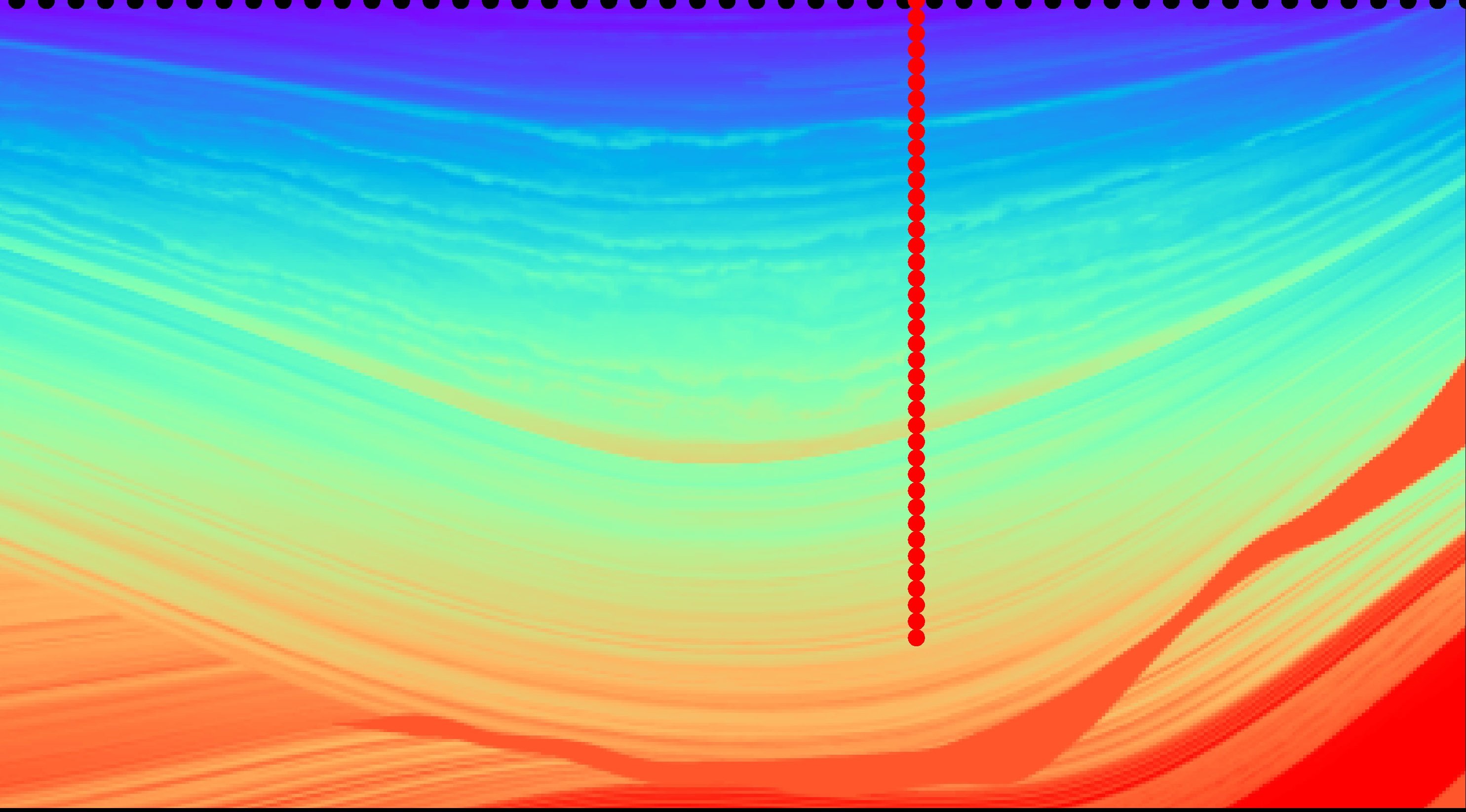
First, we test the proposed method using simulated VSP data generated from a portion of the SEAM Phase I model, as shown in Figure 2a. Note that this approach is also applicable to surface seismic data. The SEG Advanced Modelling (SEAM) model is one of the standard geological models used for testing new methods in geophysics (Fehler and Larner, 2008). The model used in this study contains various geological features, including sedimentary layers, unconformities, and a salt body. The P-velocity ranges from 1947 to 4800 m/s. The highest velocities near the bottom of the model are associated with the salt body.
Figure 2b shows the structural dip, defined as the angle between the bedding plane and the horizontal direction, which varies from -33° to 78°. The dip angle is estimated from the seismic traces using the gradient structure tensor (GST) method. The symmetric tensor is derived from first-order Gaussian derivatives, and its largest eigenvalue determines the local orientation (Bakker et al., 1999). The input seismic traces for the GST are obtained by convolving a Ricker wavelet with a dominant frequency of 25 Hz with the reflectivity derived from the SEAM velocity model (Figure 2a). The reflectivity is computed from acoustic impedance contrasts.
The SEAM model consists of 401 × 251 grid points with a spatial sampling interval of 10 m, corresponding to a model size of 4000 m × 2500 m. As shown by the black dots in Figure 2a, 101 shots are uniformly distributed along the surface from 0 to 4000 m. The head of the vertical well is located at (X, Z) = (2500 m, 0 m). The red dots indicate receiver locations in the borehole, distributed from 0 to 2000 m depth with a 10 m interval. The VSP data with a shot interval of 40 m are used for Kirchhoff migration, and the resulting images are compared with those obtained using the proposed dip-guided FVM.
The VSP data are modelled using the inverse Kirchhoff integral (e.g., Santos et al., 2000; Claerbout, 2010). A Ricker wavelet with a dominant frequency of 50 Hz is used for the simulation. Figure 3 shows representative VSP data generated by sources located at offsets of 1600 and 2400 m. Kirchhoff modelling has the advantage of generating ideal seismic datasets without requiring additional processing, such as upgoing and downgoing wavefield separation or multiple attenuation. Furthermore, it enables faster simulation of high-frequency seismic data compared with finite-difference methods. In Figure 3, the first-arrival P-wave, which often dominates the migrated image near the borehole, has been muted. As indicated by the blue arrows, weak diffractions are generated by point scatterers located at the model boundaries and are not fully suppressed by constructive interference according to Huygens’ principle.
Figure 4 presents a comparison of the migrated images obtained using Kirchhoff migration and dip-guided FVM. As indicated by the blue arrows, the Kirchhoff image contains artifacts resulting from incompletely collapsed diffraction events. Furthermore, the Kirchhoff migration operator is subject to aliasing because of the trace spacing and steep structural dips (up to 78°), consistent with the observations of Gray (2008). In contrast, dip-guided FVM produces cleaner and sharper images. The FVM image shows improved continuity of the dipping reflectors and near-borehole structures between depths of 500 and 2000 m. Dip-guided FVM, in which Fresnel weighting is guided by structural dip, effectively suppresses artifacts caused by limited illumination and sparse data sampling. Moreover, the method does not require backward ray tracing from each receiver to the image points or estimation of emergence (take-off) angles.
Figure 5 shows representative angle-domain common-image gathers (ADCIGs) obtained using Kirchhoff migration and dip-guided FVM. The incidence angles are calculated using equation (4), and the corresponding amplitudes are mapped according to equation (1) or (2), with compensation for spherical divergence and obliquity. The Kirchhoff angle gather is noisy and may not be suitable for AVA analysis. In contrast, the FVM angle gather clearly shows amplitude variations. In the shallower part of the section and at incidence angles smaller than 20°, the amplitudes are not well imaged since the angle gather is located approximately 750 m away from the well. The stronger amplitudes observed at depths greater than 1750 m are associated with the salt body and sedimentary layers with higher velocity contrasts.
Field data
Furthermore, we test the proposed FVM using a field dataset. Similar to the synthetic case, which is used as a benchmark for evaluating the performance of dip-guided FVM, Kirchhoff migration is also performed for comparison. First, we apply a 2D approach to closely examine the performance of both methods. Then, we present the 3D migration results using a full 3D DAS VSP dataset.
Figure 6 illustrates the overall acquisition geometry of the sources and receivers for the 3D DAS VSP survey. The red line represents a deviated borehole instrumented with a fibre-optic cable comprising 218 DAS sensors, while the black dots denote the 4850 shot locations. The DAS VSP data were acquired during ongoing production. To evaluate the noise suppression capability of the proposed FVM, we first apply it to the 2D survey line indicated by the green line in Figure 6.
Figure 7 shows the P-wave velocity model and the corresponding structural dip distribution. The red dots indicate the location of a highly deviated borehole, which inclines downward with a maximum deviation angle of 58.78°. The 3D velocity model is generally constructed by extrapolating 1D velocity profiles from individual wells using interpreted geological surfaces. As shown in Figure 7a, the geological structures can be broadly divided into two regions. To the left of the well, the geology is relatively simple, characterised by gentle dips ranging from -15° to 15° (Figure 7b). In contrast, to the right of the well, the structures are more complex and associated with faults, with dip angles ranging from -40° to 40°.
The model used in this study consists of 303 × 626 grid points with horizontal and vertical spatial sampling intervals of 13.98 m and 4 m, corresponding to a model size of 4222 m × 2500 m. The borehole head is located 2117.30 m from the model origin. The maximum and minimum source-to-borehole offsets are 2117.20 and 230.54 m, respectively. For migration, common-shot gathers of the upgoing wavefield from 58 selected sources are used as input. The fibre-optic cable installed in the deviated well consists of 218 sensors with an average depth interval of 8 m. The cable extends from a true vertical depth (TVD) of 1.73 to 1286.65 m. The DAS VSP data have a temporal sampling interval of 0.002 s.
Since DAS sensors measure strain rate, the recorded data are first time-integrated to obtain the displacement gradient measured by geophones (Näsholm et al., 2022). Following Hinds et al. (1996), the DAS VSP data are then processed through deconvolution, filtering, wavefield separation, and spectral balancing. Figure 8 shows that trace balancing enhances weak amplitudes generated by a near-borehole shot located at 1341.51 m. The response recorded by the fibre-optic cable is often weak when the cable orientation is nearly perpendicular to the propagation direction of the incoming wavefield (Rusmanugroho and Jaya, 2023).
Figures 9a and 9b show the migrated images obtained using Kirchhoff migration and dip-guided FVM, respectively. These images are generated directly from equations (1) and (2) without any post-stack processing. As indicated by the blue arrows, dip-guided FVM provides improved imaging compared with Kirchhoff migration. In the Kirchhoff image, artifacts result from the incomplete collapse of diffracted waves and migration operator aliasing caused by sparse data sampling and steep structural dips. In the FVM image, parts of the section at distances less than 1250 m and greater than 2750 m remain poorly imaged because of limited seismic illumination. Overall, dip-guided FVM produces a more accurate subsurface image, revealing previously obscured geological structures without significant loss of frequency content. The imaging quality of both methods is further improved in the 3D migration results.
Figure 10 compares the 3D migration results obtained using Kirchhoff migration and the proposed dip-guided FVM. The final migrated images are generated by stacking the individual migrated images from 4850 shots. The inline (Figures 10a and 10c) and crossline (Figures 10b and 10d) sections correspond to the yellow lines shown in Figure 6. The inline and crossline sections are extracted at distances of 750 and 1687 m, respectively.
Artifacts observed in the 2D results largely disappear in the 3D migration results for both methods. The use of 3D data, which better captures the true subsurface structures, produces more accurate images. The increased spatial coverage in 3D improves the signal-to-noise ratio (S/N) of seismic events (Rusmanugroho and McMechan, 2012). In addition, 3D acquisition reduces out-of-plane energy effects commonly observed in 2D migration (Drummond et al., 2004). Dense spatial sampling improves subsurface illumination and increases the contribution of constructive wavefield interference during imaging.
Some differences between Kirchhoff migration and dip-guided FVM are highlighted by the blue arrows. In the Kirchhoff image, some diffracted energy is not fully collapsed in the central region. In contrast, the FVM image exhibits reduced artifacts and improved lateral continuity of subsurface structures. The fibre-optic sensors located in the nearly vertical upper section of the borehole provide broader illumination coverage, allowing coherent energy above the maximum cable depth of 1286 m at the intersecting inline and crossline sections to be clearly observed. A similar observation was reported by Rusmanugroho and Jaya (2023). Meanwhile, sensors located in the highly deviated lower section provide limited illumination coverage.
Figures 11a and 11b show angle-domain common-image gathers (ADCIGs) extracted from Kirchhoff migration and dip-guided FVM, respectively. The five panels correspond to crossline locations at 750, 875, 1000, 1125, and 1250 m. Dip-guided FVM produces cleaner and sharper ADCIGs than Kirchhoff migration. The strong amplitudes observed near the top of each panel are likely to be caused by inaccuracies in the near-surface velocity model. The extraction of common-image gathers (CIGs) from VSP data is generally more challenging than from surface seismic data because of acquisition geometry, particularly in the presence of highly deviated wells (Liang and Zhang, 2025).
Conclusions
We demonstrate that the proposed dip-guided Fresnel volume migration (dip-guided FVM), which incorporates structural dip information, produces more accurate and cleaner images than Kirchhoff migration. The proposed method does not require backward ray tracing or emergence angle estimation. The frequency content of the dip-guided FVM image is comparable to that of the Kirchhoff image. The computational cost of dip-guided FVM is approximately twice that of Kirchhoff migration, mainly due to the additional calculations required for Fresnel weighting.
Acknowledgements
We would like to thank the management of Petronas for permission to publish this work. We acknowledge the use of the SEAM model in this study. We also thank Clement Kostov and the anonymous reviewers for their constructive comments and suggestions, which have helped improve the manuscript.
References
- Bakker, P., van Vliet, L.J. and Verbeek, P.W. [1999]. Edge preserving orientation adaptive filtering. Proc. IEEE Computer Society Conference on Computer Vision and Pattern Recognition, 535-540.
- Biondi, B. [2006]. 3D seismic imaging. Society of Exploration Geophysicists.
- Buske, S., Gutjahr, S. and Sick, C. [2009]. Fresnel volume migration of single-component seismic data. Geophysics, 74(6), WCA47-WCA55.
- Červenỳ, V. and Hron, F. [1980]. The ray series method and dynamic ray tracing system for three-dimensional inhomogeneous media. Bulletin of the Seismological Society of America, 70(1), 47-77.
- Červenỳ, V. and Soares, J. [1992]. Fresnel volume ray tracing. Geophysics, 57(7), 902-915.
- Claerbout, J.F. [1971]. Toward a unified theory of reflector mapping. Geophysics, 36(3), 467-481.
- Claerbout, J.F. [2010]. Basic earth imaging. Stanford University.
- Dellinger, J. and Etgen, J. [1989]. Wave-type separation in 3-D anisotropic media. 59th SEG Annual International Meeting, Expanded Abstracts, 977-979.
- Drummond, B.J., Hobbs, R.W. and Goleby, B.R. [2004]. The effects of out-of-plane seismic energy on reflections in crustal-scale 2D seismic sections. Tectonophysics, 388(1-4), 213224.
- Fehler, M. and Larner, K. [2008]. SEG Advanced Modeling (SEAM): Phase I first year update. The Leading Edge, 27(8), 1006-1007.
- Gray, S. [2008]. Frequency-selective design of the Kirchhoff migration operator. Geophysical Prospecting, 40, 565-571.
- Hill, N.R. [1990]. Gaussian beam migration. Geophysics, 55(11), 1416- 1428.
- Hinds, R.C., Anderson, N.L. and Kuzmiski, R.D. [1996]. VSP interpretive processing: Theory and practice. Society of Exploration Geophysicists.
- Hloušek, F., Hellwig, O. and Buske, S. [2015]. Improved structural characterization of the Earth’s crust at the German Continental Deep Drilling Site using advanced seismic imaging techniques. Journal of Geophysical Research: Solid Earth, 120(10), 6943-6959.
- Jusri, T., Buske, S., Hellwig, O. and Hloušek, F. [2022]. Angle-domain common-image gathers from Fresnel volume migration. Solid Earth Discussions, 2022(2022), 1-23.
- Liu, S., Gu, H., Tang, Y., Bingkai, H., Wang, H. and Liu, D. [2018]. Angle-domain common imaging gather extraction via Kirchhoff prestack depth migration based on a traveltime table in transversely isotropic media. Journal of Geophysics and Engineering, 15(2), 568575.
- Liang, H. and Zhang, D. [2025]. Imaging enhancement of VSP data with optimal aperture RTM. SPE Middle East Oil and Gas Show and Conference, Expanded Abstracts, D031S115R006.
- Mahmoudian, F. and Margrave, G.F. [2009]. A review of angle domain common image gathers. CREWES Research Report, 21, 1-12.
- Näsholm, S.P., Iranpour, K., Wuestefeld, A., Dando, B.D., Baird, A.F. and Oye, V. [2022]. Array signal processing on distributed acoustic sensing data: Directivity effects in slowness space. Journal of Geophysical Research: Solid Earth, 127(2), 413-420.
- Oropeza, E.V. and McMechan, G.A. [2013]. Anisotropic parsimonious prestack depth migration. Geophysics, 78(1), S25-S36.
- Rusmanugroho, H. and Jaya, M.S. [2023]. Robust and high resolution imaging of limited-aperture DAS VSP. First Break, 41(9), 37-43.
- Rusmanugroho, H. and McMechan, G.A. [2010]. Modeling sensitivity of 3D, 9-C wide azimuth data to changes in fluid content and crack density in cracked reservoirs. Geophysics, 75(5), T155-T165.
- Rusmanugroho, H. and McMechan, G.A. [2012]. Sensitivity of estimated elastic moduli to completeness of wave type, measurement type, and illumination apertures at a receiver in multicomponent VSP data. Geophysics, 77(1), R1-R18.
- Schneider, W.A. [1978]. Integral formulation for migration in two and three dimensions. Geophysics, 43(1), 49-76.
- Sheriff, R.E. [1980]. Nomogram for Fresnel-zone calculation. Geophysics, 45(5), 968-972.
- Santos, L.T., Schleicher, J., Tygel, M. and Hubral, P. [2000]. Seismic modelling by demigration. Geophysics, 65(4), 1281-1289.
- Vidale, J. [1988]. Finite-difference calculation of travel times. Bulletin of the Seismological Society of America, 78(6), 2062-2076.
- Watanabe, T., Matsuoka, T. and Ashida, Y. [1999]. Seismic traveltime tomography using Fresnel volume approach. 69th SEG Annual International Meeting, Expanded Abstracts, 1402-1405.
- Yilmaz, Ö. [2001]. Seismic data analysis: Processing, inversion, and interpretation of seismic data. Society of Exploration Geophysicists.
- Zhang, Y., Gray, S. and Young, J. [2000]. Exact and approximate weights for Kirchhoff migration. 70th SEG Annual International Meeting, Expanded Abstracts, 1036-1039.
- Zhao, H. [2005]. A fast-sweeping method for eikonal equations. Mathematics of Computation, 74(250), 603-627.
- Zhang, Q. and McMechan, G.A. [2011]. Common-image gathers in the incident phase-angle domain from reverse time migration in 2D elastic VTI media. Geophysics, 76(6), S197S206.

