
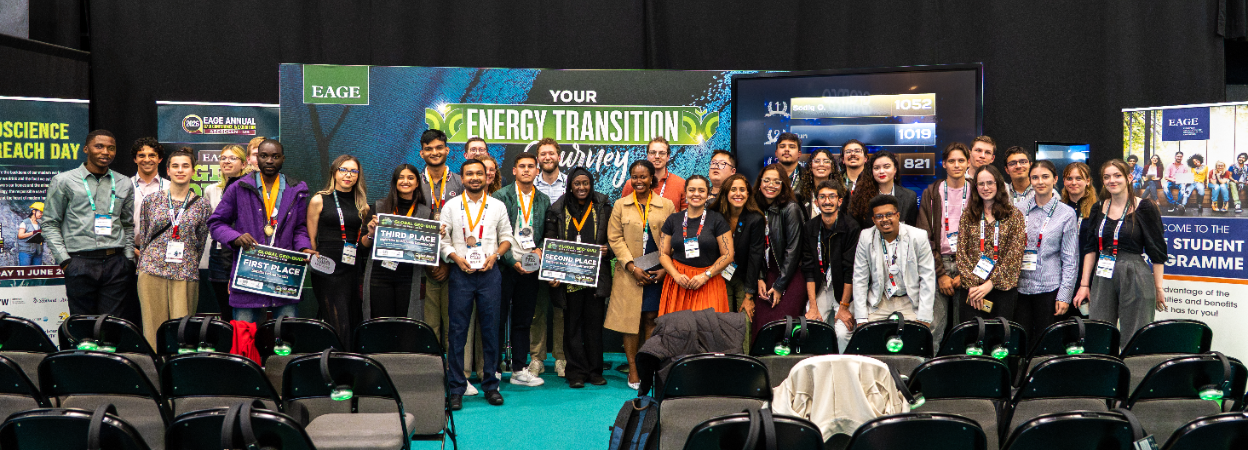
A group of industry leaders recently gathered in the UK to discuss how to solve a skills crisis that threatens both the need to find more oil and gas and the energy transition beyond.
Geoscience has a key part to play in finding solutions to the world’s long-term energy challenges, but the question repeatedly being asked is where the next generation of geoscientists are going to come from?
Finding credible answers to that question will become increasingly urgent over the next few years because a large tranche of geoscientists will be retiring and as the EAGE annual conference in Aberdeen recently heard, artificial intelligence cannot be relied upon to cover the gap. Indeed, in the UK alone some 35% of all chartered geoscientists are projected to reach retirement age within the next decade, according to data from the Geological Society of London. Globally, the geoscience industry is facing a skills and recruitment crisis.

Since 2014 the number of university students in the UK studying traditional geology courses has dropped by 43%. Universities such as Nottingham, Sussex, Kingston, West of England and Newcastle have closed their geoscience departments because they can no longer sustain the high costs of laboratories, equipment, and field trips. Fewer students are applying and course numbers are shrinking, according to The Times Educational Supplement.
Many other earth science departments across Europe face severe budget pressures, including at Delft University of Technology, while Vrije Universiteit Amsterdam decided to retain a slimmed-down Earth Sciences department only after widespread protests and strong opposition from students, staff and external organisations.
Some universities have modified their geoscience offer, covering the subject in degrees such as climate science, environmental geoscience or renewable energy engineering, but the industry is still concerned that exploiting the oil and gas which the world is still clearly going to need in the next 20 years at least will not be possible unless a new generation of petroleum geology savvy specialists are trained up.
“I thought hell would freeze over before Imperial College London stopped offering a Petroleum Geoscience course.”
‘I thought hell would freeze over before Imperial College London stopped offering a Petroleum Geoscience course,’ said Professor John Underhill, former president of EAGE and professor of energy transition at the University of Aberdeen, whose university is one of the few in the UK that still offers courses in petroleum geology.
Gautier Baudon, VP exploration excellence and transformation at TotalEnergies, told the session on Geoscience: Adapting to a New Professional Landscape at the recent EAGE Annual in Aberdeen: ‘In 2035 we will still need an average of 100 billion barrels of oil equivalent. In terms of current reserves, we need to find something like an extra 20/25 billion barrels to meet that requirement, which will require the expertise of geoscientists.’
There is general agreement that geoscientists will spend less time preparing data and building models, as the AI revolution continues to advance, but more time analysing the rocks and quality controlling the models generated by AI. The message from the EAGE Annual was clear: the best geoscientists are the ones that have seen the most rocks and they will have far more time to do that because of AI.
With less time needing to be spent on laborious and mundane tasks that AI can do, it becomes a much more attractive profession, but the main challenge is communicating that to young people who view oil and gas exploration as a ‘dirty industry’. The sector’s traditional ties to fossil fuel and mining industries have made many young people hesitant to pursue it as a career, despite the critical role geoscientists play in green energy and critical mineral extraction, both vital for lowering carbon emissions. They also doubt whether the sector offers long-term career prospects because of the uncertainty and flux in the industry.
Everyone agrees that governments, energy companies, universities and learned societies need to collaborate and launch campaigns to spread a message to children in schools that geoscience is an exciting industry that can do much to solve the world’s problems, including achieving the UN Sustainable Development Goals. Recent initiatives such as the ‘This Is Geoscience campaign’, spearheaded by the Geological Society of London, are to be applauded. Yet, any such drive to provide educational material in schools and foster a lifelong love of the subject in children would already be trying to reverse a long-term decline. For example, in the UK in the 1980s around 4,000 young people took a geoscience-related subject such as geology at A-level. That figure is now less than 1,000 according to the Geological Society of London.
Carla Riddell, chief technical officer, Serica Energy said that her company sponsored young people to attend the recent EAGE Annual Conference and Exhibition in Aberdeen. ‘As an industry, we have interesting projects, problems that need solving and we invest in people. We also have much more diversity in our team than in the past and that leads to better decisions. Serica is sponsoring young people to come to the conference to build networks and see inspirational people. If you can’t see it, you can’t be it.’
“If you can’t see it, you can’t be it.”
John Underhill said: ‘It’s not helpful to use language like “clean energy” or “dirty energy”. We have to do better at communicating that having a career in geoscience and engineering will help to save the planet in terms of emissions reductions and also enable growth in energy supply that the world needs. We have to do better in raising public awareness about how important energy is.’
John Stephenson, vice president subsurface and wells technology at bp, said: ‘People are not studying geoscience as a degree. What I hope is that geoscience can be pivoted to a place where it is seen as one of the core disciplines that will drive the energy transition as a whole because it is the thing that connects all the disciplines. It characterises uncertainty and enables us to think through what might be and not make the wrong investment decisions.’
Gaultier Baudon added: ‘We are not blaming academia. Academia is suffering from a lack of means. Politicians have to understand what’s critical for economies. We did a bad job for plenty of reasons. When I was a kid studying physics and chemistry, the small Elf logo was everywhere because the industry was supporting education. Now there’s a feeling that you are bad for influencing the kids. But we need to help each other. With new energies such as lithium, hydrogen and helium the world will still require more geoscientists. AI tools will be augmented by geoscientists to assess the multi-scenarios that will hopefully lead to better results.’
Notwithstanding the fact that there is still a good pipeline of petroleum geoscientists from the Middle East, Latin America and Africa, where the exploration of oil and gas is still seen as socially acceptable and a prerequisite for economic growth and prosperity, the overall decrease in geoscientists coming through will have a deleterious impact on the development of low carbon technologies including carbon capture, hydrogen and geothermal. ‘Without those skills, the transition will be slower,’ said Zuo X, Viridien’s development manager for Sub-Saharan Africa.
A study by the Subsurface Task Force (an independent group of industry experts, academics and professionals working with the UK North Sea Transition Authority) shows that there will be an urgent need for a new generation of geoscientists to work on carbon and hydrogen storage, geothermal and wind energy projects. The UK Carbon Capture and Storage (CCS) Task and Finish Group warns of a coming skills gap for such complex energy transition projects – a gap that can be filled by a steady pipeline of geoscientists trained to advanced MSc or PhD-level.
In terms of attracting postgraduate students to study geoscience, universities can’t do it on their own and will need the support of governments to bolster a vital industry.
All the EAGE panellists agreed that a new generation of geoscientists are needed, trained in applied geoscience to PhD standard to ‘gain the expertise to face and challenge what AI will give,’ said Baudon. ‘Be extremely good at what you are doing and be critical about how things are working. Don’t take for granted what’s given by AI. That will protect your job.’
Wadii El Karkouri, EVP imaging and technology at TGS, said: ‘We need to be training people differently and treating them differently to how I was treated 20 years ago. Now when we take interns, we have to give them more challenging problems in signal processing imaging and interpretation. Machine learning is helping us to do things faster so that we can focus on a better FWI starting model and build multiple scenarios to address uncertainty.’
However, many MSc courses, including engineering geology and geotechnical engineering, have closed or report falling student enrolment numbers, including those at the universities of Cardiff and Portsmouth.
There is general agreement that the energy industry has to step up and do more, by strengthening partnerships with universities and expanding bursaries and scholarships on offer to secure the talent it needs. The perception in the industry that an MSc is an essential requirement for a working geoscientist should also be questioned, according to a group of industry figures writing in Geoscientist, e.g., how can geology and physical geography graduates be trained to the required standard, and, if not, can such people be supported to gain an MSc-level qualification as part of continuing professional development while remaining in paid employment?
For the hundreds of students attending the conference, it was hoped that the message from Kevin McLachlan, VP Exploration at Chevron, resonated. ‘We expect oil and gas to be part of the landscape for decades to come and, with that mindset, we definitely need geoscientists for the long term.’
“This is the most exciting industry on the planet. We solve some of the hardest, toughest challenges on planet earth.”
All the panellists testified to what a brilliant career geoscience is. Rachael Moreland, VP head of energy software & technology solutions at S&P Global Energy said: ‘This is the most exciting industry on the planet. We solve some of the hardest, toughest challenges on planet earth using some of the biggest, scariest datasets and who wouldn’t want to be a part of it? I decided not to go to medical school to do this.’

