
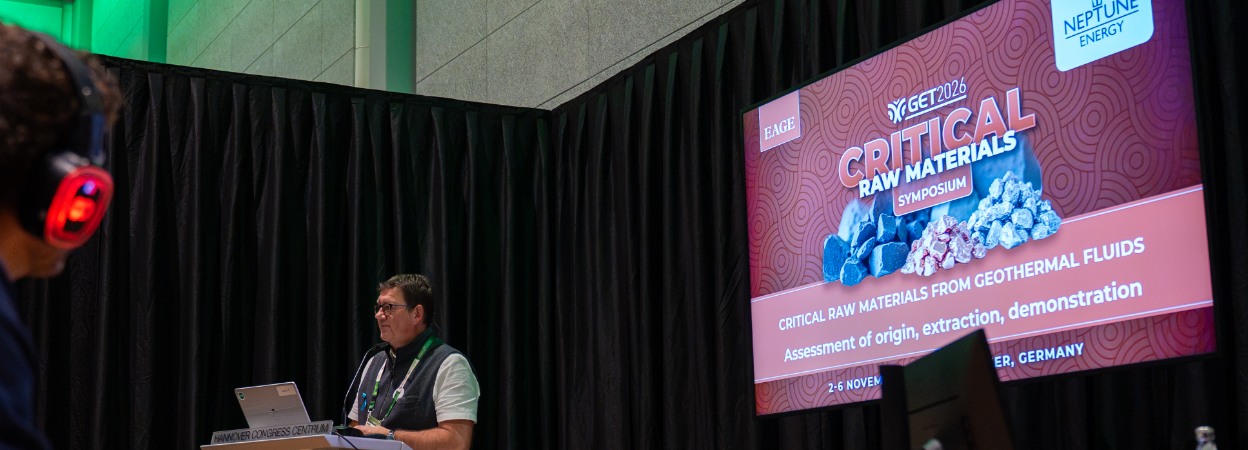
Dominik Soyk (Neptune Energy) and Andor Lips (TNO – Geological Survey of the Netherlands), co-chairs of the GET 2026 Critical Raw Materials Symposium report:
For the first time, the EAGE Global Energy Transition Conference & Exhibition (GET) featured a dedicated Critical Raw Materials (CRM) Symposium. The symposium included fourteen sessions and a dedicated poster session, spanning all three conference days in Hannover. It brought together geoscientists, engineers, policymakers, representatives from geological surveys, industry professionals, and academia to discuss how Europe can secure the raw materials essential for its energy transition.
Why critical raw materials are an integrated part of GET
The shift from a fossil fuel-based energy system to a renewable energy system is, above all, a materials challenge. Wind turbines, power grids, batteries, and electrolysers all depend on raw materials whose supply is often concentrated in a limited number of countries.
The European Union currently identifies 34 critical raw materials, 17 of which are classified as strategic. Through the Critical Raw Materials Act (CRMA), the EU has established a set of benchmarks for 2030. These include achieving domestic extraction capacity equivalent to at least 10% of the EU's annual consumption of strategic raw materials, developing processing capacity sufficient to meet 40% of annual consumption, and supplying at least 25% of demand through recycling. In addition, no more than 65% of the EU's supply of any strategic raw material should originate from a single third country. Given that these objectives ultimately support the fight against climate change, their importance can hardly be overstated.
Given EAGE's long-standing roots in petroleum geology and engineering, one of the symposium's prominent themes was the potential recovery of critical raw materials from subsurface brines and geothermal fluids. Discussions covered the full project lifecycle, from assessing geological potential to evaluating commercial feasibility.
The conference location also added particular relevance to this topic. Hannover is close to Neptune Energy's Altmark Lithium Extraction (ALE) project, which has been designated a Strategic Project under the CRMA. This proximity enabled a pre-conference field trip, during which twelve participants visited repurposed gas infrastructure and an operational direct lithium extraction (DLE) pilot at the ALE site.
Beyond the potential of brines and geothermal fluids as sources of critical raw materials, the symposium addressed the broader CRM landscape in a comprehensive manner. Topics included markets and supply chains, policy and funding frameworks, exploration technologies, geoscientific data, processing technologies, environmental stewardship, and workforce skills.
For this inaugural Critical Raw Materials Symposium at GET, a dedicated technical committee was established at the beginning of the year. The committee ultimately comprised eighteen professionals from industry, geological surveys, and academia. Through regular meetings and extensive collaboration on programme development, session planning, and speaker selection, the committee successfully delivered a symposium that met its objectives.
The GET 2026 CRM Symposium resulted in a full three-day programme that was well attended, technically strong, insightful, and impactful, providing a valuable platform for advancing dialogue and collaboration on Europe's critical raw materials challenge.
Main themes
The contributions spanned a broad spectrum, from regional case studies and new exploration methods to market and policy analyses, and from deep-sea minerals to school classrooms. Many topics were addressed across multiple sessions, each time from a different or complementary perspective. Rather than summarising every session individually, we highlight seven themes that emerged throughout the programme.
Europe’s position on CRMs - from geological potential to project implementation
The GET Opening Ceremony and Strategic Programme Panel Discussion on Tuesday morning set the scene for both the importance of critical raw materials (CRMs) and the relevance of a dedicated CRM symposium. The keynote session and subsequent programme provided a comprehensive view of Europe’s CRM landscape, offering a unique opportunity to examine the entire value chain in an integrated way.
Together, the sessions traced the journey from geological potential and resource assessment through policy development and implementation, to project financing, permitting, development, and deployment across Europe. By connecting geoscience, industrial strategy, and real-world project delivery, the symposium offered a holistic view of how Europe can strengthen resilience, competitiveness, and sustainability in critical raw materials. The discussions also highlighted opportunities to leverage existing expertise, datasets, subsurface knowledge, and infrastructure developed during Europe’s long history of oil and gas exploration and production (E&P).
Subsurface skills transfer, up to a point
The symposium clearly demonstrated how the E&P and geothermal sectors can contribute to the recovery of critical raw materials from oilfield and geothermal brines, in some cases through the repurposing of existing oil and gas infrastructure.
Below ground, the required skill sets are highly transferable. Geology, geophysics, petrophysics, reservoir engineering, and well engineering all remain central to exploration and development activities. In addition, new CRM projects can benefit from the vast subsurface datasets acquired by the E&P industry over several decades. Case studies ranged from geothermal lithium projects in Alsace and the broader Permian Rotliegend play to the Altmark gas province in northern Germany, where legacy gas infrastructure and historic datasets are being repurposed for lithium production, while reservoir modelling and simulation support production planning.
At the same time, the differences should not be underestimated. Producing highly mineralised brines instead of hydrocarbons requires different well designs and a much greater focus on scaling management and flow performance. Compared with conventional geothermal operations, reservoir management must also prevent the premature decline of lithium concentrations caused by the reinjection of lithium-depleted brine.
Above ground, entirely new capabilities are required. Long-term industrial-scale experience with direct lithium extraction (DLE) from geothermal and oilfield brines remains limited, meaning that operational know-how still needs to be developed. Moreover, there is no universal extraction technology. Processes must be selected and adapted to the specific chemistry and operating conditions of each brine.
From resource to bankable project
Over several decades, the E&P sector has developed a mature and well-defined business model. Companies manage portfolios of projects and producing assets, apply established methods for assessing exploration risk, and use these evaluations to guide investment decisions. Mining companies operate in a similar way, albeit using their own portfolio approaches and reporting standards.
Lithium production from geothermal and oilfield brines, however, remains at an earlier stage of development. Where E&P companies engage in CRM projects, these are often standalone initiatives competing internally for investment against traditional oil and gas projects and assessed primarily on their economic merits, regardless of their strategic importance. Smaller developers, meanwhile, frequently face challenges in securing sufficient funding for the next phase of development.
This is where public support and financing mechanisms become critical. The EU remains far from achieving the CRMA target of 10% domestic extraction capacity, while exploration risks remain significant and early-stage investment requirements are substantial. Although every Member State is required to establish a national exploration programme under the CRMA, only a limited number, such as France and Spain, have committed substantial funding. Others, including the Netherlands, benefit significantly from pre-existing subsurface data collected during decades of E&P activity.
Discussions highlighted the need for a coordinated European approach that can support promising projects at an early stage and improve their international competitiveness. The goal should be to make project risks better understood and more transparent, thereby improving access to private investment and bank financing in an increasingly risk-sensitive financial environment. High-quality projects are already emerging, as demonstrated by the Strategic Projects designated under the CRMA. Following the second selection round in October 2026, 36 of the 93 Strategic Projects within the EU focus on extraction, with the remainder addressing processing, recycling, or substitution.
Thinking in supply chains
Contributions under this theme ranged from Europe’s lithium supply chain and commodity price risks to the implications of the China-US trade conflict for rare earth elements.
A key message was that expanding domestic production of critical raw materials requires a detailed understanding of supply chains and their vulnerabilities. CRM strategies must be designed with these realities in mind, and their effectiveness should be regularly evaluated.
China provides a particularly relevant example. While it has secured access to mineral resources globally, its strongest position lies in processing and refining. China currently leads the refining of 19 of the 20 energy-related strategic minerals identified by the International Energy Agency (IEA), holding an average market share of approximately 70%. The supply chains supporting these industries are highly complex, deeply international, and built on long-term partnerships and trusted networks.
Geodata as public infrastructure
Geodata are fundamental to raw materials development in Europe. Member States collectively hold vast amounts of subsurface information acquired over many decades, and these datasets are increasingly being used across multiple applications. At the same time, subsurface data are more frequently being combined with other data types to support integrated decision-making.
The challenge lies in accessibility. Data availability and levels of digitisation vary considerably across Europe. National geological surveys, coordinated through EuroGeoSurveys, are working to integrate geological knowledge and datasets through the European Geological Data Infrastructure (EGDI), creating a shared cross-border information platform.
Examples from Australia, Saudi Arabia, and Norway illustrate the value of investing in open-access geodata. In these countries, publicly available datasets have stimulated exploration activity and economic value creation far exceeding the cost of maintaining the underlying infrastructure. Despite its strategic relevance for CRM development, carbon capture and storage (CCS), and geothermal energy, EGDI has yet to secure permanent funding.
The discussions also emphasised the broader value of integrating geological and non-geological datasets. AI-enabled tools, including those demonstrated at the symposium for discovering and digitising historical well data, can help unlock the considerable value still contained within existing archives.
A related discussion focused on data confidentiality. In the Norwegian E&P sector and the Australian mining industry, companies are required to release data after a relatively short confidentiality period or once licence areas are relinquished. Where such rules apply equally to all participants, the benefits are broadly shared. In this model, geological surveys provide foundational datasets that are supplemented by private-sector investment in more detailed information. This creates multiple business opportunities, ranging from exploring underexplored areas to generating new insights from existing datasets.
New tools and adjacent sectors
Exploration technologies continue to evolve rapidly. Drones, robotics, and artificial intelligence are opening new possibilities across both onshore and offshore environments, delivering levels of precision, resolution, and efficiency that exceed those of many conventional datasets.
Examples presented at the symposium included high-resolution airborne magnetic surveys in Norway, AI-enabled real-time 3D geological modelling, and integrated geophysical modelling of seafloor massive sulphide deposits. Across these examples, a common theme emerged: the strongest opportunities often lie at the intersection of disciplines and sectors. From conventional exploration to deep-sea mining, advances in geology and geophysics continue to generate new applications and technological crossovers.
These cross-sector insights were particularly valuable, illustrating how innovations developed for one application can often be adapted to address challenges in another.
Skills and social licence
Within the EU, securing and maintaining a social licence to operate remains one of the most significant challenges facing the raw materials sector. Effective public communication and education are essential, but they must be based on openness and realistic expectations rather than promises that cannot be delivered.
The symposium provided several examples demonstrating that engagement should begin early. School projects that allow students to work with local geodata and interact directly with industry, researchers, and decision-makers can stimulate curiosity and reduce misconceptions about mining and resource development. Similarly, geoparks and other informal learning environments could broaden their activities to include critical raw materials.
In regions affected by the negative legacy of historical mining, transparent and sustained community engagement can help rebuild the trust needed for mining to resume under modern environmental and social standards. Universities also have an important role to play by ensuring graduates acquire sufficient practical experience to enter the raw materials sector, which may require adjustments to curricula and training programmes.
Successful education begins with motivation, curiosity, and exposure. Building a multidisciplinary workforce also requires industry to demonstrate the value of collaboration, teamwork, and coordinated communication across the value chain.
Looking ahead
This first edition demonstrated that critical raw materials have a natural and important place within the GET agenda.
As co-chairs, we see several opportunities for future editions. Greater interaction between the different mining disciplines and the E&P and geothermal communities would be particularly valuable, helping to identify new interfaces and opportunities for collaboration. Resource reporting provides a practical example. For the same brine resource, petroleum-sector classification systems (PRMS), mining-sector standards (such as CIM, PERC, or JORC), and the UNFC framework may all be applicable. The choice of reporting framework can significantly influence how investors evaluate a project.
Other themes deserving continued attention include funding and de-risking mechanisms, the exploration data economy, and the surface side of the value chain, from extraction technologies to processing. Future programmes could also bring financiers together with project developers, including developers of CRMA Strategic Projects, to provide first-hand insights into what is required to make CRM projects bankable. Permitting, regulation, and policymaking perspectives would likewise enrich the discussion.
These are only a few examples of how GET can continue to deepen discussions across data acquisition, management, and application; technology and service provision; and policy development.
We would like to thank the technical committee, session chairs, speakers, panelists, and the EAGE team for making this first symposium a real success. It has been an excellent start and provides a strong foundation for the next event at GET27 in Aberdeen.

